Kuznetsov Nikita A, Rhea Christopher K
Department of Kinesiology, University of North Carolina at Greensboro, Greensboro, North Carolina, United States of America.
PLoS One. 2017 Mar 21;12(3):e0174144. doi: 10.1371/journal.pone.0174144. eCollection 2017.
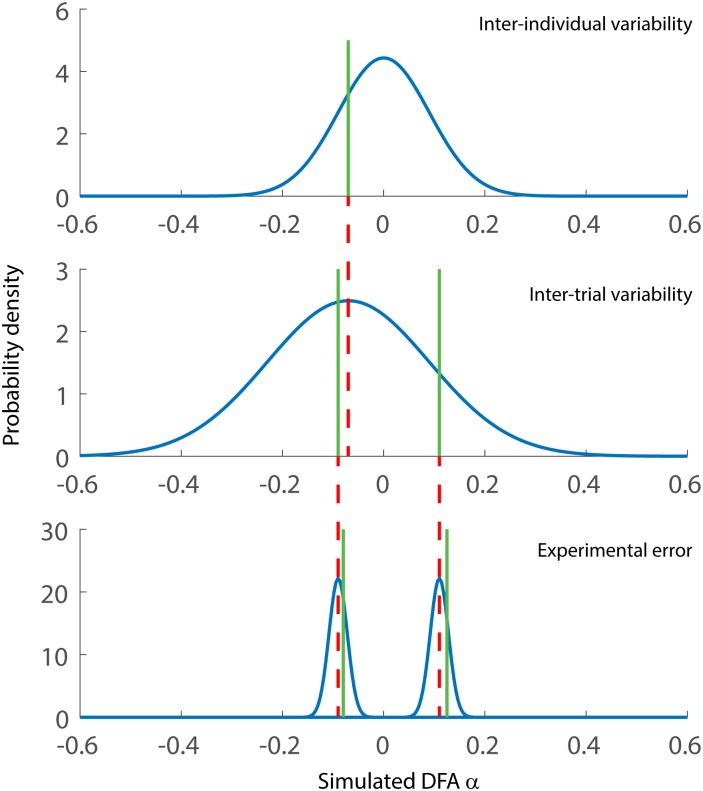
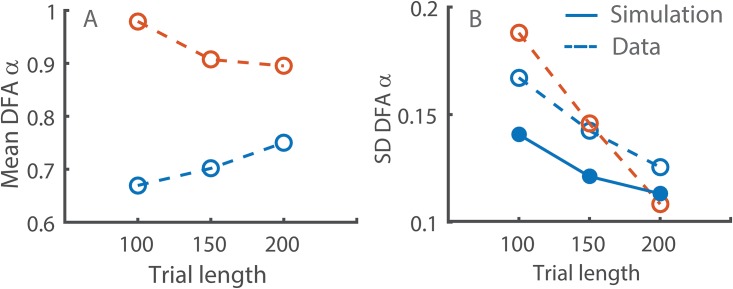
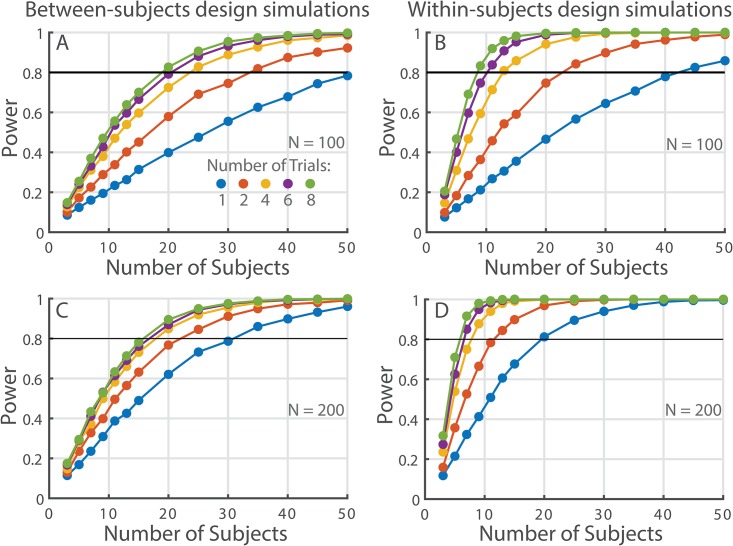
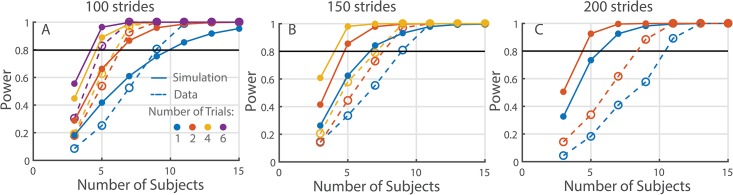
The assessment of gait variability using stochastic signal processing techniques such as detrended fluctuation analysis (DFA) has been shown to be a sensitive tool for evaluation of gait alterations due to aging and neuromuscular disease. However, previous studies have suggested that the application of DFA requires relatively long recordings (600 strides), which is difficult when working with clinical populations or older adults. In this paper we propose a model for predicting DFA variance in experimental data and conduct a Monte Carlo simulation to estimate the sample size and number of trials required to detect a change in DFA scaling exponent. We illustrate the model in a simulation to detect a difference of 0.1 (medium effect) between two groups of subjects when using short gait time series (100 to 200 strides) in the context of between- and within-subject designs. We assumed that the variance of DFA scaling exponent arises due to individual differences, time series length, and experimental error. Results showed that sample sizes required to achieve acceptable power of 80% are practically feasible, especially when using within-subject designs. For example, to detect a group difference in the DFA scaling exponent of 0.1, it would require either 25 subjects and 2 trials per subject or 12 subjects and 4 trials per subject using a within-subject design. We then compared plausibility of such power predictions to the empirically observed power from a study that required subjects to synchronize with a persistent fractal metronome. The results showed that the model adequately predicted the empirical pattern of results. Our power simulations could be used in conjunction with previous design guidelines in the literature when planning new gait variability experiments.
使用诸如去趋势波动分析(DFA)等随机信号处理技术来评估步态变异性,已被证明是评估因衰老和神经肌肉疾病导致的步态改变的一种敏感工具。然而,先前的研究表明,DFA的应用需要相对较长的记录(600步),这在针对临床人群或老年人进行研究时是困难的。在本文中,我们提出了一个用于预测实验数据中DFA方差的模型,并进行了蒙特卡洛模拟,以估计检测DFA标度指数变化所需的样本量和试验次数。我们在一个模拟中展示了该模型,该模拟用于在受试者间和受试者内设计的背景下,使用短步态时间序列(100至200步)时检测两组受试者之间0.1的差异(中等效应)。我们假设DFA标度指数的方差是由于个体差异、时间序列长度和实验误差而产生的。结果表明,达到80%的可接受检验效能所需的样本量在实际中是可行的,特别是在使用受试者内设计时。例如,要检测DFA标度指数中0.1的组间差异,使用受试者内设计时,需要25名受试者且每人进行2次试验,或者12名受试者且每人进行4次试验。然后,我们将这种检验效能预测的合理性与一项要求受试者与持续分形节拍器同步的研究中通过实证观察到的检验效能进行了比较。结果表明,该模型充分预测了结果的实证模式。我们的检验效能模拟可在规划新的步态变异性实验时与文献中先前的设计指南结合使用。