Karjula Salla, Morin-Papunen Laure, Auvinen Juha, Ruokonen Aimo, Puukka Katri, Franks Stephen, Järvelin Marjo-Riitta, Tapanainen Juha S, Jokelainen Jari, Miettunen Jouko, Piltonen Terhi T
Department of Obstetrics and Gynecology, University Hospital of Oulu, University of Oulu, FI-90014 Oulu, Finland.
Medical Research Center, University Hospital of Oulu, University of Oulu, FI-90014 Oulu, Finland.
J Clin Endocrinol Metab. 2017 Jun 1;102(6):1861-1869. doi: 10.1210/jc.2016-3863.
Polycystic ovary syndrome (PCOS) is associated with increased psychological distress, obesity and hyperandrogenism being suggested as key promoters.
To investigate the prevalence of anxiety/depression and their coexistence in women with PCOS/PCOS-related symptoms at ages 31 and 46. The roles of obesity, hyperandrogenism, and awareness of PCOS on psychological distress were also assessed.
Population-based follow-up.
Northern Finland Birth Cohort 1966 with 15-year follow-up.
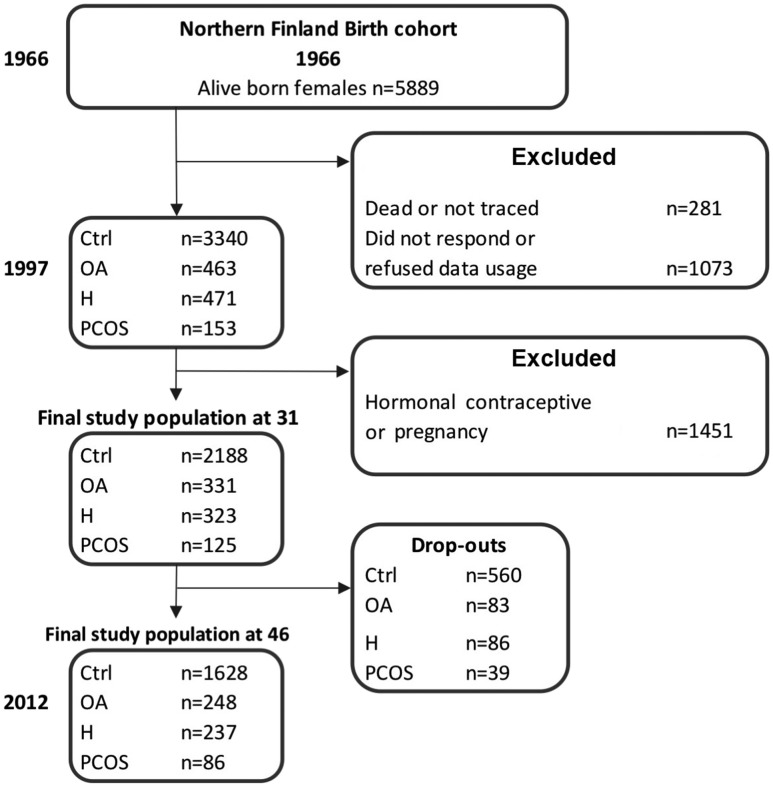
At age 31, a questionnaire-based screening for oligoamenorrhea (OA) and hirsutism (H): 2188 asymptomatic (controls), 331 OA, 323 H, and 125 OA plus H (PCOS). Follow-up at age 46: 1576 controls, 239 OA, 231 H, and 85 PCOS.
Questionnaire-based screening for anxiety and depression symptoms (Hopkins Symptom Checklist-25) and previously diagnosed/treated depression at ages 31 and 46. Body mass index (BMI), serum testosterone/free androgen index, and awareness of polycystic ovaries/PCOS on psychological distress were also assessed.
Population-based prevalence of anxiety and/or depression in women with PCOS/PCOS-related symptoms at ages 31 and 46.
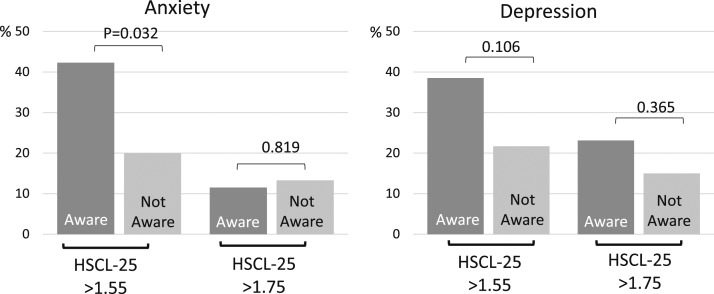
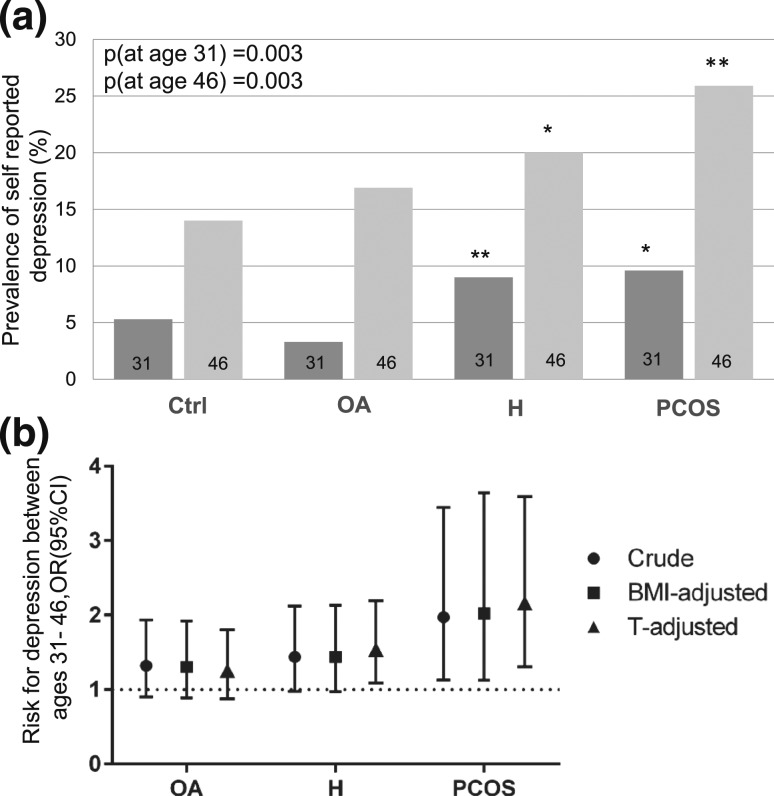
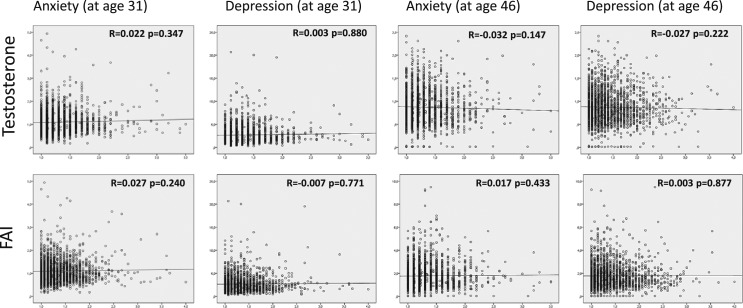
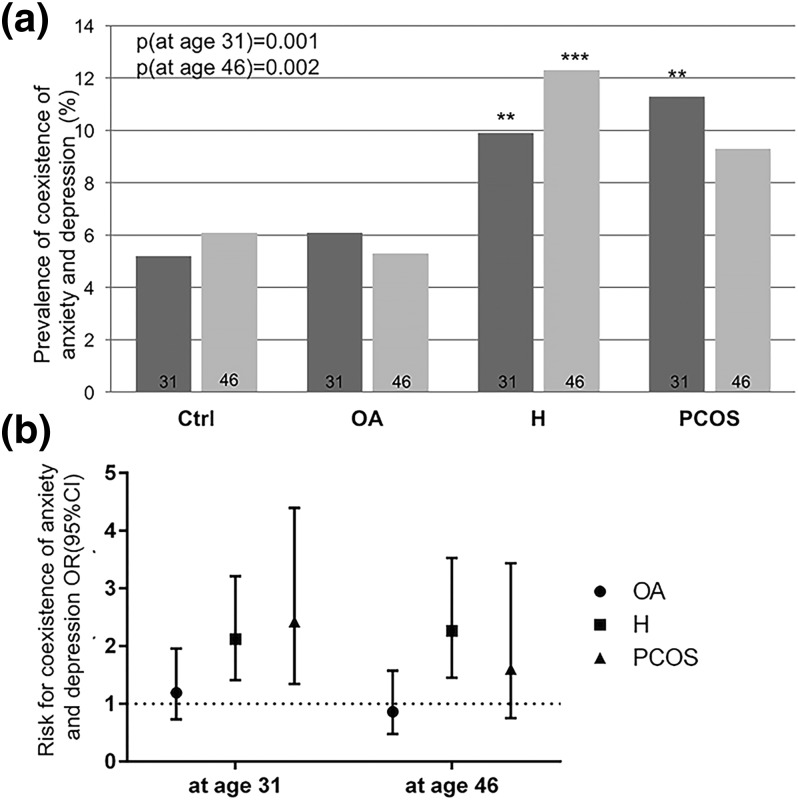
Anxiety and/or depression symptoms, their coexistence, and rate of depression were increased at ages 31 and 46 in women with PCOS or isolated H compared with controls. High BMI or hyperandrogenism did not associate with increased anxiety or depression symptoms. The awareness of PCOS was associated with increased anxiety.
Women with PCOS or isolated H present more often with anxiety and/or depression symptoms and their coexistence compared with controls. High BMI or hyperandrogenism did not provoke psychological distress in PCOS. The awareness of PCOS increased anxiety but did not associate with severe anxiety or depression.
多囊卵巢综合征(PCOS)与心理困扰增加有关,肥胖和高雄激素血症被认为是关键的促发因素。
调查31岁和46岁患有PCOS/与PCOS相关症状的女性中焦虑/抑郁的患病率及其共存情况。还评估了肥胖、高雄激素血症和PCOS认知对心理困扰的作用。
基于人群的随访研究。
1966年芬兰北部出生队列,随访15年。
31岁时,基于问卷对月经稀发(OA)和多毛症(H)进行筛查:2188名无症状者(对照组),331名OA患者,323名H患者,以及125名OA合并H患者(PCOS)。46岁时随访:1576名对照组,239名OA患者,231名H患者,以及85名PCOS患者。
基于问卷对31岁和46岁时的焦虑和抑郁症状(霍普金斯症状清单-25)以及先前诊断/治疗过的抑郁症进行筛查。还评估了体重指数(BMI)、血清睾酮/游离雄激素指数以及多囊卵巢/PCOS认知对心理困扰的影响。
31岁和46岁患有PCOS/与PCOS相关症状的女性中焦虑和/或抑郁的基于人群的患病率。
与对照组相比,31岁和46岁患有PCOS或单纯H的女性中,焦虑和/或抑郁症状、其共存情况以及抑郁症发生率均有所增加。高BMI或高雄激素血症与焦虑或抑郁症状增加无关。PCOS认知与焦虑增加有关。
与对照组相比,患有PCOS或单纯H的女性更常出现焦虑和/或抑郁症状及其共存情况。高BMI或高雄激素血症不会引发PCOS患者的心理困扰。PCOS认知增加了焦虑,但与严重焦虑或抑郁无关。