Ghosh Anindya, Abdo Shaaban, Zhao Shuiling, Wu Chin-Han, Shi Yixuan, Lo Chao-Sheng, Chenier Isabelle, Alquier Thierry, Filep Janos G, Ingelfinger Julie R, Zhang Shao-Ling, Chan John S D
Department of Medicine, Université de Montréal and Centre de recherche du Centre hospitalier de l'Université de Montréal (CRCHUM), Montreal, Quebec, Canada.
Department of Pathology and Cell Biology, Université de Montréal and Centre de recherche, Hôpital Maisonneuve-Rosemont, Montreal, Quebec, Canada.
Endocrinology. 2017 Apr 1;158(4):903-919. doi: 10.1210/en.2016-1576.
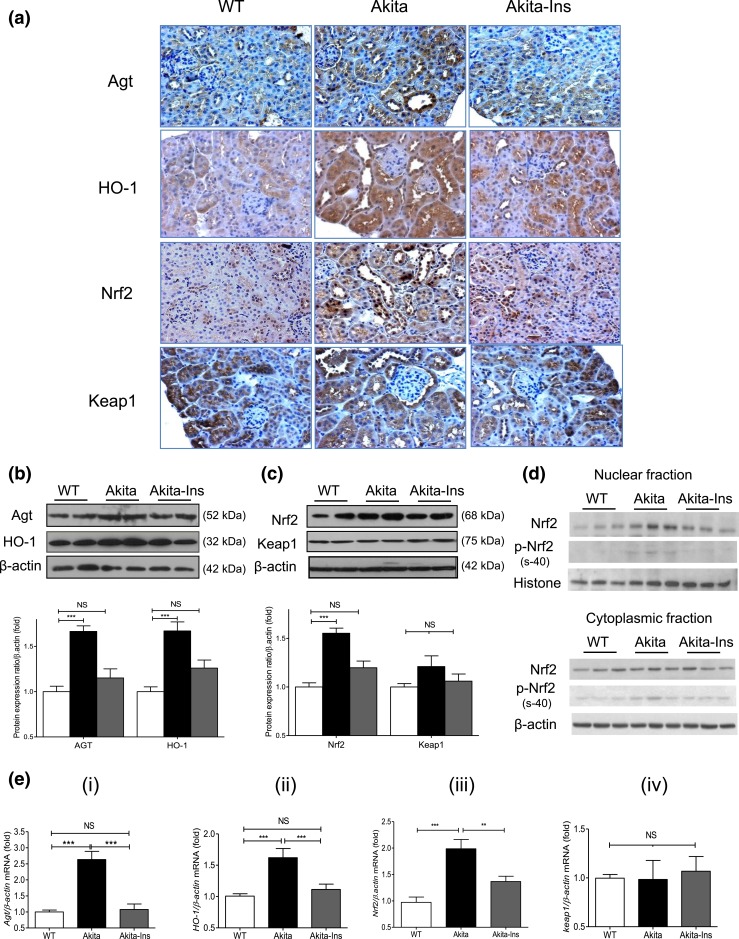
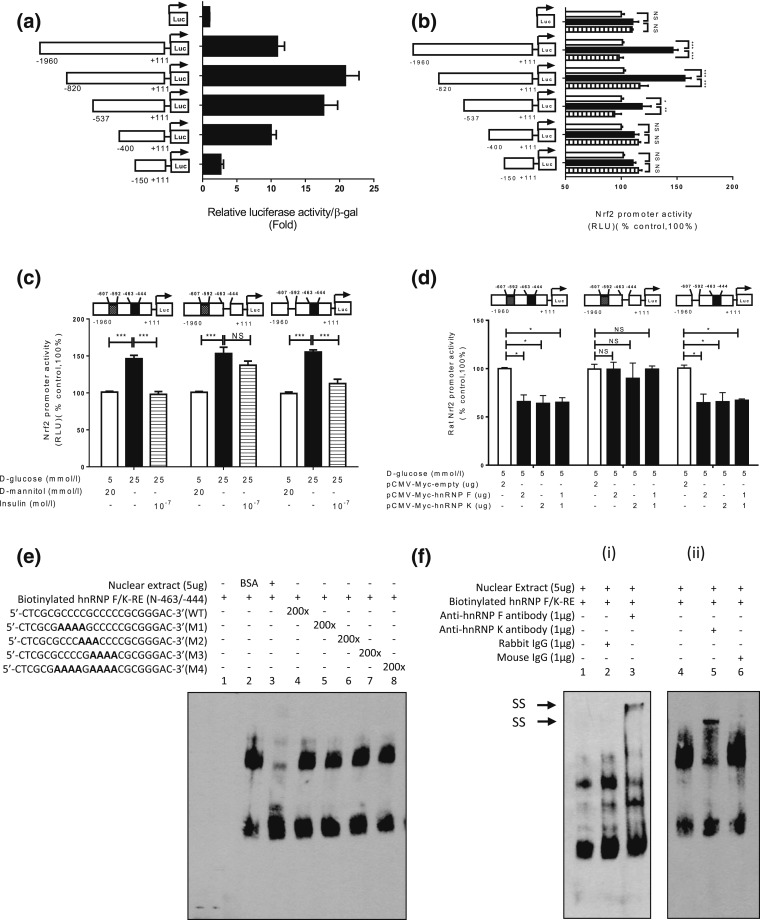
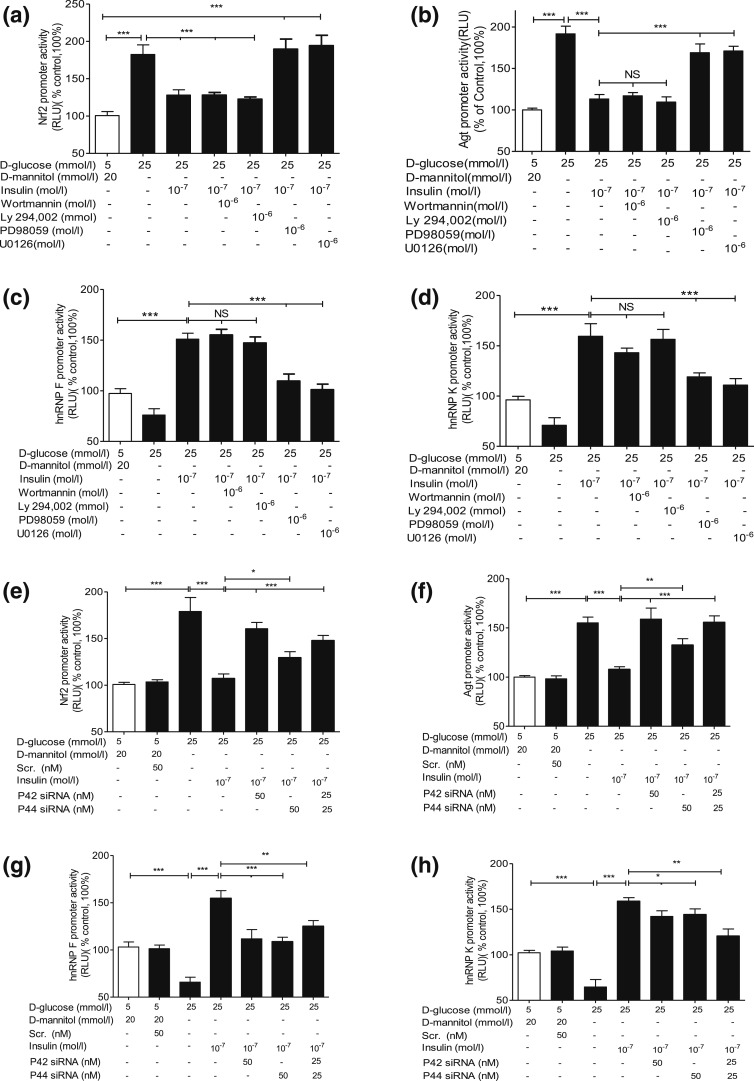
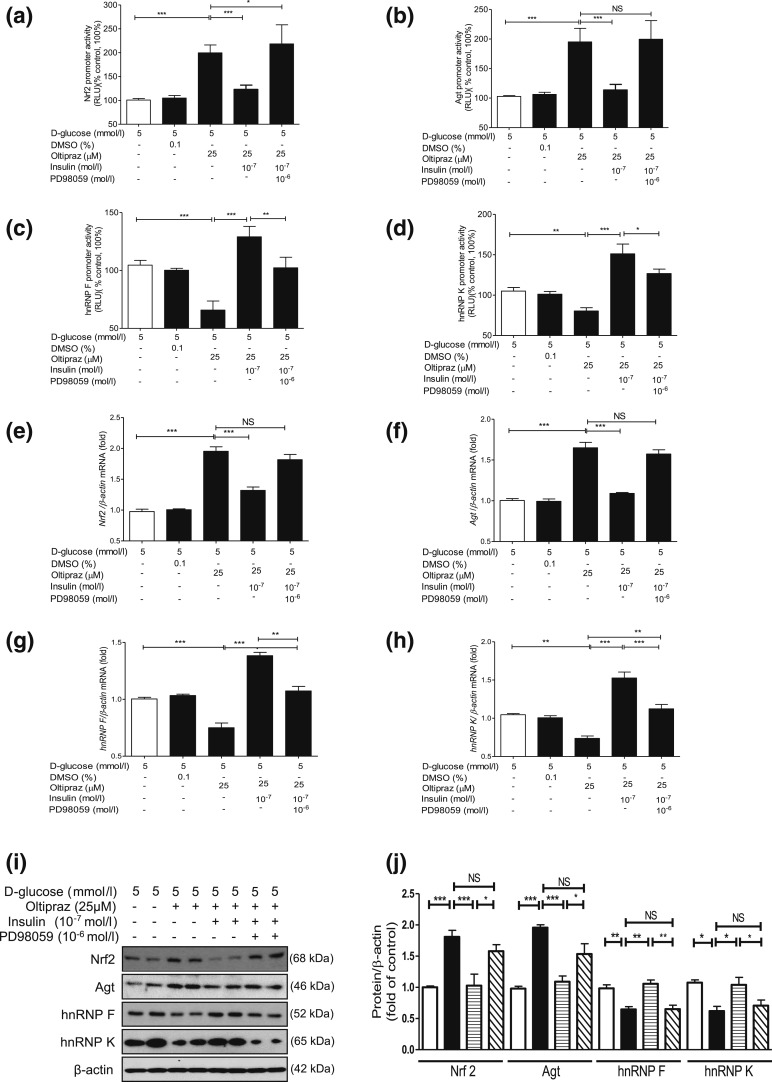
Oxidative stress induces endogenous antioxidants via nuclear factor erythroid 2-related factor 2 (Nrf2), potentially preventing tissue injury. We investigated whether insulin affects renal Nrf2 expression in type 1 diabetes (T1D) and studied its underlying mechanism. Insulin normalized hyperglycemia, hypertension, oxidative stress, and renal injury; inhibited renal Nrf2 and angiotensinogen (Agt) gene expression; and upregulated heterogeneous nuclear ribonucleoprotein F and K (hnRNP F and hnRNP K) expression in Akita mice with T1D. In immortalized rat renal proximal tubular cells, insulin suppressed Nrf2 and Agt but stimulated hnRNP F and hnRNP K gene transcription in high glucose via p44/42 mitogen-activated protein kinase signaling. Transfection with small interfering RNAs of p44/42 MAPK, hnRNP F, or hnRNP K blocked insulin inhibition of Nrf2 gene transcription. Insulin curbed Nrf2 promoter activity via a specific DNA-responsive element that binds hnRNP F/K, and hnRNP F/K overexpression curtailed Nrf2 promoter activity. In hyperinsulinemic-euglycemic mice, renal Nrf2 and Agt expression was downregulated, whereas hnRNP F/K expression was upregulated. Thus, the beneficial actions of insulin in diabetic nephropathy appear to be mediated, in part, by suppressing renal Nrf2 and Agt gene transcription and preventing Nrf2 stimulation of Agt expression via hnRNP F/K. These findings identify hnRNP F/K and Nrf2 as potential therapeutic targets in diabetes.
氧化应激通过核因子红细胞2相关因子2(Nrf2)诱导内源性抗氧化剂,可能预防组织损伤。我们研究了胰岛素是否影响1型糖尿病(T1D)患者的肾脏Nrf2表达,并探讨了其潜在机制。胰岛素可使高血糖、高血压、氧化应激和肾损伤恢复正常;抑制肾脏Nrf2和血管紧张素原(Agt)基因表达;并上调T1D阿基塔小鼠的异质性核核糖核蛋白F和K(hnRNP F和hnRNP K)表达。在永生化大鼠肾近端小管细胞中,胰岛素通过p44/42丝裂原活化蛋白激酶信号通路抑制高糖环境下的Nrf2和Agt,但刺激hnRNP F和hnRNP K基因转录。用p44/42 MAPK、hnRNP F或hnRNP K的小干扰RNA转染可阻断胰岛素对Nrf2基因转录的抑制作用。胰岛素通过与hnRNP F/K结合的特定DNA反应元件抑制Nrf2启动子活性,而hnRNP F/K的过表达则降低Nrf2启动子活性。在高胰岛素-正常血糖小鼠中,肾脏Nrf2和Agt表达下调,而hnRNP F/K表达上调。因此,胰岛素在糖尿病肾病中的有益作用似乎部分是通过抑制肾脏Nrf2和Agt基因转录以及通过hnRNP F/K阻止Nrf2对Agt表达的刺激来介导的。这些发现确定hnRNP F/K和Nrf2为糖尿病潜在的治疗靶点。