Sherwin LeeAnne B, Leary Emily, Henderson Wendy A
Sinclair School of Nursing, University of Missouri, Columbia, MO, USA.
Biobehavioral Branch, National Institute of Nursing Research, National Institutes of Health, DHHS, Bethesda, MD, USA.
Qual Life Res. 2017 Aug;26(8):2161-2170. doi: 10.1007/s11136-017-1554-0. Epub 2017 Mar 21.
Catastrophizing is a cognitive process characterized by a propensity to concentrate on and magnify the value of an actual or anticipated painful stimulus and negatively assesses one's ability to cope. Catastrophizing is an important predictor of pain-related outcomes. A cornerstone symptom of irritable bowel syndrome (IBS) is abdominal pain or discomfort. Also individuals with IBS have been reported to have a tendency to catastrophize. In a sample of individuals who suffer from IBS, we hypothesized that those individuals who catastrophize (catastrophizers) would have worse outcomes as compared to those who do not catastrophize (non-catastrophizers).
One hundred and one adults with IBS (79% female, mean age 42 years, 97% Caucasian) were recruited from outpatient clinics and data were collected through self-report measures. Catastrophizing was measured with the catastrophizing subscale of the Coping Strategies Questionnaire, illness representations were measured with The Revised Illness Perception Questionnaire (IPQ-R), psychological distress was measured with the Brief Symptom Inventory 18 (BSI-18), and health-related quality of life was measured using the Irritable Bowel Syndrome-Quality of Life (IBS-QOL) measure. Descriptive statistics, correlations, and multiple linear regression analyses were completed to describe participants, the associations of the variables of interest, and the unique relationship between psychosocial variables and HRQOL.
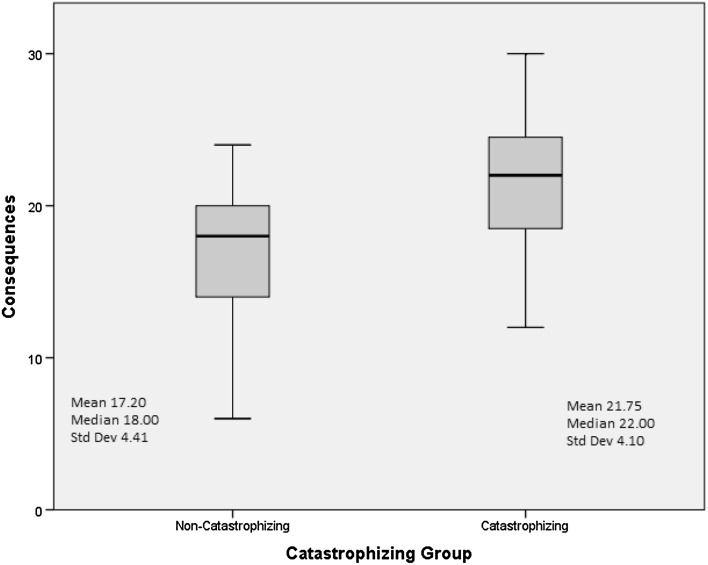
Overall, participants reported poor HRQOL (M = 63.32, range 0-100). Catastrophizers differed significantly on IBS-QOL from non-catastrophizers (M = 48.98 vs. non-catastrophizers M = 78.53; p < 0.001), BSI-18 (M = 21.35 vs. non-catastrophizers M = 6.76; p < 0.001), and IPQ-R, specifically the consequences (M = 21.75 vs. non-catastrophizers M = 17.20; p < 0.001) and emotional representations (M = 20.90 vs. non-catastrophizers M = 15.43; p < 0.001). Catastrophizing was positively correlated with the consequences (r = .54; p < 0.01) and emotional representations (r = .65; p < 0.01) and negatively correlated with total HRQOL (r = -0.76; p < 0.01).
The findings indicated that participants who catastrophized reported worse psychosocial and functional outcomes. Thus, catastrophizing, in addition to psychological distress variables, may be an important factor to address in optimizing health outcomes in individuals with IBS. In addition, illness perceptions were strongly related to catastrophizing and HRQOL; assessment and integration of illness perceptions as well as catastrophizing into the management of individuals who suffer with IBS may maximize the health outcomes.
灾难化思维是一种认知过程,其特点是倾向于专注并放大实际的或预期的疼痛刺激的影响,并对个人的应对能力进行负面评估。灾难化思维是疼痛相关结果的重要预测指标。肠易激综合征(IBS)的一个关键症状是腹痛或不适。此外,有报道称IBS患者有灾难化思维的倾向。在一组IBS患者样本中,我们假设那些有灾难化思维的个体(灾难化者)与没有灾难化思维的个体(非灾难化者)相比,会有更差的结果。
从门诊招募了101名成年IBS患者(79%为女性,平均年龄42岁,97%为白种人),并通过自我报告测量收集数据。使用应对策略问卷的灾难化分量表测量灾难化思维,使用修订后的疾病认知问卷(IPQ-R)测量疾病认知,使用简明症状量表18(BSI-18)测量心理困扰,使用肠易激综合征生活质量量表(IBS-QOL)测量健康相关生活质量。完成描述性统计、相关性分析和多元线性回归分析,以描述参与者、感兴趣变量之间的关联以及心理社会变量与健康相关生活质量之间的独特关系。
总体而言,参与者报告的健康相关生活质量较差(M = 63.32,范围0 - 100)。灾难化者在IBS-QOL方面与非灾难化者有显著差异(灾难化者M = 48.98,非灾难化者M = 78.53;p < 0.001),在BSI-18方面也有差异(灾难化者M = 21.35,非灾难化者M = 6.76;p < 0.001),在IPQ-R方面,特别是在后果(灾难化者M = 21.75,非灾难化者M = 17.20;p < 0.001)和情感认知(灾难化者M = 20.90,非灾难化者M = 15.43;p < 0.001)方面。灾难化思维与后果(r = 0.54;p < 0.01)和情感认知(r = 0.65;p < 0.01)呈正相关,与总体健康相关生活质量呈负相关(r = -0.76;p < 0.01)。
研究结果表明,有灾难化思维的参与者报告的心理社会和功能结果更差。因此,除了心理困扰变量外,灾难化思维可能是优化IBS患者健康结果时需要考虑的一个重要因素。此外,疾病认知与灾难化思维和健康相关生活质量密切相关;将疾病认知以及灾难化思维纳入IBS患者的管理评估和整合中,可能会使健康结果最大化。