Fernández-Alonso Rubén, Álvarez-Díaz Marcos, Suárez-Álvarez Javier, Muñiz José
Department of Education Sciences, University of OviedoOviedo, Spain; Department of Education, Principality of Asturias GovernmentOviedo, Spain.
Department of Education, Principality of Asturias Government Oviedo, Spain.
Front Psychol. 2017 Mar 7;8:286. doi: 10.3389/fpsyg.2017.00286. eCollection 2017.
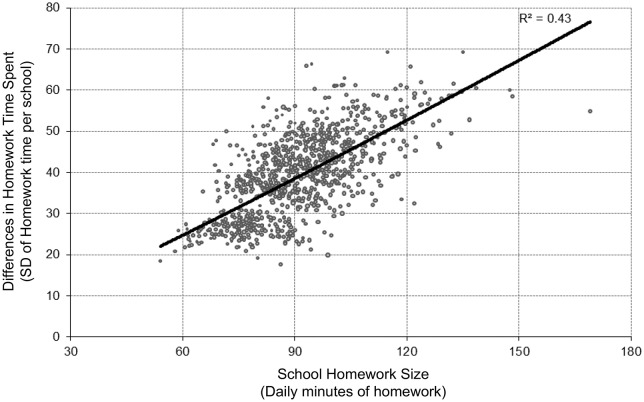
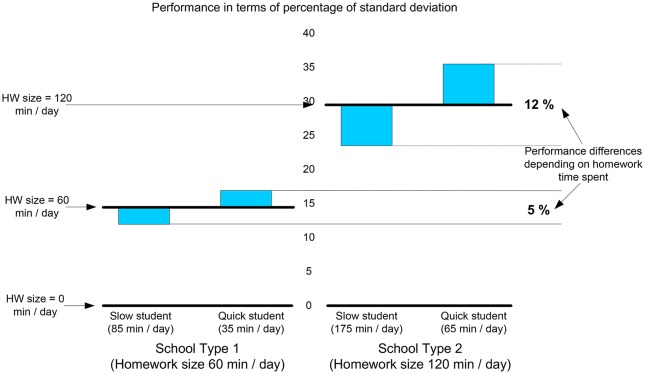
The optimum time students should spend on homework has been widely researched although the results are far from unanimous. The main objective of this research is to analyze how homework assignment strategies in schools affect students' academic performance and the differences in students' time spent on homework. Participants were a representative sample of Spanish adolescents ( = 26,543) with a mean age of 14.4 (±0.75), 49.7% girls. A test battery was used to measure academic performance in four subjects: Spanish, Mathematics, Science, and Citizenship. A questionnaire allowed the measurement of the indicators used for the description of homework and control variables. Two three-level hierarchical-linear models (student, school, autonomous community) were produced for each subject being evaluated. The relationship between academic results and homework time is negative at the individual level but positive at school level. An increase in the amount of homework a school assigns is associated with an increase in the differences in student time spent on homework. An optimum amount of homework is proposed which schools should assign to maximize gains in achievement for students overall.
学生应该花在家庭作业上的最佳时间已得到广泛研究,尽管结果远未达成一致。本研究的主要目的是分析学校的家庭作业布置策略如何影响学生的学业成绩以及学生在家庭作业上花费时间的差异。参与者是西班牙青少年的代表性样本( = 26,543),平均年龄为14.4岁(±0.75),女生占49.7%。使用一组测试来衡量四个学科的学业成绩:西班牙语、数学、科学和公民教育。通过一份问卷来测量用于描述家庭作业和控制变量的指标。针对每个被评估的学科构建了两个三级分层线性模型(学生、学校、自治区)。学业成绩与家庭作业时间之间的关系在个体层面上是负相关的,但在学校层面上是正相关的。学校布置的家庭作业量增加与学生在家庭作业上花费时间的差异增大有关。提出了一个最佳的家庭作业量,学校应该布置这样的作业量,以使学生总体上在成绩提升方面获得最大收益。