Zhang Yunxiang, Feng Lihua, Jiang Hao, Zhang Yuanbin, Zhang Sheng
Key Laboratory of Mountain Surface Processes and Ecological Regulation, Institute of Mountain Hazards and Environment, Chinese Academy of SciencesChengdu, China; University of Chinese Academy of SciencesBeijing, China.
Key Laboratory of Mountain Surface Processes and Ecological Regulation, Institute of Mountain Hazards and Environment, Chinese Academy of SciencesChengdu, China; Institute of Evolution and the Department of Evolutionary and Environmental Biology, University of HaifaHaifa, Israel.
Front Plant Sci. 2017 Mar 7;8:320. doi: 10.3389/fpls.2017.00320. eCollection 2017.
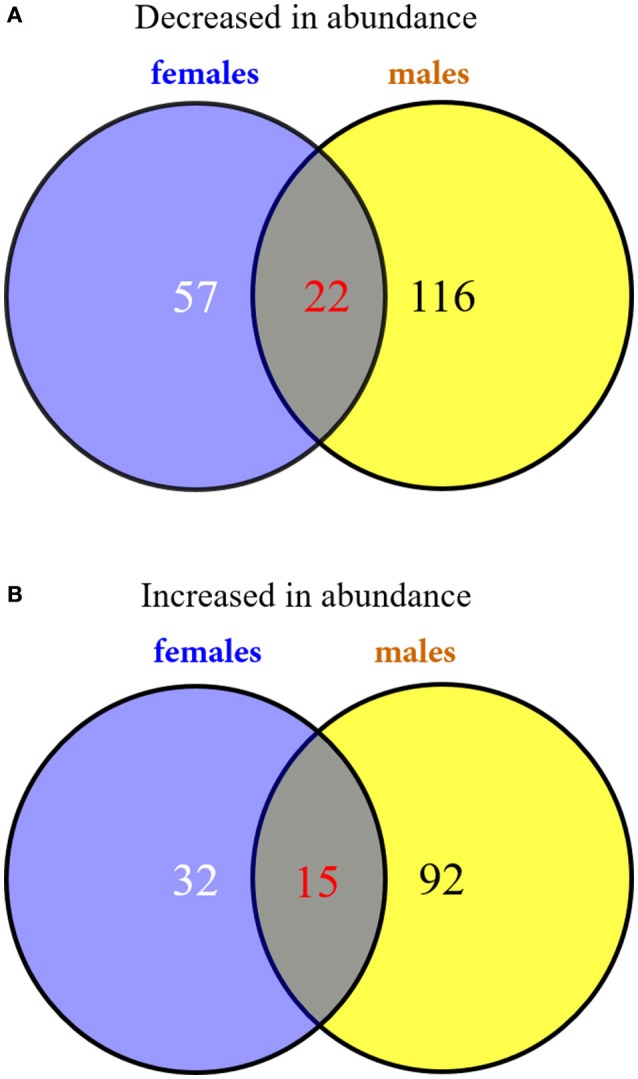
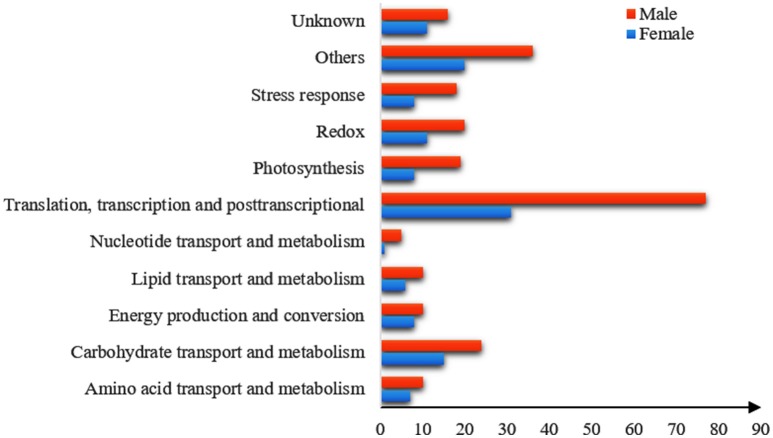
With increasing altitude, solar UV-B radiation is enhanced. Based on the phenomenon of male-biased sex ratio of Rehder in high altitude alpine area, we hypothesized that males have a faster and more sophisticated responsive mechanism to high UV-B radiation than that of females. Our previous studies have shown sexually different responses to high UV-B radiation were existed in at the morphological, physiological, and transcriptomic levels. However, the responses at the proteomic level remain unclear. In this study, an isobaric tag for relative and absolute quantification (iTRAQ)-based quantitative proteome analysis was performed in females and males. A total of 2,405 proteins were identified, with 331 proteins defined as differentially expressed proteins (DEPs). Among of these, 79 and 138 DEPs were decreased and 47 and 107 DEPs were increased under high solar UV-B radiation in females and males, respectively. A bioinformatics analysis categorized the common responsive proteins in the sexes as related to carbohydrate and energy metabolism, translation/transcription/post-transcriptional modification, photosynthesis, and redox reactions. The responsive proteins that showed differences in sex were mainly those involved in amino acid metabolism, stress response, and translation/transcription/post-transcriptional modification. This study provides proteomic profiles that poplars responding to solar UV-B radiation, and it also provides new insights into differentially sex-related responses to UV-B radiation.
随着海拔升高,太阳紫外线B辐射增强。基于高海拔高寒地区青皮杨雄株偏多的现象,我们推测雄性对高紫外线B辐射的反应机制比雌性更快、更复杂。我们之前的研究表明,在形态、生理和转录组水平上,对高紫外线B辐射存在性别差异反应。然而,蛋白质组水平的反应仍不清楚。在本研究中,对雌性和雄性进行了基于相对和绝对定量的等压标签(iTRAQ)定量蛋白质组分析。共鉴定出2405种蛋白质,其中331种蛋白质被定义为差异表达蛋白(DEP)。其中,在高太阳紫外线B辐射下,雌性和雄性分别有79种和138种DEP减少,47种和107种DEP增加。生物信息学分析将两性中的常见反应蛋白归类为与碳水化合物和能量代谢、翻译/转录/转录后修饰、光合作用和氧化还原反应相关。在性别上表现出差异的反应蛋白主要涉及氨基酸代谢、应激反应和翻译/转录/转录后修饰。本研究提供了杨树对太阳紫外线B辐射反应的蛋白质组图谱,也为紫外线B辐射的性别差异相关反应提供了新的见解。