Senbanjo Linda T, Chellaiah Meenakshi A
Department of Oncology and Diagnostic Sciences, Dental School, University of Maryland Baltimore, MD, USA.
Front Cell Dev Biol. 2017 Mar 7;5:18. doi: 10.3389/fcell.2017.00018. eCollection 2017.
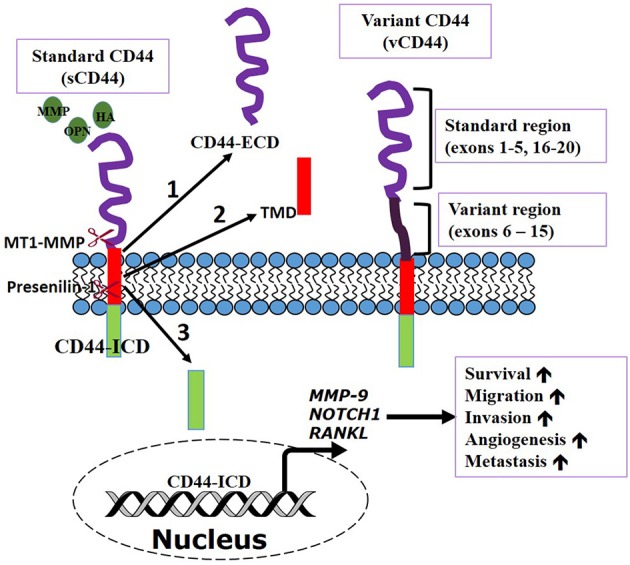
CD44 is a cell surface adhesion receptor that is highly expressed in many cancers and regulates metastasis via recruitment of CD44 to the cell surface. Its interaction with appropriate extracellular matrix ligands promotes the migration and invasion processes involved in metastases. It was originally identified as a receptor for hyaluronan or hyaluronic acid and later to several other ligands including, osteopontin (OPN), collagens, and matrix metalloproteinases. CD44 has also been identified as a marker for stem cells of several types. Beside standard CD44 (sCD44), variant (vCD44) isoforms of CD44 have been shown to be created by alternate splicing of the mRNA in several cancer. Addition of new exons into the extracellular domain near the transmembrane of sCD44 increases the tendency for expressing larger size vCD44 isoforms. Expression of certain vCD44 isoforms was linked with progression and metastasis of cancer cells as well as patient prognosis. The expression of CD44 isoforms can be correlated with tumor subtypes and be a marker of cancer stem cells. CD44 cleavage, shedding, and elevated levels of soluble CD44 in the serum of patients is a marker of tumor burden and metastasis in several cancers including colon and gastric cancer. Recent observations have shown that CD44 intracellular domain (CD44-ICD) is related to the metastatic potential of breast cancer cells. However, the underlying mechanisms need further elucidation.
CD44是一种细胞表面黏附受体,在许多癌症中高表达,并通过将CD44招募到细胞表面来调节转移。它与合适的细胞外基质配体的相互作用促进了转移过程中涉及的迁移和侵袭过程。它最初被鉴定为透明质酸或透明质酸的受体,后来又被鉴定为包括骨桥蛋白(OPN)、胶原蛋白和基质金属蛋白酶在内的其他几种配体的受体。CD44也被鉴定为几种类型干细胞的标志物。除了标准CD44(sCD44)外,CD44的可变(vCD44)异构体已被证明是由几种癌症中mRNA的可变剪接产生的。在sCD44跨膜附近的细胞外结构域中添加新的外显子会增加表达更大尺寸vCD44异构体的倾向。某些vCD44异构体的表达与癌细胞的进展和转移以及患者预后有关。CD44异构体的表达可以与肿瘤亚型相关,并成为癌症干细胞的标志物。在包括结肠癌和胃癌在内的几种癌症中,患者血清中CD44的裂解、脱落和可溶性CD44水平升高是肿瘤负荷和转移的标志物。最近的观察表明,CD44细胞内结构域(CD44-ICD)与乳腺癌细胞的转移潜能有关。然而,其潜在机制需要进一步阐明。