Ruppe Mary D, Zhang Xiaoping, Imel Erik A, Weber Thomas J, Klausner Mark A, Ito Takahiro, Vergeire Maria, Humphrey Jeffrey S, Glorieux Francis H, Portale Anthony A, Insogna Karl, Peacock Munro, Carpenter Thomas O
Department of Medicine, Houston Methodist Hospital, Houston, TX, USA.
Kyowa Hakko Kirin Pharma Inc., Princeton, NJ, USA.
Bone Rep. 2016 May 13;5:158-162. doi: 10.1016/j.bonr.2016.05.004. eCollection 2016 Dec.
X-linked hypophosphatemia (XLH) is characterized by lower extremity deformities that lead to bone and/or joint pain that result from decreased renal tubular reabsorption leading to hypophosphatemia caused by elevated levels of fibroblast growth factor 23 (FGF23).
Validate the use of SF-36v2 Health Survey (SF-36v2) and the Western Ontario and McMaster Osteoarthritis Index (WOMAC) to measure previously unstudied health-related quality of life (HRQoL) in XLH patients and determine the change in HRQoL before and after treatment with KRN23, a human monoclonal anti-FGF23 antibody.
Twenty-eight adult outpatients with XLH received up to four doses of KRN23 administered subcutaneously every 28 days. General HRQoL was measured with the SF-36v2 and condition-related HRQoL with the WOMAC at baseline and study endpoint as a secondary outcome of a Phase 1/2, open-label, multicenter, dose-escalation trial.
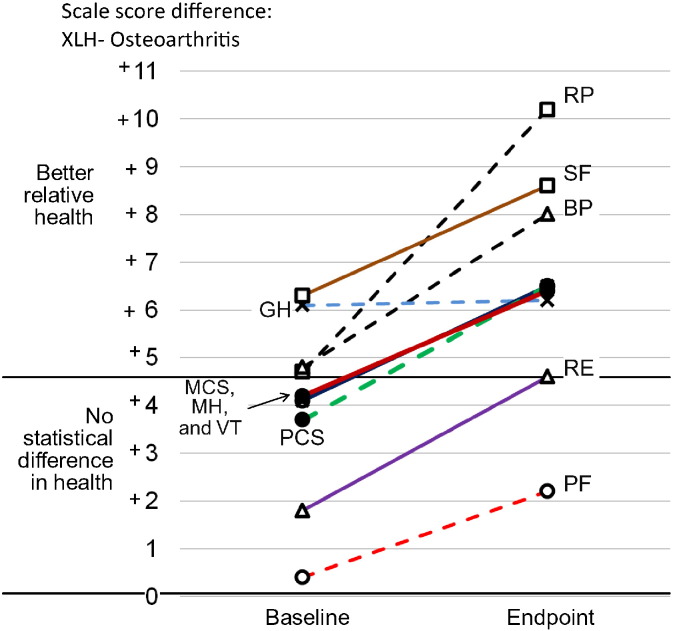
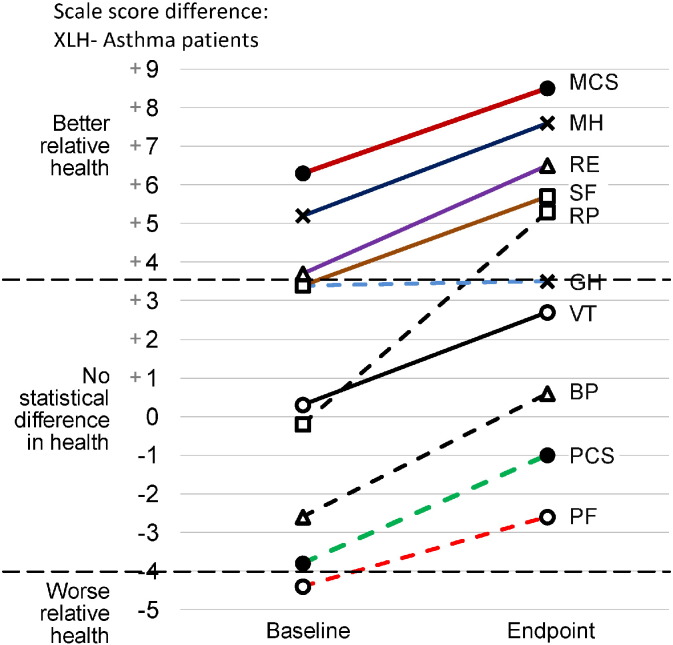
Testing for scale discriminant validity and convergent-divergent validity supported the use of these scales in the assessment of HRQoL in XLH. Both instruments indicated impairment of physical function at baseline with all mean scores showing a trend to improved health at study endpoint compared to baseline. When corrected for multiple comparisons, the score for Role Limitations due to physical health on the SF-36v2 which measures the patient's perception of their own chronic functional impairments due to poor physical health remained significantly improved ( < 0.05), increasing to the mean score of US adults. For the WOMAC, Physical Functioning and Stiffness scores were significantly improved ( < 0.05).
KRN23 administration was associated with significantly improved patient perception of their Physical Functioning and Stiffness due to their disease. This study demonstrates that the SF-36v2 and WOMAC are valid tools for assessing HRQoL in XLH.
X连锁低磷血症(XLH)的特征是下肢畸形,导致骨和/或关节疼痛,这是由肾小管重吸收减少导致低磷血症引起的,而成纤维细胞生长因子23(FGF23)水平升高会导致肾小管重吸收减少。
验证SF-36v2健康调查(SF-36v2)和西安大略和麦克马斯特大学骨关节炎指数(WOMAC)在测量XLH患者先前未研究的健康相关生活质量(HRQoL)方面的应用,并确定用人类单克隆抗FGF23抗体KRN23治疗前后HRQoL的变化。
28名成年XLH门诊患者每28天皮下注射多达4剂KRN23。在一项1/2期、开放标签、多中心、剂量递增试验的基线和研究终点,用SF-36v2测量一般HRQoL,用WOMAC测量与病情相关的HRQoL作为次要结果。
量表区分效度和收敛-发散效度测试支持这些量表在评估XLH患者HRQoL中的应用。两种工具均表明基线时身体功能受损,与基线相比,所有平均得分在研究终点均显示出健康改善的趋势。在进行多重比较校正后,SF-36v2上因身体健康导致的角色限制得分仍有显著改善(P<0.05),该得分衡量患者对自身因身体健康不佳导致的慢性功能损害的认知,提高到美国成年人的平均得分。对于WOMAC,身体功能和僵硬程度得分有显著改善(P<0.05)。
KRN23给药与患者对因疾病导致的身体功能和僵硬程度的认知显著改善有关。本研究表明,SF-36v2和WOMAC是评估XLH患者HRQoL的有效工具。