Elshoury Amro, Khedr Maha, Abousayed Mostafa M, Mehdi Syed
Department of Internal Medicine, Albany Medical Center, Albany, NY, USA.
Division of Clinical Chemistry and Laboratory Medicine, Department of Clinical Pathology, Ain Shams University, Cairo, Egypt.
Arthroplast Today. 2015 Sep 5;1(3):69-71. doi: 10.1016/j.artd.2015.07.003. eCollection 2015 Sep.
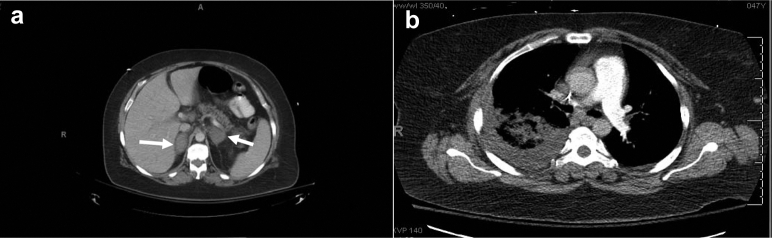
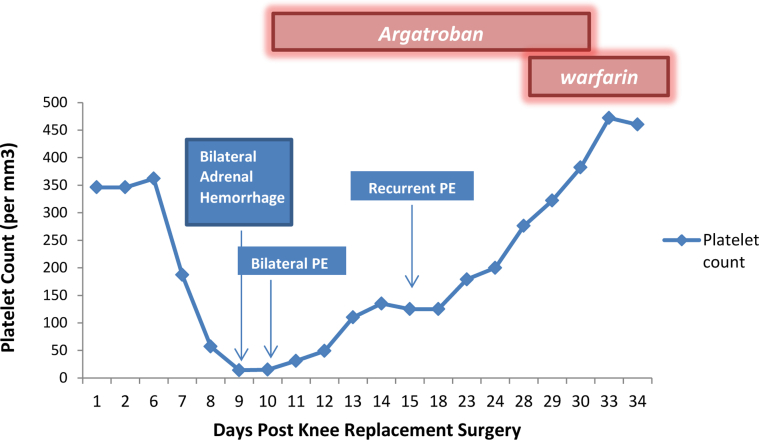
Heparin-induced thrombocytopenia syndrome is an acquired potentially life-threatening prothrombotic disorder caused by antibodies that recognize complexes of platelet factor 4 bound to heparin or heparin-like molecules. It typically occurs after exposure to unfractionated heparin, to a lesser extent after exposure to low-molecular-weight heparins, and rarely after exposure to fondaparinux. Herein, we report the case of a 48-year-old woman who developed severe thrombocytopenia, bilateral pulmonary embolism, and bilateral adrenal hemorrhages after total knee arthroplasty without evidence of heparin exposure. Antibodies to the heparin-platelet factor 4 complex and serotonin-release assay were positive. Spontaneous heparin-induced thrombocytopenia syndrome should be considered in patients with unexplained thrombocytopenia after knee replacement surgery even without heparin exposure, and a high index of suspicion for adrenal hemorrhage is needed in patients with fever, abdominal pain, and shock.
肝素诱导的血小板减少综合征是一种获得性的、可能危及生命的血栓前状态疾病,由识别与肝素或类肝素分子结合的血小板因子4复合物的抗体引起。它通常在接触普通肝素后发生,接触低分子量肝素后发生的程度较轻,而接触磺达肝癸钠后很少发生。在此,我们报告一例48岁女性病例,该患者在全膝关节置换术后出现严重血小板减少、双侧肺栓塞和双侧肾上腺出血,且无肝素接触证据。肝素-血小板因子4复合物抗体和5-羟色胺释放试验均为阳性。即使在未接触肝素的情况下,膝关节置换术后出现不明原因血小板减少的患者也应考虑自发性肝素诱导的血小板减少综合征,对于发热、腹痛和休克的患者,需要高度怀疑肾上腺出血。