Anstey Matthew H, Wibrow Bradley, Thevathasan Tharusan, Roberts Brigit, Chhangani Khushi, Ng Pauline Yeung, Levine Alexander, DiBiasio Alan, Sarge Todd, Eikermann Matthias
Sir Charles Gairdner Hospital, Perth, WA, Australia.
School of Medicine and Pharmacology, University of Western Australia, Perth, Australia.
BMC Anesthesiol. 2017 Mar 21;17(1):47. doi: 10.1186/s12871-017-0339-x.
Patients admitted to intensive care units (ICU) are often treated with intravenous (IV) vasopressors. Persistent hypotension and dependence on IV vasopressors in otherwise resuscitated patients lead to delay in discharge from ICU. Midodrine is an oral alpha-1 adrenergic agonist approved for treatment of symptomatic orthostatic hypotension. This trial aims to evaluate whether oral administration of midodrine is an effective adjunct to standard therapy to reduce the duration of IV vasopressor treatment, and allow earlier discharge from ICU and hospital.
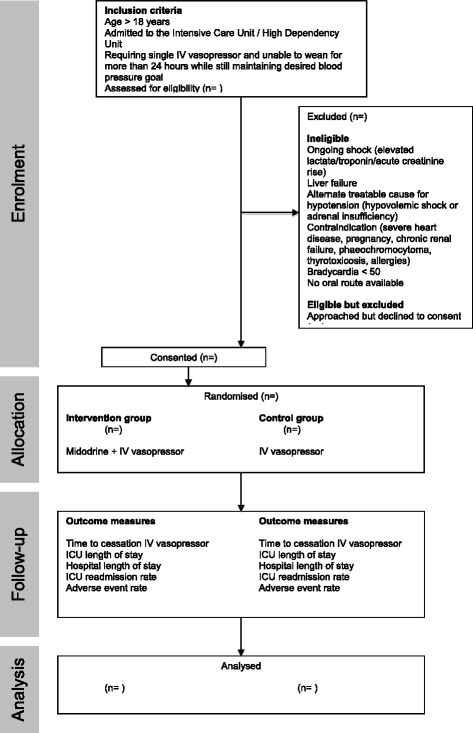
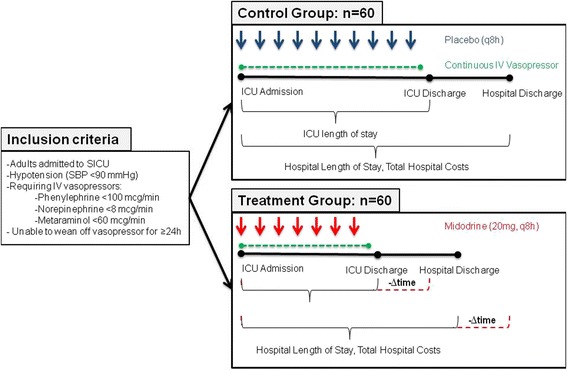
The MIDAS trial is an international, multicenter, randomized, double-blind, placebo-controlled clinical trial being conducted in the USA and Australia. We are targeting 120 patients. Adult patients admitted to the ICU who are resuscitated and otherwise stable on low dose IV vasopressors for at least 24 h will be considered for recruitment. Participants will be randomized to receive midodrine (20 mg) or placebo three times a day, in addition to standard care. The primary outcome is time (hours) from initiation of midodrine or placebo to discontinuation of IV vasopressors. Secondary outcomes include time (hours) from ICU admission to discharge readiness, ICU length of stay (LOS) (days), hospital LOS (days), rates of ICU readmission, and rates of adverse events related to midodrine administration.
Midodrine is approved by the Food and Drug Administration (FDA) for the treatment of symptomatic orthostatic hypotension. In August 2010, FDA proposed to withdraw approval of midodrine because of lack of studies that verify the clinical benefit of the drug. We obtained Investigational New Drug (IND 113,330) approval to study its effects in critically ill patients who require IV vasopressors but are otherwise ready for discharge from the ICU. A pilot observational study in a cohort of surgical ICU patients showed that the rate of decline in vasopressor requirements increased after initiation of midodrine treatment. We hypothesize that midodrine administration is effective to wean IV vasopressors and shorten ICU and hospital LOS. This trial may have significant implications on lowering costs of hospital care and obtaining FDA approval for new indications for midodrine.
This study has been registered at clinicaltrials.gov on 02/09/2012 (NCT01531959).
入住重症监护病房(ICU)的患者常接受静脉注射血管加压药治疗。在其他方面已复苏的患者中,持续性低血压和对静脉注射血管加压药的依赖会导致ICU出院延迟。米多君是一种口服α-1肾上腺素能激动剂,已被批准用于治疗症状性体位性低血压。本试验旨在评估口服米多君是否为标准治疗的有效辅助手段,以缩短静脉注射血管加压药的治疗时间,并使患者能更早从ICU和医院出院。
米多君治疗急性重症休克试验(MIDAS试验)是一项在美国和澳大利亚进行的国际多中心随机双盲安慰剂对照临床试验。我们的目标是招募120名患者。入住ICU且已复苏、在低剂量静脉注射血管加压药治疗下至少稳定24小时的成年患者将被纳入研究。参与者将被随机分组,除接受标准治疗外,分别每日三次接受米多君(20毫克)或安慰剂治疗。主要结局指标是从开始使用米多君或安慰剂至停用静脉注射血管加压药的时间(小时)。次要结局指标包括从入住ICU至准备出院的时间(小时)、ICU住院时间(天)、住院时间(天)、ICU再入院率以及与米多君给药相关的不良事件发生率。
米多君已获美国食品药品监督管理局(FDA)批准用于治疗症状性体位性低血压。2010年8月,FDA提议撤销米多君的批准,原因是缺乏验证该药物临床益处的研究。我们获得了研究性新药(IND 113,330)批准,以研究其在需要静脉注射血管加压药但在其他方面已准备好从ICU出院的重症患者中的作用。一项针对一组外科ICU患者的初步观察性研究表明,开始米多君治疗后血管加压药需求量的下降速度加快。我们假设米多君给药对于撤停静脉注射血管加压药及缩短ICU和住院时间是有效的。本试验可能对降低医院护理成本以及使米多君获得FDA新适应症批准具有重大意义。
本研究已于2012年9月2日在clinicaltrials.gov上注册(NCT01531959)。