Lote H, Spiteri I, Ermini L, Vatsiou A, Roy A, McDonald A, Maka N, Balsitis M, Bose N, Simbolo M, Mafficini A, Lampis A, Hahne J C, Trevisani F, Eltahir Z, Mentrasti G, Findlay C, Kalkman E A J, Punta M, Werner B, Lise S, Aktipis A, Maley C, Greaves M, Braconi C, White J, Fassan M, Scarpa A, Sottoriva A, Valeri N
Division of Molecular Pathology, The Institute of Cancer Research, Sutton.
Gastrointestinal Cancers and Lymphoma Unit, The Royal Marsden NHS Trust, Sutton.
Ann Oncol. 2017 Jun 1;28(6):1243-1249. doi: 10.1093/annonc/mdx074.
Patients often ask oncologists how long a cancer has been present before causing symptoms or spreading to other organs. The evolutionary trajectory of cancers can be defined using phylogenetic approaches but lack of chronological references makes dating the exact onset of tumours very challenging.
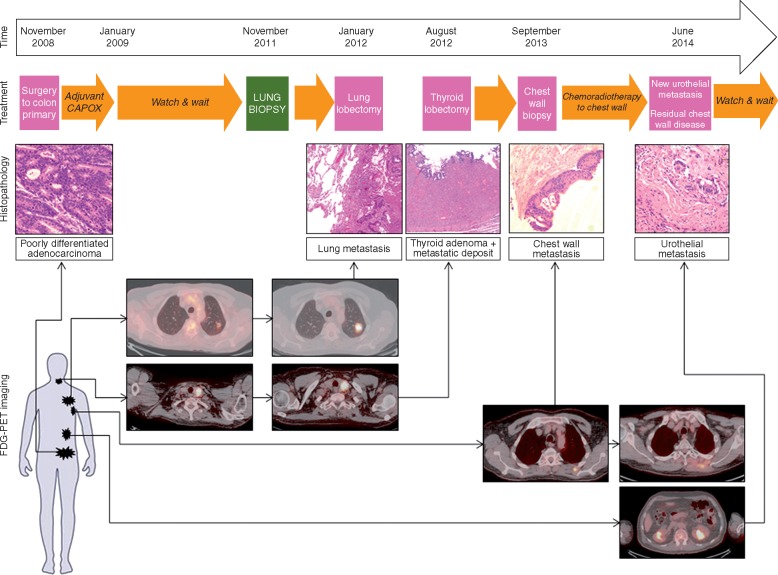
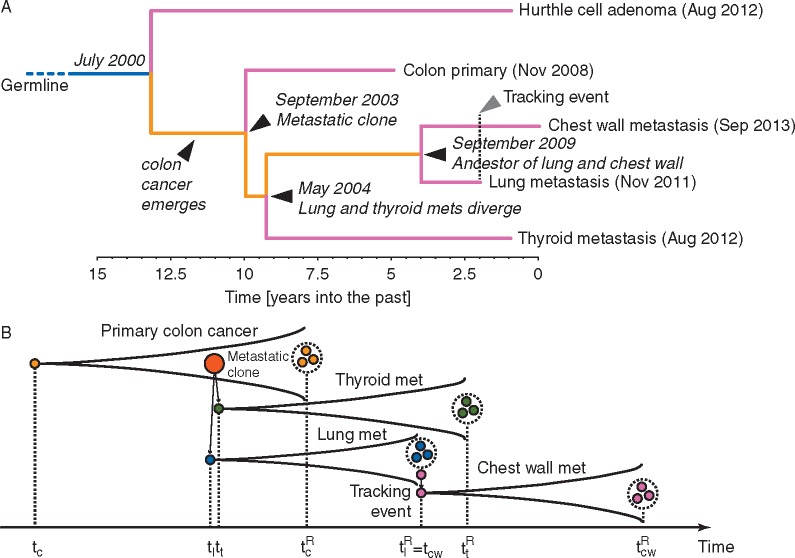
Here, we describe the case of a colorectal cancer (CRC) patient presenting with synchronous lung metastasis and metachronous thyroid, chest wall and urinary tract metastases over the course of 5 years. The chest wall metastasis was caused by needle tract seeding, implying a known time of onset. Using whole genome sequencing data from primary and metastatic sites we inferred the complete chronology of the cancer by exploiting the time of needle tract seeding as an in vivo 'stopwatch'. This approach allowed us to follow the progression of the disease back in time, dating each ancestral node of the phylogenetic tree in the past history of the tumour. We used a Bayesian phylogenomic approach, which accounts for possible dynamic changes in mutational rate, to reconstruct the phylogenetic tree and effectively 'carbon date' the malignant progression.
The primary colon cancer emerged between 5 and 8 years before the clinical diagnosis. The primary tumour metastasized to the lung and the thyroid within a year from its onset. The thyroid lesion presented as a tumour-to-tumour deposit within a benign Hurthle adenoma. Despite rapid metastatic progression from the primary tumour, the patient showed an indolent disease course. Primary cancer and metastases were microsatellite stable and displayed low chromosomal instability. Neo-antigen analysis suggested minimal immunogenicity.
Our data provide the first in vivo experimental evidence documenting the timing of metastatic progression in CRC and suggest that genomic instability might be more important than the metastatic potential of the primary cancer in dictating CRC fate.
患者常常会询问肿瘤学家癌症在出现症状或扩散至其他器官之前已经存在了多长时间。癌症的进化轨迹可以通过系统发育学方法来定义,但缺乏时间顺序参考使得确定肿瘤的确切发病时间极具挑战性。
在此,我们描述了一例结直肠癌(CRC)患者的病例,该患者在5年的病程中出现了同时性肺转移以及异时性甲状腺、胸壁和泌尿道转移。胸壁转移是由针道种植引起的,这意味着有一个已知的发病时间。利用来自原发部位和转移部位的全基因组测序数据,我们通过将针道种植时间作为体内“秒表”来推断癌症的完整时间顺序。这种方法使我们能够追溯疾病的进展时间,确定肿瘤过去历史中系统发育树的每个祖先节点的时间。我们使用了一种贝叶斯系统发育基因组学方法,该方法考虑了突变率可能的动态变化,以重建系统发育树并有效地对恶性进展进行“碳年代测定”。
原发性结肠癌在临床诊断前5至8年出现。原发性肿瘤在发病后一年内转移至肺和甲状腺。甲状腺病变表现为良性许特耳腺瘤内的肿瘤至肿瘤沉积物。尽管原发性肿瘤转移进展迅速,但患者的病程呈惰性。原发性癌症和转移灶均为微卫星稳定,且染色体不稳定性较低。新抗原分析表明免疫原性极小。
我们的数据提供了首个记录CRC转移进展时间的体内实验证据,并表明在决定CRC命运方面,基因组不稳定性可能比原发性癌症的转移潜能更为重要。