Caldano Marzia, Raoul William, Rispens Theo, Bertolotto Antonio
*Neuroscience Institute Cavalieri Ottolenghi (NICO) and Neurology Department-Centro Riferimento Regionale Sclerosi Multipla (CReSM), San Luigi University Hospital, Turin, Italy; †CNRS, GICC UMR 7292, Université François-Rabelais de Tours, Tours, France; and ‡Sanquin Research and Landsteiner Laboratory, Department of Immunopathology, Academic Medical Center, University of Amsterdam, Amsterdam, the Netherlands.
Ther Drug Monit. 2017 Aug;39(4):350-355. doi: 10.1097/FTD.0000000000000393.
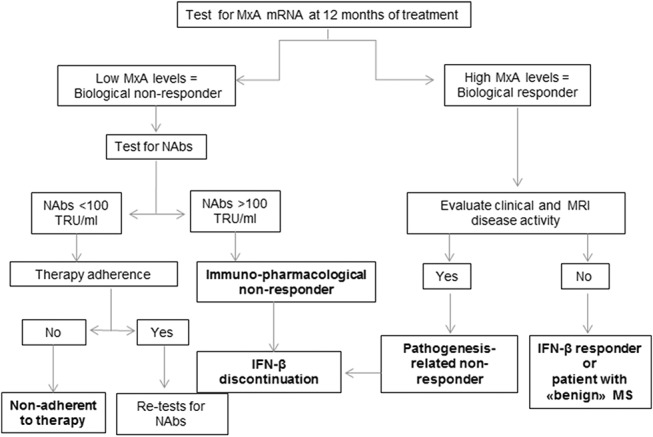
Multiple sclerosis is a heterogenous disease. Although several EMA-approved disease-modifying treatments including biopharmaceuticals are available, their efficacy is limited, and a certain percentage of patients are always nonresponsive. Drug efficacy monitoring is an important tool to identify these nonresponsive patients early on. Currently, detection of antidrug antibodies and quantification of biological activity are used as methods of efficacy monitoring for interferon beta and natalizumab therapies. For natalizumab and alemtuzumab treatments, drug level quantification could be an essential component of the overall disease management. Thus, utilization and development of strategies to determine treatment response are vital aspects of multiple sclerosis management given the tremendous clinical and economic promise of this tool.
多发性硬化症是一种异质性疾病。尽管有几种欧洲药品管理局(EMA)批准的疾病修饰疗法,包括生物制药,但它们的疗效有限,总有一定比例的患者无反应。药物疗效监测是早期识别这些无反应患者的重要工具。目前,抗药物抗体检测和生物活性定量被用作干扰素β和那他珠单抗疗法疗效监测的方法。对于那他珠单抗和阿仑单抗治疗,药物水平定量可能是整体疾病管理的重要组成部分。因此,鉴于该工具巨大的临床和经济前景,确定治疗反应的策略的应用和开发是多发性硬化症管理的重要方面。