Pandit Pranitha S, Ranade Dilip R, Dhakephalkar Prashant K, Rahalkar Monali C
MACS Agharkar Research Institute, G.G. Agarkar Road, Pune, Maharashtra, 411004, India.
Microbial Culture Collection, NCCS, Sai-Trinity Building, Pashan, Pune, Maharashtra, 411021, India.
3 Biotech. 2016 Dec;6(2):135. doi: 10.1007/s13205-016-0453-3. Epub 2016 Jun 16.
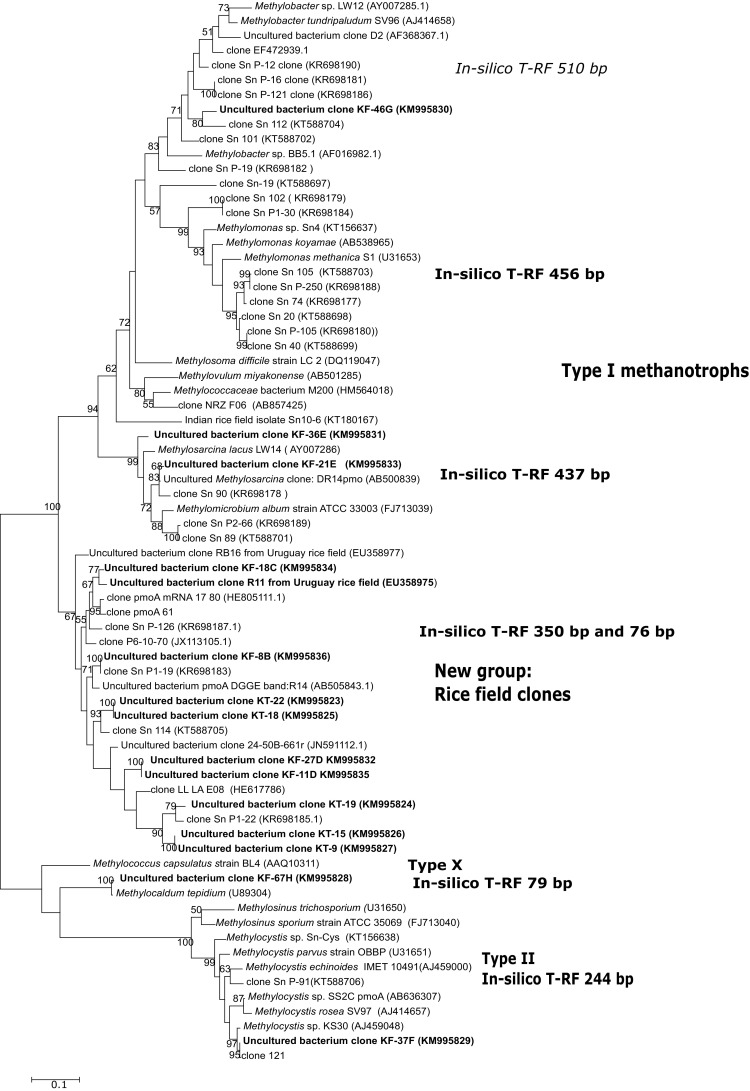
Rice fields are one of the important sources of anthropogenic methane. Methanotrophs can oxidize up to 30 % of the produced methane and thus have a pivotal environmental role in methane mitigation. India occupies the largest region under rice cultivation; however, most of the studies done on methanotrophic communities have focused on the Northern region. We studied methanotrophic community of a flooded, organically fertilized rice field using pmoA clone library approach. Organic rice fields impose a more serious threat as they produce more methane. pmoA gene is the main functional gene which is primarily used for taxonomical analysis of methanotrophs. Our results showed that the pmoA clone libraries from two growth stages of rice were dominated by pmoA sequences which were very distant from cultivated Type Ia methanotrophic genera (80-82 % nucleotide similarity) indicative of the presence of a putatively novel genus. We designated this group of clones as 'rice field clones' as this also includes many pmoA sequences originating from other rice fields. Thus, our current knowledge of methanotroph diversity from Indian rice fields has been expanded revealing that a substantial portion of methanotrophic diversity is unexplored.
稻田是人为甲烷的重要来源之一。甲烷氧化菌能够氧化高达30%的产生的甲烷,因此在甲烷减排中具有关键的环境作用。印度拥有最大的水稻种植区域;然而,大多数关于甲烷氧化菌群落的研究都集中在北部地区。我们使用pmoA克隆文库方法研究了一个淹水、有机施肥稻田的甲烷氧化菌群落。有机稻田产生更多甲烷,构成更严重的威胁。pmoA基因是主要的功能基因,主要用于甲烷氧化菌的分类分析。我们的结果表明,来自水稻两个生长阶段的pmoA克隆文库以pmoA序列为主,这些序列与培养的I型甲烷氧化菌属非常远(核苷酸相似性为80-82%),表明存在一个推测的新属。我们将这一组克隆命名为“稻田克隆”,因为其中还包括许多源自其他稻田的pmoA序列。因此,我们目前对印度稻田甲烷氧化菌多样性的认识得到了扩展,揭示出很大一部分甲烷氧化菌多样性尚未被探索。