Korbakis Dimitrios, Schiza Christina, Brinc Davor, Soosaipillai Antoninus, Karakosta Theano D, Légaré Christine, Sullivan Robert, Mullen Brendan, Jarvi Keith, Diamandis Eleftherios P, Drabovich Andrei P
Department of Laboratory Medicine and Pathobiology, University of Toronto, Toronto, ON, M5T 3L9, Canada.
Lunenfeld-Tanenbaum Research Institute, Mount Sinai Hospital, Toronto, ON, M5T 3L9, Canada.
BMC Med. 2017 Mar 23;15(1):60. doi: 10.1186/s12916-017-0817-5.
TEX101 is a cell membrane protein exclusively expressed by testicular germ cells and shed into seminal plasma. We previously verified human TEX101 as a biomarker for the differential diagnosis of azoospermia, and developed a first-of-its-kind TEX101 ELISA. To demonstrate the clinical utility of TEX101, in this work we aimed at evaluating ELISA performance in a large population of fertile, subfertile, and infertile men.
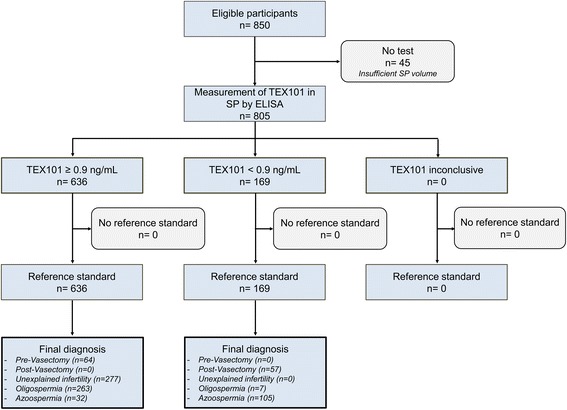
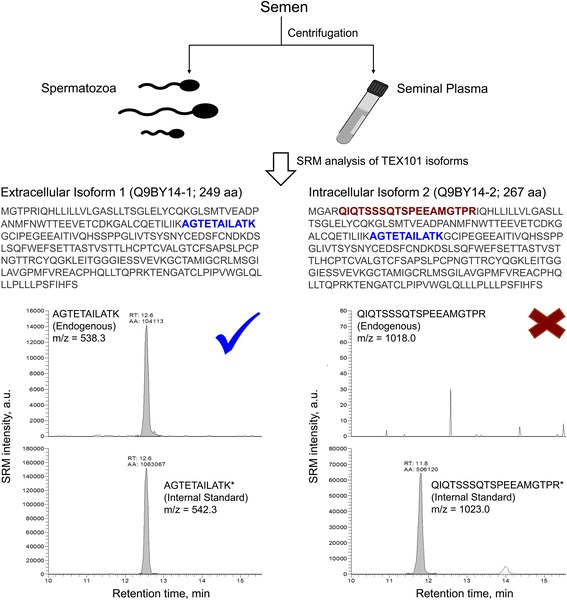
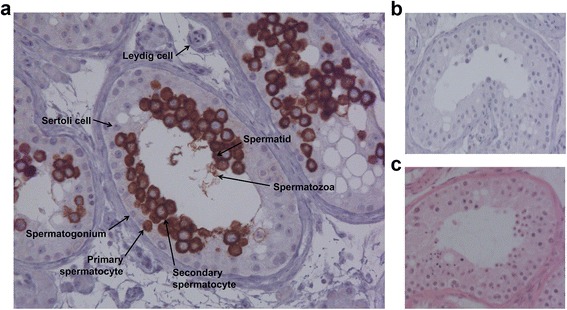
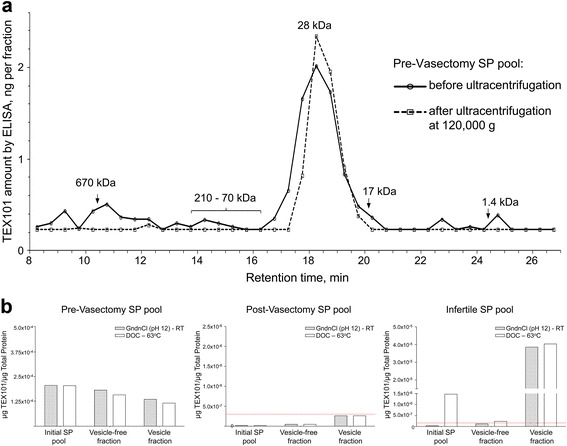
Mass spectrometry, size-exclusion chromatography, ultracentrifugation, and immunohistochemistry were used to characterize TEX101 protein as an analyte in seminal plasma. Using the optimized protocol for seminal plasma pretreatment, TEX101 was measured by ELISA in 805 seminal plasma samples.
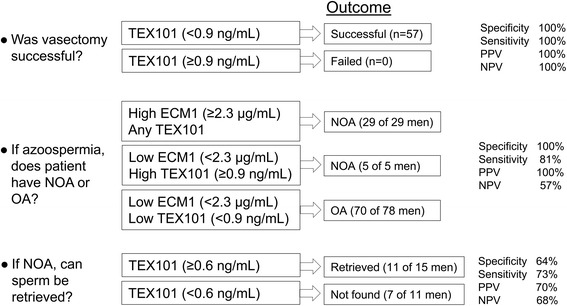
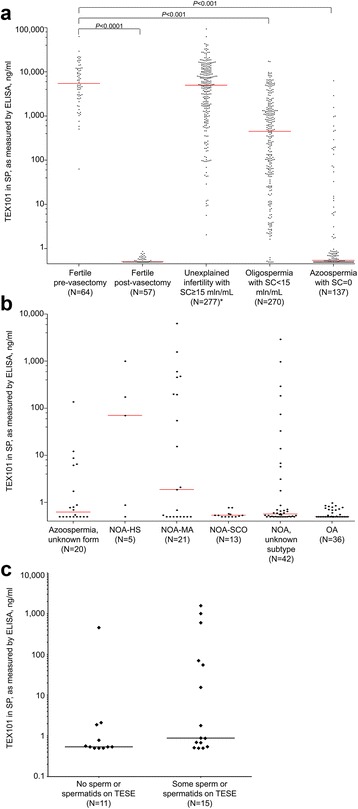
We demonstrated that TEX101 was present in seminal plasma mostly in a free soluble form and that its small fraction was associated with seminal microvesicles. TEX101 median values were estimated in healthy, fertile pre-vasectomy men (5436 ng/mL, N = 64) and in patients with unexplained infertility (4967 ng/mL, N = 277), oligospermia (450 ng/mL, N = 270), and azoospermia (0.5 ng/mL, N = 137). Fertile post-vasectomy men (N = 57) and patients with Sertoli cell-only syndrome (N = 13) and obstructive azoospermia (N = 36) had undetectable levels of TEX101 (≤0.5 ng/mL). A cut-off value of 0.9 ng/mL provided 100% sensitivity at 100% specificity for distinguishing pre- and post-vasectomy men. The combination of a concentration of TEX101 > 0.9 ng/mL and epididymis-specific protein ECM1 > 2.3 μg/mL provided 81% sensitivity at 100% specificity for differentiating between non-obstructive and obstructive azoospermia, thus eliminating the majority of diagnostic testicular biopsies. In addition, a cut-off value of ≥0.6 ng/mL provided 73% sensitivity at 64% specificity for predicting sperm or spermatid retrieval in patients with non-obstructive azoospermia.
We demonstrated the clinical utility of TEX101 ELISA as a test to evaluate vasectomy success, to stratify azoospermia forms, and to better select patients for sperm retrieval.
TEX101是一种仅由睾丸生殖细胞表达并释放到精浆中的细胞膜蛋白。我们之前已验证人TEX101可作为无精子症鉴别诊断的生物标志物,并开发了首个TEX101酶联免疫吸附测定法(ELISA)。为证明TEX101的临床应用价值,在本研究中,我们旨在评估ELISA在大量生育力正常、亚生育力和不育男性群体中的性能。
采用质谱分析、尺寸排阻色谱法、超速离心法和免疫组织化学法将TEX101蛋白鉴定为精浆中的一种分析物。使用优化的精浆预处理方案,通过ELISA对805份精浆样本中的TEX101进行检测。
我们证明TEX101在精浆中大多以游离可溶形式存在,其一小部分与精浆微泡相关。对健康、生育力正常的输精管结扎术前男性(5436 ng/mL,N = 64)、不明原因不育患者(4967 ng/mL,N = 277)、少精子症患者(450 ng/mL,N = 270)和无精子症患者(0.5 ng/mL,N = 137)的TEX101中位数进行了估计。输精管结扎术后生育力正常的男性(N =