Stein Mark N, Bertino Joseph R, Kaufman Howard L, Mayer Tina, Moss Rebecca, Silk Ann, Chan Nancy, Malhotra Jyoti, Rodriguez Lorna, Aisner Joseph, Aiken Robert D, Haffty Bruce G, DiPaola Robert S, Saunders Tracie, Zloza Andrew, Damare Sherri, Beckett Yasmeen, Yu Bangning, Najmi Saltanat, Gabel Christian, Dickerson Siobhan, Zheng Ling, El-Deiry Wafik S, Allen Joshua E, Stogniew Martin, Oster Wolfgang, Mehnert Janice M
Clinical Investigations and Precision Therapeutics Research Program, Rutgers Cancer Institute of New Jersey, New Brunswick, New Jersey.
Formerly at Rutgers Cancer Institute of New Jersey, New Brunswick, New Jersey.
Clin Cancer Res. 2017 Aug 1;23(15):4163-4169. doi: 10.1158/1078-0432.CCR-16-2658. Epub 2017 Mar 22.
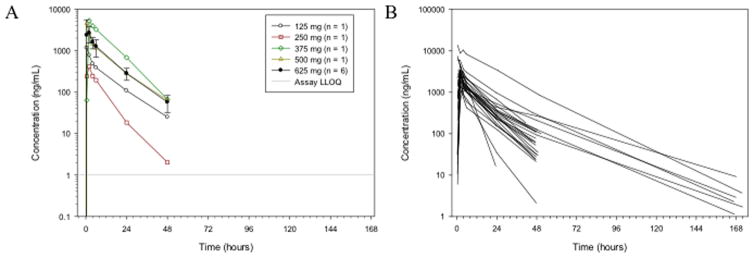
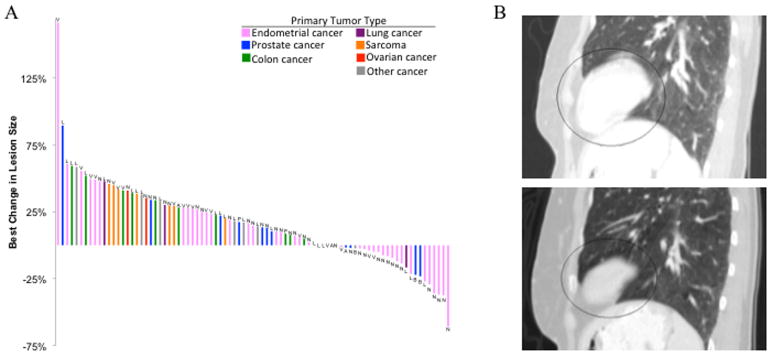
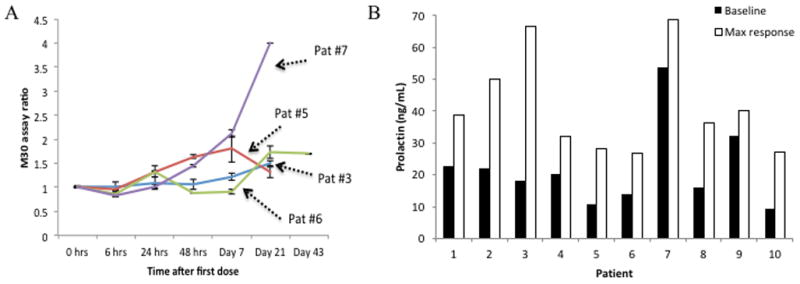
ONC201 is a small-molecule selective antagonist of the G protein-coupled receptor DRD2 that is the founding member of the imipridone class of compounds. A first-in-human phase I study of ONC201 was conducted to determine its recommended phase II dose (RP2D). This open-label study treated 10 patients during dose escalation with histologically confirmed advanced solid tumors. Patients received ONC201 orally once every 3 weeks, defined as one cycle, at doses from 125 to 625 mg using an accelerated titration design. An additional 18 patients were treated at the RP2D in an expansion phase to collect additional safety, pharmacokinetic, and pharmacodynamic information. No grade >1 drug-related adverse events occurred, and the RP2D was defined as 625 mg. Pharmacokinetic analysis revealed a of 1.5 to 7.5 μg/mL (∼3.9-19.4 μmol/L), mean half-life of 11.3 hours, and mean AUC of 37.7 h·μg/L. Pharmacodynamic assays demonstrated induction of caspase-cleaved keratin 18 and prolactin as serum biomarkers of apoptosis and DRD2 antagonism, respectively. No objective responses by RECIST were achieved; however, radiographic regression of several individual metastatic lesions was observed along with prolonged stable disease (>9 cycles) in prostate and endometrial cancer patients. ONC201 is a selective DRD2 antagonist that is well tolerated, achieves micromolar plasma concentrations, and is biologically active in advanced cancer patients when orally administered at 625 mg every 3 weeks. .
ONC201是一种G蛋白偶联受体DRD2的小分子选择性拮抗剂,是咪吡酮类化合物的首个成员。开展了ONC201的首次人体I期研究以确定其推荐的II期剂量(RP2D)。这项开放标签研究在剂量递增阶段治疗了10例经组织学确诊的晚期实体瘤患者。患者每3周口服一次ONC201,采用加速滴定设计,剂量从125毫克至625毫克,每3周定义为一个周期。另外18例患者在扩展阶段接受RP2D治疗,以收集更多的安全性、药代动力学和药效学信息。未发生>1级的药物相关不良事件,RP2D定义为625毫克。药代动力学分析显示血药浓度为1.5至7.5微克/毫升(约3.9 - 19.4微摩尔/升),平均半衰期为11.3小时,平均AUC为37.7小时·微克/升。药效学分析分别证明半胱天冬酶切割的角蛋白18和催乳素的诱导作为凋亡和DRD2拮抗作用的血清生物标志物。未达到RECIST标准的客观缓解;然而,在前列腺癌和子宫内膜癌患者中观察到几个单个转移病灶的影像学退缩以及疾病长期稳定(>9个周期)。ONC201是一种选择性DRD2拮抗剂,耐受性良好,血浆浓度达到微摩尔水平,每3周口服给药625毫克时在晚期癌症患者中具有生物学活性。