Guo Wei, Zheng Yabing, Xu Bing, Ma Fang, Li Chang, Zhang Xiaoqian, Wang Yao, Chang Xiaotian
Medical Research Center, Shandong Provincial Qianfoshan Hospital; Obstetrical Department, Shandong Provincial Qianfoshan Hospital, Shandong University, Jinan, Shandong.
Obstetrical Department, Shandong Provincial Qianfoshan Hospital, Shandong University, Jinan, Shandong.
Onco Targets Ther. 2017 Mar 8;10:1475-1485. doi: 10.2147/OTT.S92389. eCollection 2017.
Peptidylarginine deiminase (PAD) catalyzes the conversion of arginine residues to citrulline residues, termed citrullination. Recent studies have suggested that PAD isoform 2 (PADI2) plays an important role in tumors, although its tumorigenic effect and mechanism are largely unknown.
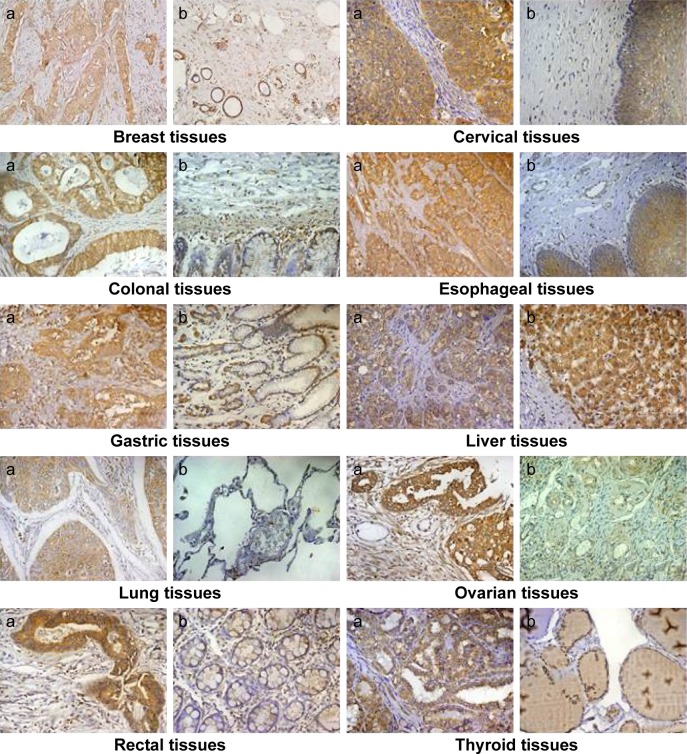
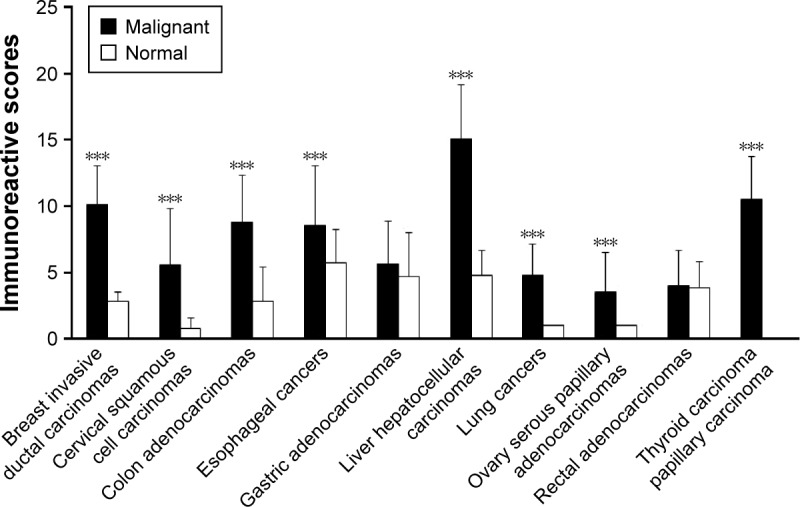
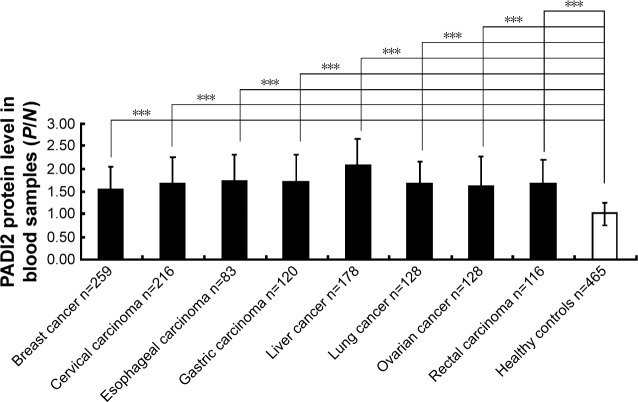
Immunohistochemistry and enzyme-linked immunosorbent assay (ELISA) were used to investigate the expression level of PADI2 in various tumor tissues and patient blood samples, respectively. MNK-45 and Bel-7402 tumor cell lines originating from gastric and liver tumors, respectively, were treated with anti-PADI2 siRNA, and the subsequent cell proliferation, apoptosis and migration were observed. Polymerase chain reaction (PCR) arrays, including Cancer PathwayFinder, Oncogenes and Tumor Suppressor Genes, p53 Signaling Pathway, Signal Transduction Pathway and Tumor Metastasis PCR arrays, were used to investigate the tumorigenic pathway of PADI2 in the siRNA-treated tumor cells. This analysis was verified by real-time PCR.
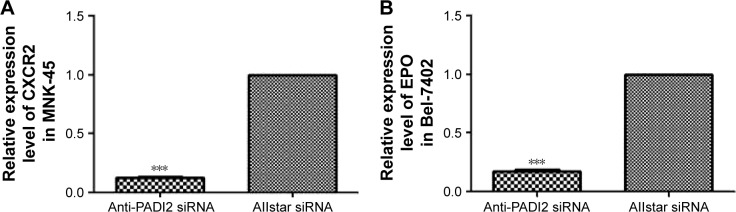
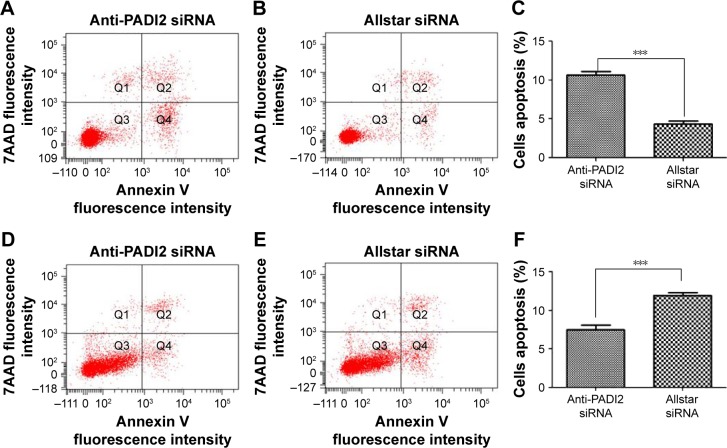
Immunohistochemistry detected significantly increased expression of PADI2 in invasive breast ductal carcinoma, cervical squamous cell carcinoma, colon adenocarcinoma, liver hepatocellular carcinoma, lung cancer, ovarian serous papillary adenocarcinoma and papillary thyroid carcinoma samples. ELISA detected a twofold increase in PADI2 expression in the blood of 48.3% of patients with liver cancer, 38% of patients with cervical carcinoma and 32% of patients with gastric carcinoma. Increased apoptosis and decreased cell proliferation and migration were observed in the anti-PADI2 siRNA-treated MNK-45 cells, and increased cell proliferation and migration and decreased apoptosis were observed in the treated Bel-7402 cells with suppressed PADI2 expression. PCR arrays and real-time PCR detected significantly decreased CXCR2 and EPO expression in the MNK-45 cells and Bel-7402 cells, respectively, with the anti-PADI2 siRNA treatments.
PADI2 expression is increased in many types of tumor tissues and patient blood samples. PADI2 may advance abnormal cell behavior in gastric cancers by mediating CXCR2, a well-known gene that stimulates cell proliferation and invasion. However, PADI2 might have deleterious effects on tumor growth and metastasis in liver tumor cells by regulating the expression of EPO, a gene with controversial functions in tumor growth. The results suggest that the effect of PADI2 on tumorigenesis is multifactorial, depending on the tumor type.
肽基精氨酸脱亚氨酶(PAD)催化精氨酸残基转化为瓜氨酸残基,此过程称为瓜氨酸化。近期研究表明,PAD同工型2(PADI2)在肿瘤中发挥重要作用,但其致瘤作用及机制大多尚不清楚。
分别采用免疫组织化学和酶联免疫吸附测定(ELISA)法检测PADI2在各种肿瘤组织和患者血液样本中的表达水平。分别用抗PADI2小干扰RNA(siRNA)处理源自胃癌和肝癌的MNK - 45和Bel - 7402肿瘤细胞系,随后观察细胞增殖、凋亡和迁移情况。利用包括癌症通路查找器、癌基因和肿瘤抑制基因、p53信号通路、信号转导通路和肿瘤转移PCR阵列在内的聚合酶链反应(PCR)阵列,研究PADI2在经siRNA处理的肿瘤细胞中的致瘤途径。该分析通过实时PCR进行验证。
免疫组织化学检测发现,PADI2在浸润性乳腺导管癌、宫颈鳞状细胞癌、结肠腺癌、肝肝细胞癌、肺癌、卵巢浆液性乳头状腺癌和甲状腺乳头状癌样本中的表达显著增加。ELISA检测发现,48.3%的肝癌患者、38%的宫颈癌患者和32%的胃癌患者血液中PADI2表达增加两倍。在经抗PADI2 siRNA处理的MNK - 45细胞中观察到凋亡增加,细胞增殖和迁移减少;在PADI2表达受抑制的经处理的Bel - 7402细胞中观察到细胞增殖和迁移增加,凋亡减少。PCR阵列和实时PCR检测发现,经抗PADI2 siRNA处理后,MNK - 45细胞和Bel - 7402细胞中CXCR2和EPO表达分别显著降低。
PADI2在多种肿瘤组织和患者血液样本中的表达增加。PADI2可能通过介导CXCR2促进胃癌中的异常细胞行为,CXCR2是一个刺激细胞增殖和侵袭的知名基因。然而,PADI2可能通过调节EPO的表达对肝肿瘤细胞的肿瘤生长和转移产生有害影响,EPO在肿瘤生长中的功能存在争议。结果表明,PADI2对肿瘤发生的影响是多因素的,取决于肿瘤类型。