Young Vicki L, Cole Amy, Lecky Donna M, Fettis Dennis, Pritchard Beth, Verlander Neville Q, Eley Charlotte V, McNulty Cliodna A M
Public Health England, Primary Care Unit, Gloucestershire Royal Hospital, Gloucester GL1 3NN, UK.
Environmental Health Department, Forest of Dean District Council, Coleford GL16 8HG, UK.
J Antimicrob Chemother. 2017 Jul 1;72(7):2119-2126. doi: 10.1093/jac/dkx083.
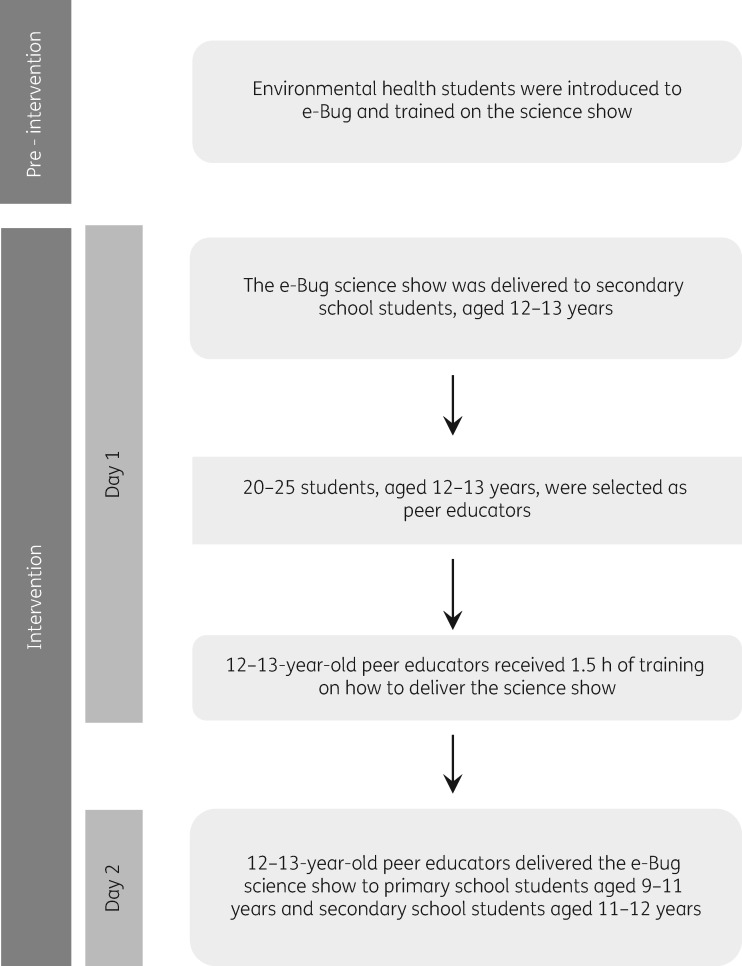
Delivering health topics in schools through peer education is known to be beneficial for all students involved. In this study, we have evaluated a peer-education workshop that aims to educate primary and secondary school students on hygiene, the spread of infection and antibiotics.
Four schools in south-west England, in a range of localities, took part in peer-education workshops, with students completing before, after and knowledge-retention questionnaires. Mixed-effect logistic regression and mixed-effect linear regression were used to analyse the data. Data were analysed by topic, region and peer/non-peer-educator status. Qualitative interviews and focus groups with students and educators were conducted to assess changes in participants' skills, confidence and behaviour.
Qualitative data indicated improvements in peer-educator skills and behaviour, including confidence, team-working and communication. There was a significant improvement in knowledge for all topics covered in the intervention, although this varied by region. In the antibiotics topic, peer-educators' knowledge increased in the retention questionnaire, whereas non-peer-educators' knowledge decreased. Knowledge declined in the retention questionnaires for the other topics, although this was mostly not significant.
This study indicates that peer education is an effective way to educate young people on important topics around health and hygiene, and to concurrently improve communication skills. Its use should be encouraged across schools to help in the implementation of the National Institute for Health and Care Excellence (NICE) guidance that recommends children are taught in an age-appropriate manner about hygiene and antibiotics.
通过同伴教育在学校传授健康主题对所有参与的学生都有益。在本研究中,我们评估了一个同伴教育工作坊,其旨在对中小学生进行卫生、感染传播和抗生素方面的教育。
英格兰西南部不同地区的四所学校参加了同伴教育工作坊,学生们完成了课前、课后及知识保留问卷。采用混合效应逻辑回归和混合效应线性回归分析数据。数据按主题、地区以及同伴/非同伴教育者身份进行分析。对学生和教育者进行了定性访谈和焦点小组讨论,以评估参与者在技能、信心和行为方面的变化。
定性数据表明同伴教育者在技能和行为方面有所改进,包括信心、团队合作和沟通能力。干预涵盖的所有主题的知识都有显著提高,尽管因地区而异。在抗生素主题方面,同伴教育者在知识保留问卷中的知识有所增加,而非同伴教育者的知识有所下降。其他主题在知识保留问卷中的知识有所下降,尽管大多不显著。
本研究表明同伴教育是一种有效的方式,可以就健康和卫生等重要主题对年轻人进行教育,并同时提高沟通技能。应鼓励在各学校采用同伴教育,以帮助实施英国国家卫生与临床优化研究所(NICE)的指南,该指南建议以适合年龄的方式向儿童传授卫生和抗生素知识。