Kouwaki Takahisa, Okamoto Masaaki, Tsukamoto Hirotake, Fukushima Yoshimi, Oshiumi Hiroyuki
Department of Immunology, Graduate School of Medical Sciences, Faculty of Life Sciences, Kumamoto University, 1-1-1 Honjo, Chuo-ku, Kumamoto 860-8556, Japan.
Japan Science and Technology Agency, PRESTO, 1-1-1 Honjo, Chuo-ku, Kumamoto 860-8556, Japan.
Int J Mol Sci. 2017 Mar 20;18(3):666. doi: 10.3390/ijms18030666.
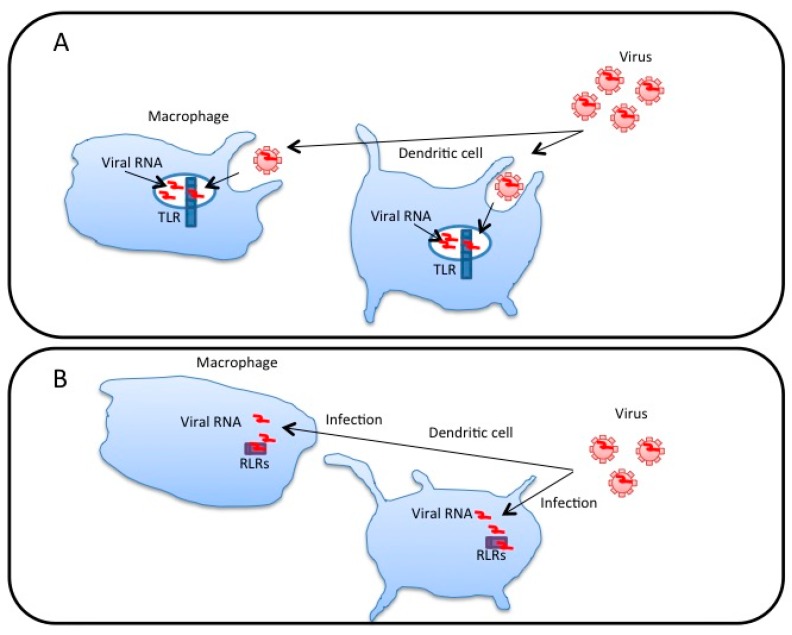
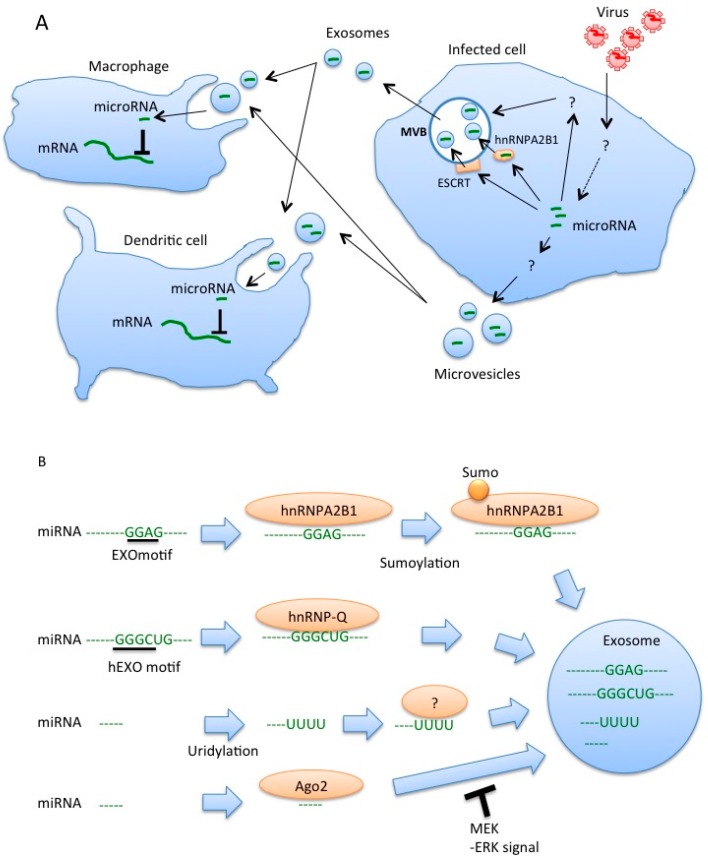
The innate immune system plays a crucial role in controlling viral infection. Pattern recognition receptors (PRRs), such as Toll-like receptors and RIG-I-like receptors, sense viral components called pathogen-associated molecular patterns (PAMPs) and trigger signals to induce innate immune responses. Extracellular vesicles (EVs), including exosomes and microvesicles, deliver functional RNA and mediate intercellular communications. Recent studies have revealed that EVs released from virus-infected cells deliver viral RNA to dendritic cells and macrophages, thereby activating PRRs in recipient cells, which results in the expression of type I interferon and pro-inflammatory cytokines. On the other hand, EVs transfer not only viral RNA but also host microRNAs to recipient cells. Recently, infection of hepatocytes with hepatitis B virus (HBV) was shown to affect microRNA levels in EVs released from virus-infected cells, leading to attenuation of host innate immune response. This suggests that the virus utilizes the EVs and host microRNAs to counteract the antiviral innate immune responses. In this review, we summarize recent findings related to the role of EVs in antiviral innate immune responses.
固有免疫系统在控制病毒感染中发挥着关键作用。模式识别受体(PRRs),如Toll样受体和RIG-I样受体,可感知被称为病原体相关分子模式(PAMPs)的病毒成分,并触发信号以诱导固有免疫反应。细胞外囊泡(EVs),包括外泌体和微囊泡,可传递功能性RNA并介导细胞间通讯。最近的研究表明,病毒感染细胞释放的EVs将病毒RNA传递给树突状细胞和巨噬细胞,从而激活受体细胞中的PRRs,导致I型干扰素和促炎细胞因子的表达。另一方面,EVs不仅将病毒RNA传递给受体细胞,还传递宿主微小RNA。最近的研究表明,乙型肝炎病毒(HBV)感染肝细胞会影响病毒感染细胞释放的EVs中的微小RNA水平,从而导致宿主固有免疫反应减弱。这表明病毒利用EVs和宿主微小RNA来对抗抗病毒固有免疫反应。在本综述中,我们总结了与EVs在抗病毒固有免疫反应中的作用相关的最新研究结果。