Murungi Edwin K, Kariithi Henry M
Department of Biochemistry and Molecular Biology, Egerton University, P.O. Box 536, 20115 Njoro, Kenya.
Biotechnology Research Institute, Kenya Agricultural and Livestock Research Organization, P.O. Box 57811, Kaptagat Rd, Loresho, 00200 Nairobi, Kenya.
Pathogens. 2017 Mar 21;6(1):12. doi: 10.3390/pathogens6010012.
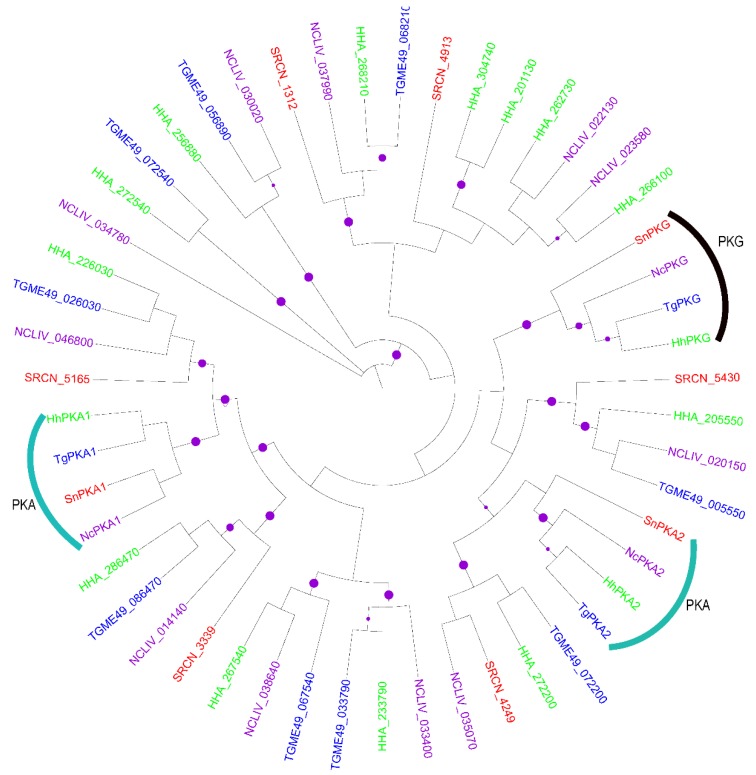
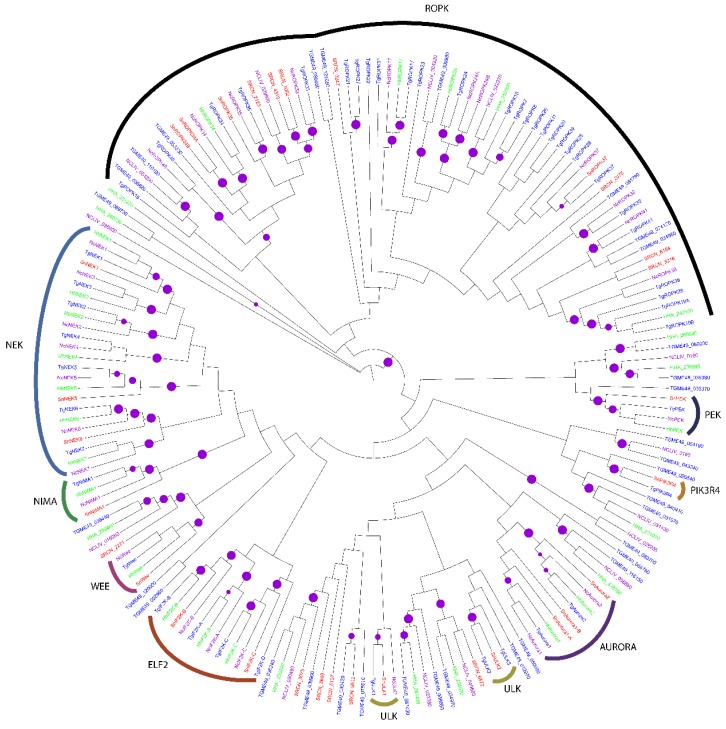
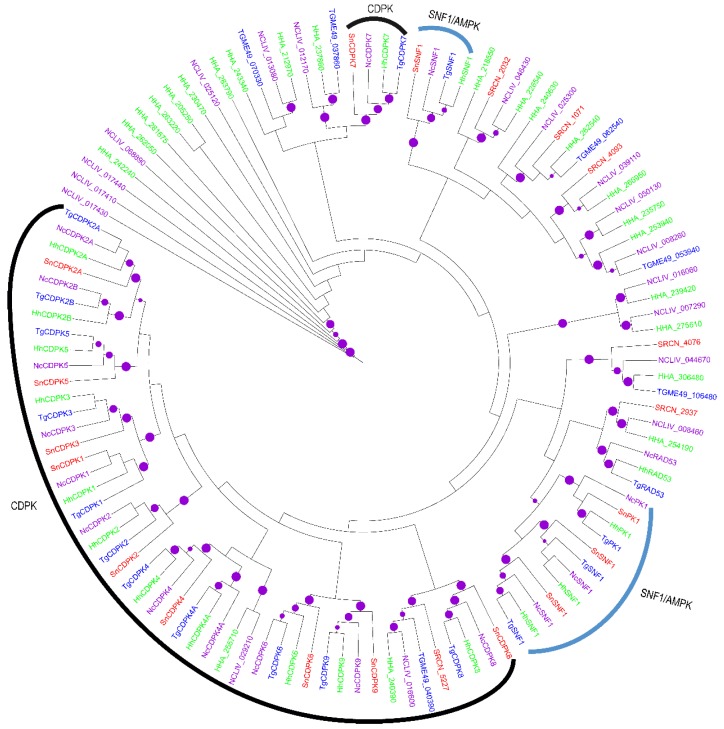
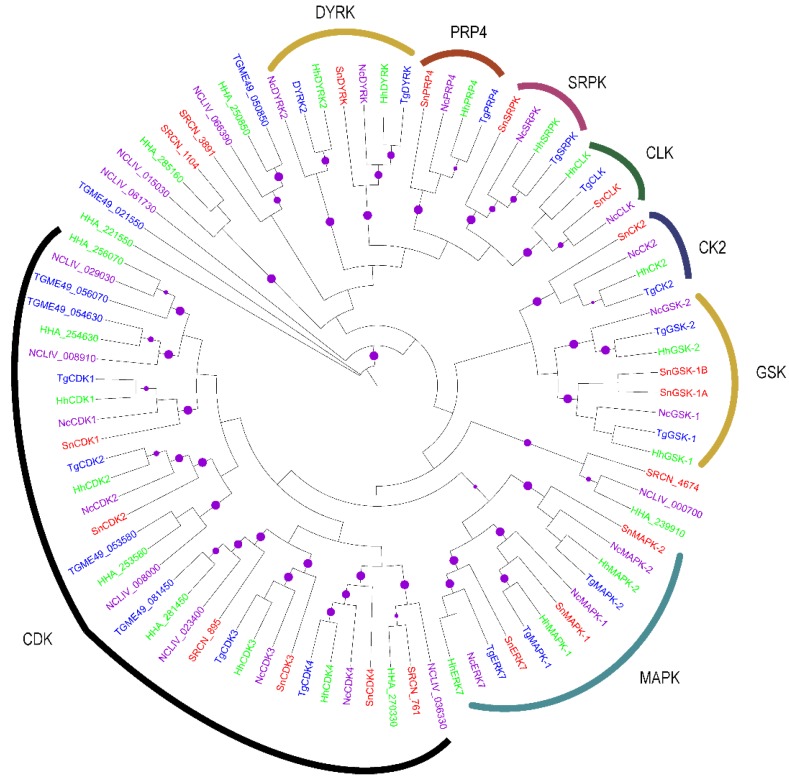
The apicomplexan parasite Sarcocystis neurona causes equine protozoal myeloencephalitis (EPM), a degenerative neurological disease of horses. Due to its host range expansion, S. neurona is an emerging threat that requires close monitoring. In apicomplexans, protein kinases (PKs) have been implicated in a myriad of critical functions, such as host cell invasion, cell cycle progression and host immune response evasion. Here, we used various bioinformatics methods to define the kinome of S. neurona and phylogenetic relatedness of its PKs to other apicomplexans. We identified 97 putative PKs clustering within the various eukaryotic kinase groups. Although containing the universally-conserved PKA (AGC group), S. neurona kinome was devoid of PKB and PKC. Moreover, the kinome contains the six-conserved apicomplexan CDPKs (CAMK group). Several OPK atypical kinases, including ROPKs 19A, 27, 30, 33, 35 and 37 were identified. Notably, S. neurona is devoid of the virulence-associated ROPKs 5, 6, 18 and 38, as well as the Alpha and RIO kinases. Two out of the three S. neurona CK1 enzymes had high sequence similarities to Toxoplasma gondii TgCK1-α and TgCK1-β and the Plasmodium PfCK1. Further experimental studies on the S. neurona putative PKs identified in this study are required to validate the functional roles of the PKs and to understand their involvement in mechanisms that regulate various cellular processes and host-parasite interactions. Given the essentiality of apicomplexan PKs in the survival of apicomplexans, the current study offers a platform for future development of novel therapeutics for EPM, for instance via application of PK inhibitors to block parasite invasion and development in their host.
顶复门寄生虫神经肉孢子虫会引发马的原生动物脑脊髓炎(EPM),这是一种马的退行性神经疾病。由于其宿主范围的扩大,神经肉孢子虫成为一种需要密切监测的新出现的威胁。在顶复门生物中,蛋白激酶(PKs)参与了众多关键功能,如宿主细胞入侵、细胞周期进程以及逃避宿主免疫反应。在此,我们运用多种生物信息学方法来界定神经肉孢子虫的激酶组及其蛋白激酶与其他顶复门生物的系统发育相关性。我们鉴定出97个推定的蛋白激酶,它们聚集在不同的真核激酶组中。尽管神经肉孢子虫的激酶组包含普遍保守的蛋白激酶A(AGC组),但却没有蛋白激酶B和蛋白激酶C。此外,该激酶组包含六个保守的顶复门钙依赖蛋白激酶(CAMK组)。我们还鉴定出了几种OPK非典型激酶,包括ROPKs 19A、27、30、33、35和37。值得注意的是,神经肉孢子虫没有与毒力相关的ROPKs 5、6、18和38,以及Alpha和RIO激酶。神经肉孢子虫的三种酪蛋白激酶1(CK1)酶中有两种与刚地弓形虫的TgCK1-α和TgCK1-β以及疟原虫的PfCK1具有高度的序列相似性。需要对本研究中鉴定出的神经肉孢子虫推定蛋白激酶进行进一步的实验研究,以验证这些蛋白激酶的功能作用,并了解它们在调节各种细胞过程和宿主-寄生虫相互作用机制中的参与情况。鉴于顶复门蛋白激酶在顶复门生物生存中的重要性,本研究为未来开发针对EPM的新型疗法提供了一个平台,例如通过应用蛋白激酶抑制剂来阻断寄生虫在其宿主体内的入侵和发育。