Yu Lei, Gan Xiuguo, Liu Xukun, An Ruihua
a Department of Urology , the First Affiliated Hospital of Harbin Medical University , Harbin , Heilongjiang Province , P.R. China.
b Department of General Surgery , the People's Hospital of Jixi , Jixi , Heilongjiang Province , P.R. China.
Ren Fail. 2017 Nov;39(1):440-451. doi: 10.1080/0886022X.2017.1305968.
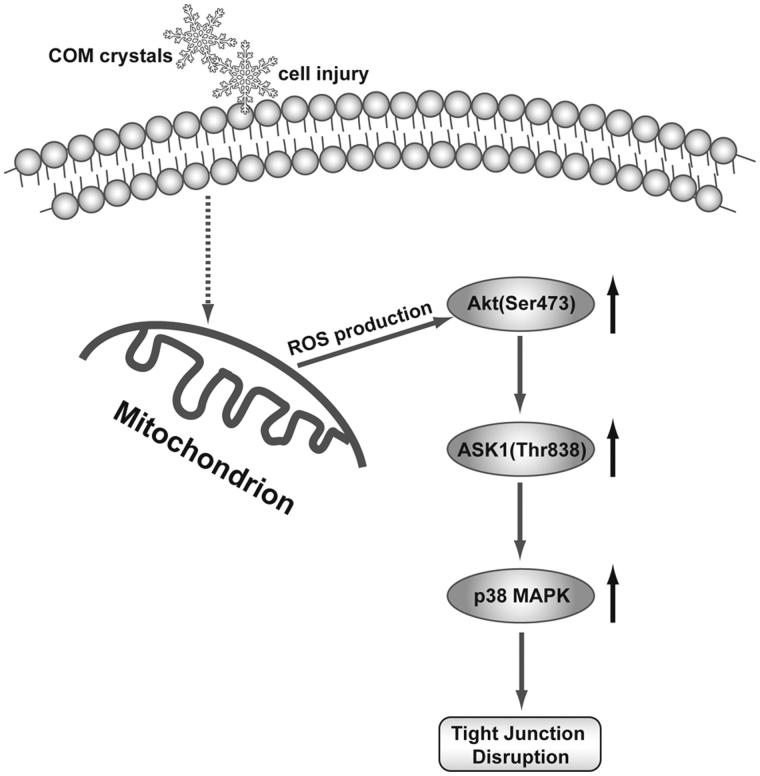
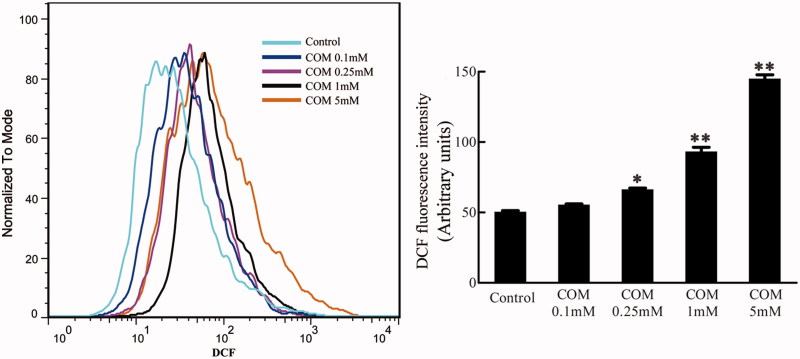
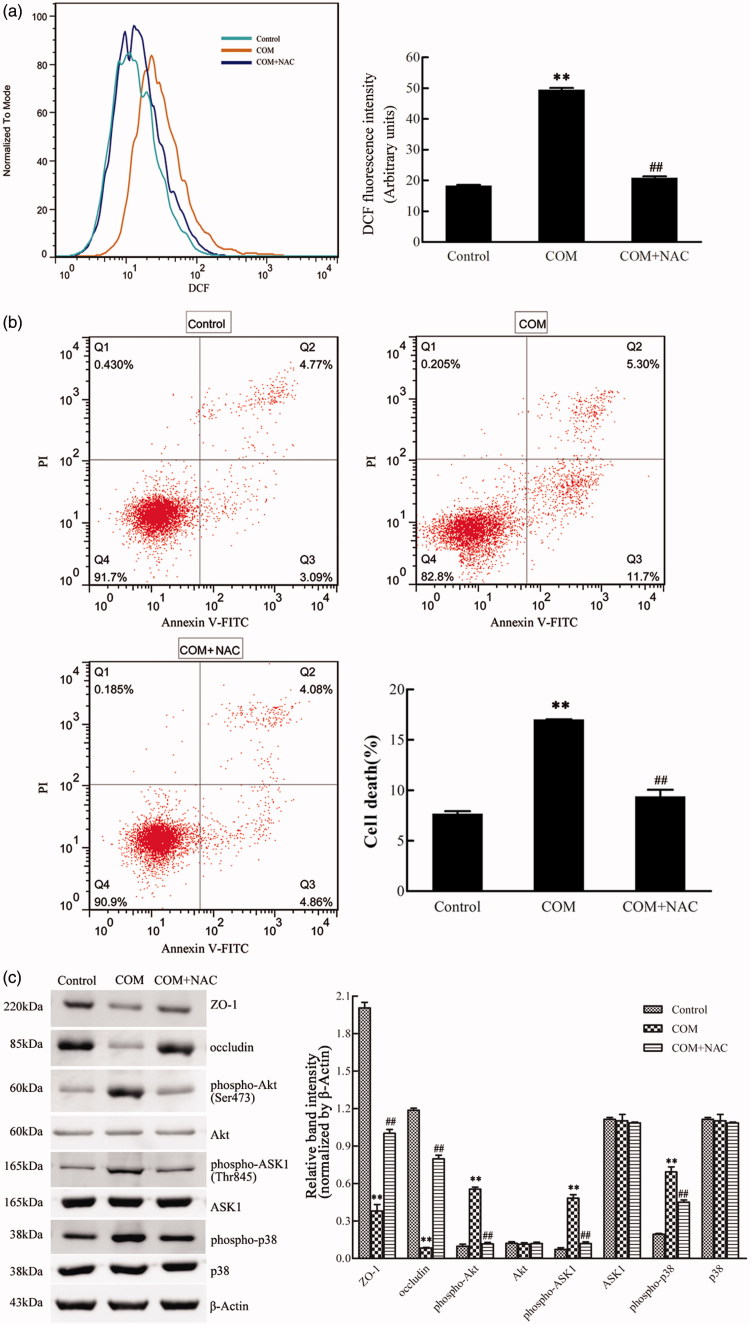
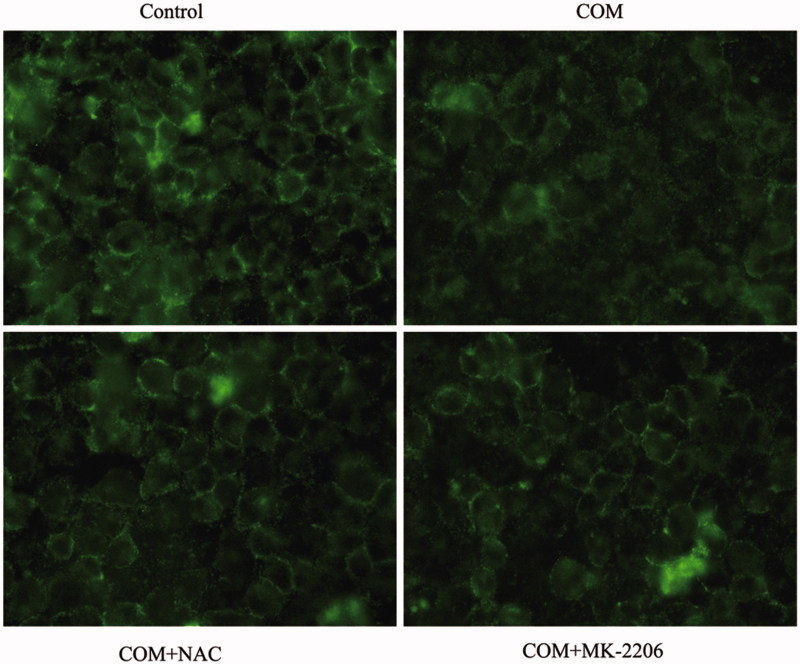
Tight junction plays important roles in regulating paracellular transports and maintaining cell polarity. Calcium oxalate monohydrate (COM) crystals, the major crystalline composition of kidney stones, have been demonstrated to be able to cause tight junction disruption to accelerate renal cell injury. However, the cellular signaling involved in COM crystal-induced tight junction disruption remains largely to be investigated. In the present study, we proved that COM crystals induced tight junction disruption by activating ROS/Akt/p38 MAPK pathway. Treating Madin-Darby canine kidney (MDCK) cells with COM crystals induced a substantial increasing of ROS generation and activation of Akt that triggered subsequential activation of ASK1 and p38 mitogen-activated protein kinase (MAPK). Western blot revealed a significantly decreased expression of ZO-1 and occludin, two important structural proteins of tight junction. Besides, redistribution and dissociation of ZO-1 were observed by COM crystals treatment. Inhibition of ROS by N-acetyl-l-cysteine (NAC) attenuated the activation of Akt, ASK1, p38 MAPK, and down-regulation of ZO-1 and occludin. The redistribution and dissociation of ZO-1 were also alleviated by NAC treatment. These results indicated that ROS were involved in the regulation of tight junction disruption induced by COM crystals. In addition, the down-regulation of ZO-1 and occludin, the phosphorylation of ASK1 and p38 MAPK were also attenuated by MK-2206, an inhibitor of Akt kinase, implying Akt was involved in the disruption of tight junction upstream of p38 MAPK. Thus, these results suggested that ROS-Akt-p38 MAPK signaling pathway was activated in COM crystal-induced disruption of tight junction in MDCK cells.
紧密连接在调节细胞旁转运和维持细胞极性方面发挥着重要作用。一水草酸钙(COM)晶体是肾结石的主要晶体成分,已被证明能够导致紧密连接破坏,加速肾细胞损伤。然而,COM晶体诱导紧密连接破坏所涉及的细胞信号传导在很大程度上仍有待研究。在本研究中,我们证明COM晶体通过激活ROS/Akt/p38 MAPK信号通路诱导紧密连接破坏。用COM晶体处理Madin-Darby犬肾(MDCK)细胞会导致ROS生成大量增加以及Akt激活,进而引发ASK1和p38丝裂原活化蛋白激酶(MAPK)的后续激活。蛋白质免疫印迹法显示紧密连接的两种重要结构蛋白ZO-1和闭合蛋白的表达显著降低。此外,通过COM晶体处理观察到ZO-1的重新分布和解离。用N-乙酰-L-半胱氨酸(NAC)抑制ROS可减弱Akt、ASK1、p38 MAPK的激活以及ZO-1和闭合蛋白的下调。NAC处理也减轻了ZO-1的重新分布和解离。这些结果表明ROS参与了COM晶体诱导的紧密连接破坏的调节。此外,Akt激酶抑制剂MK-2206也减弱了ZO-1和闭合蛋白的下调、ASK1和p38 MAPK的磷酸化,这意味着Akt参与了p38 MAPK上游紧密连接的破坏。因此,这些结果表明在COM晶体诱导的MDCK细胞紧密连接破坏中ROS-Akt-p38 MAPK信号通路被激活。