W. M. Keck Center for Transgene Research, University of Notre Dame, Notre Dame, IN, USA.
Department of Chemistry and Biochemistry, University of Notre Dame, Notre Dame, IN, USA.
Sci Rep. 2017 Mar 23;7(1):365. doi: 10.1038/s41598-017-00418-y.
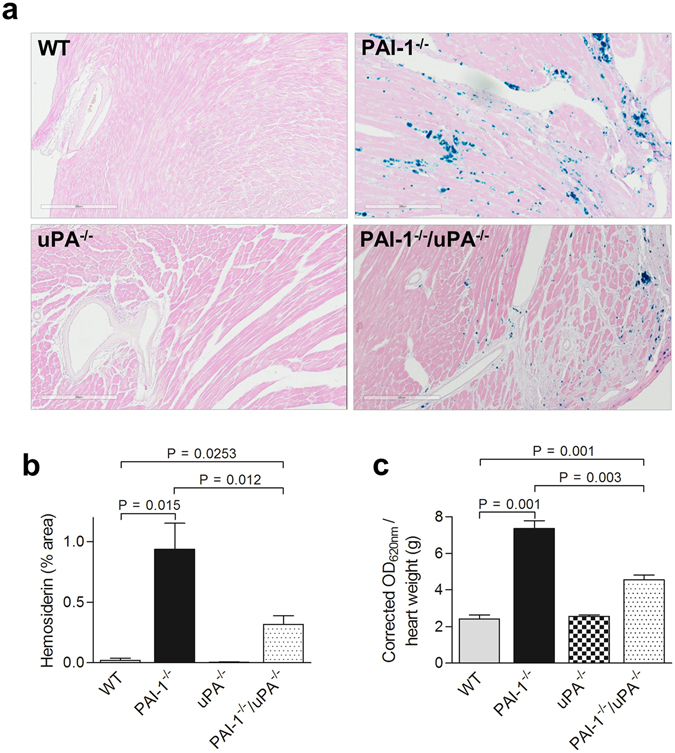
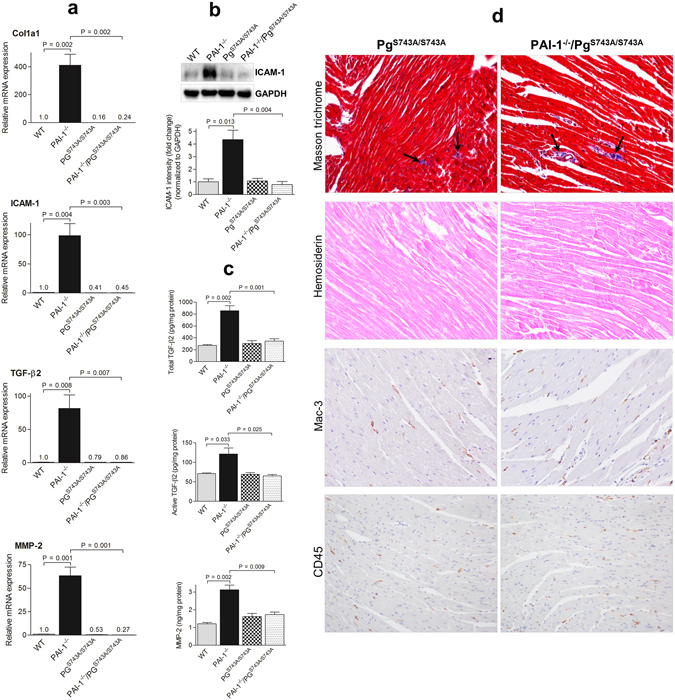
Plasminogen activator inhibitor-1 (PAI-1) is known to protect mice against cardiac fibrosis. It has been speculated that PAI-1 may regulate cardiac fibrosis by inactivating urokinase-type plasminogen activator (uPA) and ultimately plasmin (Pm) generation. However, the in vivo role of PAI-1 in inactivating uPA and limiting the generation of Pm during cardiac fibrosis remains to be established. The objective of this study was to determine if the cardioprotective effect of PAI-1 is mediated through its ability to directly regulate urokinase -mediated activation of plasminogen (Pg). An Angiotensin II (AngII)-aldosterone (Ald) infusion mouse model of hypertension was utilised in this study. Four weeks after AngII-Ald infusion, PAI-1-deficient (PAI-1) mice developed severe cardiac fibrosis. However, a marked reduction in cardiac fibrosis was observed in PAI-1/uPA double knockout mice that was associated with reduced inflammation, lower expression levels of TGF-β and proteases associated with tissue remodeling, and diminished Smad2 signaling. Moreover, total ablation of cardiac fibrosis was observed in PAI-1 mice that express inactive plasmin (Pm) but normal levels of zymogen Pg (PAI-1/Pg). Our findings indicate that PAI-1 protects mice from hypertension-induced cardiac fibrosis by inhibiting the generation of active Pm.
纤溶酶原激活物抑制剂-1(PAI-1)已知可保护小鼠免受心脏纤维化的影响。人们推测,PAI-1 可能通过使尿激酶型纤溶酶原激活物(uPA)失活并最终抑制纤溶酶(Pm)的产生来调节心脏纤维化。然而,PAI-1 在心脏纤维化过程中失活 uPA 和限制 Pm 生成中的体内作用仍有待确定。本研究的目的是确定 PAI-1 的心脏保护作用是否通过其直接调节尿激酶介导的纤溶酶原(Pg)激活来介导。本研究利用血管紧张素 II(AngII)-醛固酮(Ald)输注高血压小鼠模型。在 AngII-Ald 输注 4 周后,PAI-1 缺陷(PAI-1)小鼠发生严重的心脏纤维化。然而,在 PAI-1/uPA 双敲除小鼠中观察到心脏纤维化明显减少,这与炎症减少、TGF-β和与组织重塑相关的蛋白酶表达水平降低以及 Smad2 信号转导减弱有关。此外,在表达无活性纤溶酶(Pm)但正常水平酶原 Pg(PAI-1/Pg)的 PAI-1 小鼠中观察到心脏纤维化完全消融。我们的研究结果表明,PAI-1 通过抑制活性 Pm 的产生来保护小鼠免受高血压引起的心脏纤维化。