Hingston Patricia, Chen Jessica, Dhillon Bhavjinder K, Laing Chad, Bertelli Claire, Gannon Victor, Tasara Taurai, Allen Kevin, Brinkman Fiona S L, Truelstrup Hansen Lisbeth, Wang Siyun
Department of Food, Nutrition, and Health, University of British Columbia Vancouver, BC, Canada.
Department of Molecular Biology and Biochemistry, Simon Fraser University Burnaby, BC, Canada.
Front Microbiol. 2017 Mar 8;8:369. doi: 10.3389/fmicb.2017.00369. eCollection 2017.
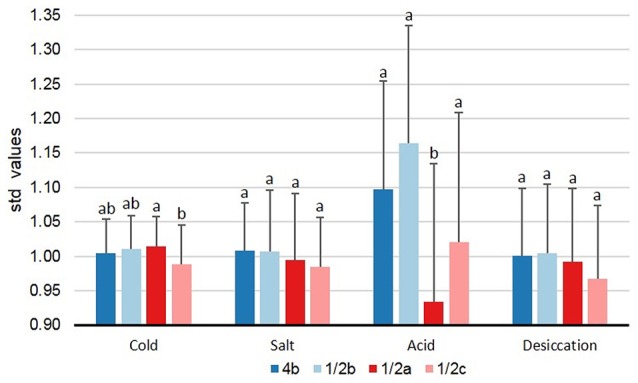
The human pathogen is a large concern in the food industry where its continuous detection in food products has caused a string of recalls in North America and Europe. Most recognized for its ability to grow in foods during refrigerated storage, can also tolerate several other food-related stresses with some strains possessing higher levels of tolerances than others. The objective of this study was to use a combination of phenotypic analyses and whole genome sequencing to elucidate potential relationships between genotypes and food-related stress tolerance phenotypes. To accomplish this, 166 isolates were sequenced and evaluated for their ability to grow in cold (4°C), salt (6% NaCl, 25°C), and acid (pH 5, 25°C) stress conditions as well as survive desiccation (33% RH, 20°C). The results revealed that the stress tolerance of is associated with serotype, clonal complex (CC), full length profiles, and the presence of a plasmid which was identified in 55% of isolates. Isolates with full length exhibited significantly ( < 0.001) enhanced cold tolerance relative to those harboring a premature stop codon (PMSC) in this gene. Similarly, isolates possessing a plasmid demonstrated significantly ( = 0.013) enhanced acid tolerance. We also identified nine new sequence types, a new PMSC, and several connections between CCs and the presence/absence or variations of specific genetic elements. A whole genome single-nucleotide-variants phylogeny revealed sporadic distribution of tolerant isolates and closely related sensitive and tolerant isolates, highlighting that minor genetic differences can influence the stress tolerance of . Specifically, a number of cold and desiccation sensitive isolates contained PMSCs in σ regulator genes (). Collectively, the results suggest that knowing the sequence type of an isolate in addition to screening for the presence of full-length and a plasmid, could help food processors and food agency investigators determine why certain isolates might be persisting in a food processing environment. Additionally, increased sequencing of isolates in combination with stress tolerance profiling, will enhance the ability to identify genetic elements associated with higher risk strains.
这种人类病原体在食品行业备受关注,其在食品中的持续检出已导致北美和欧洲一系列召回事件。因其在冷藏储存期间能够在食品中生长的能力而最为人所知,它还能耐受其他几种与食品相关的压力,一些菌株的耐受性水平高于其他菌株。本研究的目的是结合表型分析和全基因组测序,以阐明该病原体基因型与食品相关压力耐受表型之间的潜在关系。为此,对166株该病原体分离株进行了测序,并评估了它们在低温(4°C)、盐(6% NaCl,25°C)和酸(pH 5,25°C)胁迫条件下生长以及在干燥(33%相对湿度,20°C)环境中存活的能力。结果表明,该病原体的压力耐受性与血清型、克隆复合体(CC)、全长基因图谱以及质粒的存在有关,在55%的分离株中鉴定出了质粒。与该基因中含有提前终止密码子(PMSC)的分离株相比,具有全长基因的分离株表现出显著(P < 0.001)增强的耐寒性。同样,拥有质粒的分离株表现出显著(P = 0.013)增强的耐酸性。我们还鉴定出了9种新的该病原体序列类型、一种新的该病原体PMSC,以及CCs与特定遗传元件的存在/缺失或变异之间的若干联系。全基因组单核苷酸变异系统发育分析揭示了耐受分离株以及密切相关的敏感和耐受分离株的散在分布,突出表明微小的遗传差异会影响该病原体的压力耐受性。具体而言,一些对低温和干燥敏感的分离株在σ调节基因中含有PMSCs。总体而言,结果表明,除了筛选全长基因和质粒的存在外,了解分离株的序列类型有助于食品加工商和食品机构调查人员确定某些分离株为何可能在食品加工环境中持续存在。此外,增加该病原体分离株的测序并结合压力耐受性分析,将提高识别与高风险菌株相关的遗传元件的能力。