Camara Bienvenu S, Delamou Alexandre, Diro Ermias, Béavogui Abdoul H, El Ayadi Alison M, Sidibé Sidikiba, Grovogui Fassou M, Takarinda Kudakwashe C, Bouedouno Patrice, Sandouno Sah D, Okumura Junko, Baldé Mamadou D, Van Griensven Johan, Zachariah Rony
Department of Public Health, Gamal University of Conakry, Conakry, Guinea.
Woman and Child Health Research Centre, Institute of Tropical Medicine, Antwerp, Belgium.
Trans R Soc Trop Med Hyg. 2017 Jan 1;111(1):22-29. doi: 10.1093/trstmh/trx009.
The 2014/2015 Ebola outbreak was the most sustained in history. In Guinea, we compared trends in family planning, antenatal care, and institutional deliveries over the period before, during and after the outbreak.
We carried out an ecological study involving all the health facilities during pre-Ebola (1 March 2013 to 28 February 2014), intra-Ebola (1 March 2014 to 28 February 2015) and post-Ebola (1 March to 31 July 2016) periods in Macenta district.
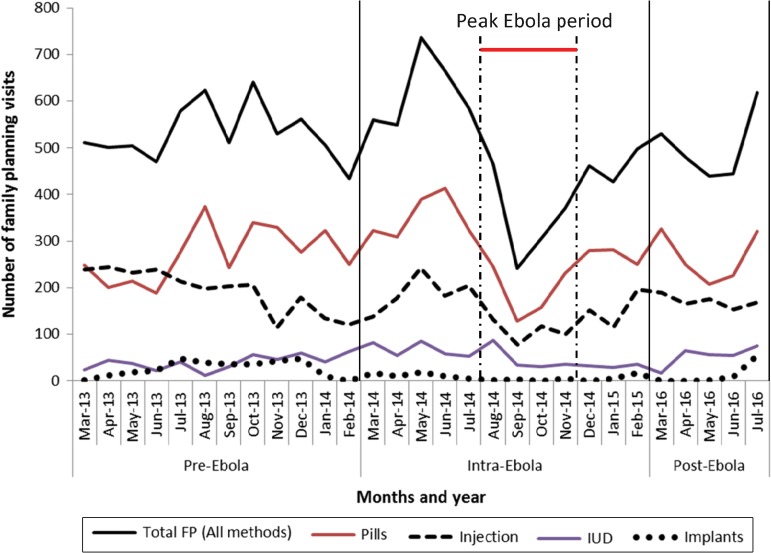
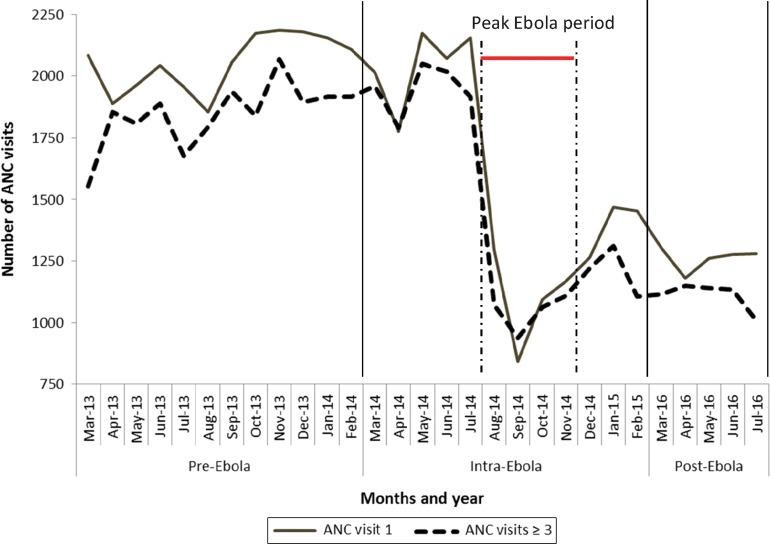
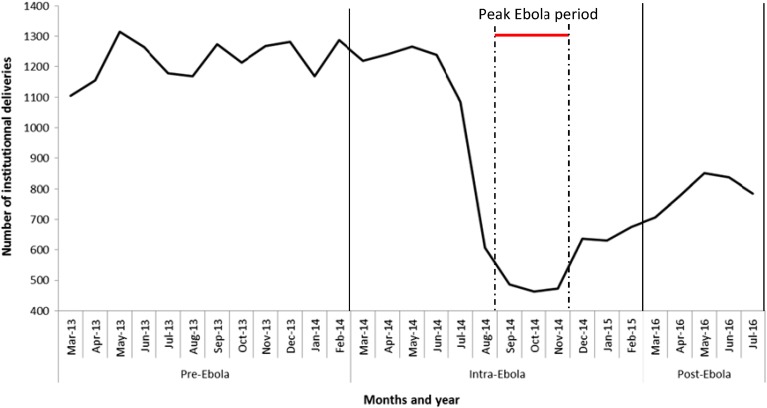
Utilization of family planning declined from a monthly average of 531 visits during the pre-Ebola period to 242 visits in the peak month of the Ebola outbreak (51% decline) but recovered in the post-Ebola period. From a monthly average of 2053 visits pre-Ebola, antenatal care visits declined by 41% during Ebola and then recovered to only 63% of the pre-Ebola level (recovery gap of 37%, p<0.001). From a monthly average of 1223 deliveries pre-Ebola, institutional deliveries also declined during Ebola and then recovered to only 66% of the pre-Ebola level (p<0.001).
All services assessed were affected by Ebola. Family planning recovered post-Ebola; however, shortfalls were observed in recovery of antenatal care and institutional deliveries. We call for stronger political will, international support and generous funding to change the current state of affairs.
2014/2015年埃博拉疫情是历史上持续时间最长的一次。在几内亚,我们比较了疫情爆发前、期间和之后计划生育、产前护理和机构分娩的趋势。
我们开展了一项生态研究,涉及马森塔地区埃博拉疫情前(2013年3月1日至2014年2月28日)、埃博拉疫情期间(2014年3月1日至2015年2月28日)和埃博拉疫情后(2016年3月1日至7月31日)所有的医疗机构。
计划生育的利用率从埃博拉疫情前的月均531次就诊降至埃博拉疫情高峰期的242次就诊(下降51%),但在埃博拉疫情后有所恢复。产前护理就诊次数从埃博拉疫情前的月均2053次在疫情期间下降了41%,然后仅恢复到埃博拉疫情前水平的63%(恢复差距为37%,p<0.001)。机构分娩次数从埃博拉疫情前的月均1223次在疫情期间也有所下降,然后仅恢复到埃博拉疫情前水平的66%(p<0.001)。
所有评估的服务都受到了埃博拉的影响。计划生育在埃博拉疫情后有所恢复;然而,产前护理和机构分娩的恢复存在不足。我们呼吁拿出更强的政治意愿、国际支持和慷慨资助来改变当前的状况。