Department of Public Health, Gamal University of Conakry, Conakry, Guinea; Centre national de formation et de recherche en santé rurale de Maferinyah, Forécariah, Guinea; Woman and Child Health Research Centre, Institute of Tropical Medicine, Antwerp, Belgium.
University of California, Bixby Center for Global Reproductive Health, San Francisco, CA, USA.
Lancet Glob Health. 2017 Apr;5(4):e448-e457. doi: 10.1016/S2214-109X(17)30078-5. Epub 2017 Feb 23.
The 2014 west African epidemic of Ebola virus disease posed a major threat to the health systems of the countries affected. We sought to quantify the consequences of Ebola virus disease on maternal and child health services in the highly-affected Forest region of Guinea.
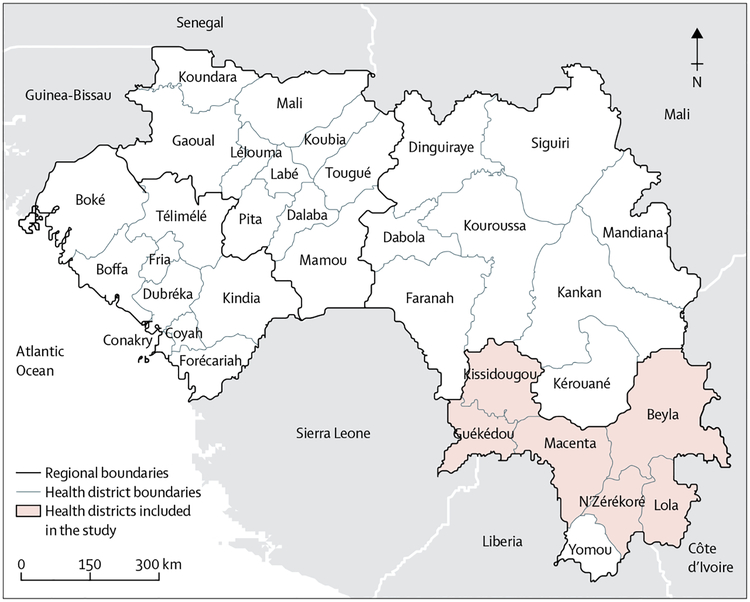
We did a retrospective, observational cohort study of women and children attending public health facilities for antenatal care, institutional delivery, and immunisation services in six of seven health districts in the Forest region (Beyla, Guéckédou, Kissidougou, Lola, Macenta, and N'Zérékoré). We examined monthly service use data for eight maternal and child health services indicators: antenatal care (≥1 antenatal care visit and ≥3 antenatal care visits), institutional delivery, and receipt of five infant vaccines: polio, pentavalent (diphtheria, tetanus, pertussis, hepatitis B virus, and Haemophilus influenzae type b), yellow fever, measles, and tuberculosis. We used interrupted time series models to estimate trends in each indicator across three time periods: pre-Ebola virus disease epidemic (January, 2013, to February, 2014), during-epidemic (March, 2014, to February, 2015) and post-epidemic (March, 2015, to Feb, 2016). We used segmented ordinary least-squares (OLS) regression using Newey-West standard errors to accommodate for serial autocorrelation, and adjusted for any potential effect of birth seasonality on our outcomes.
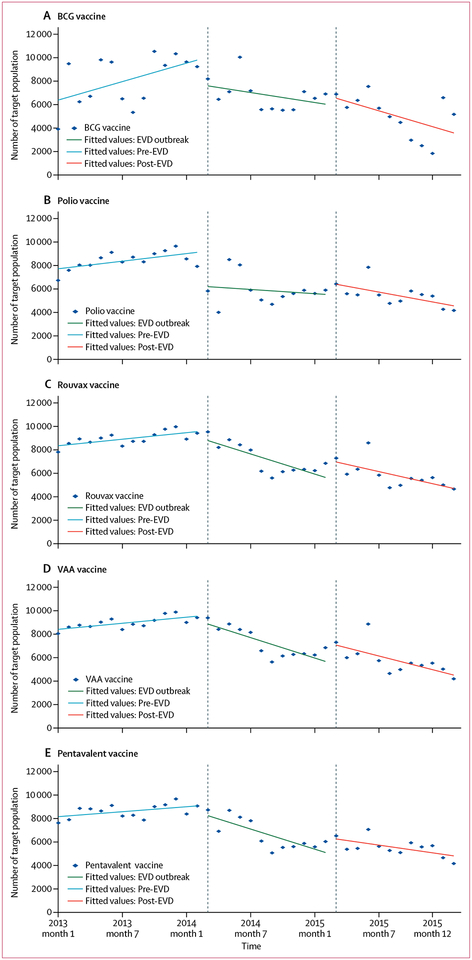
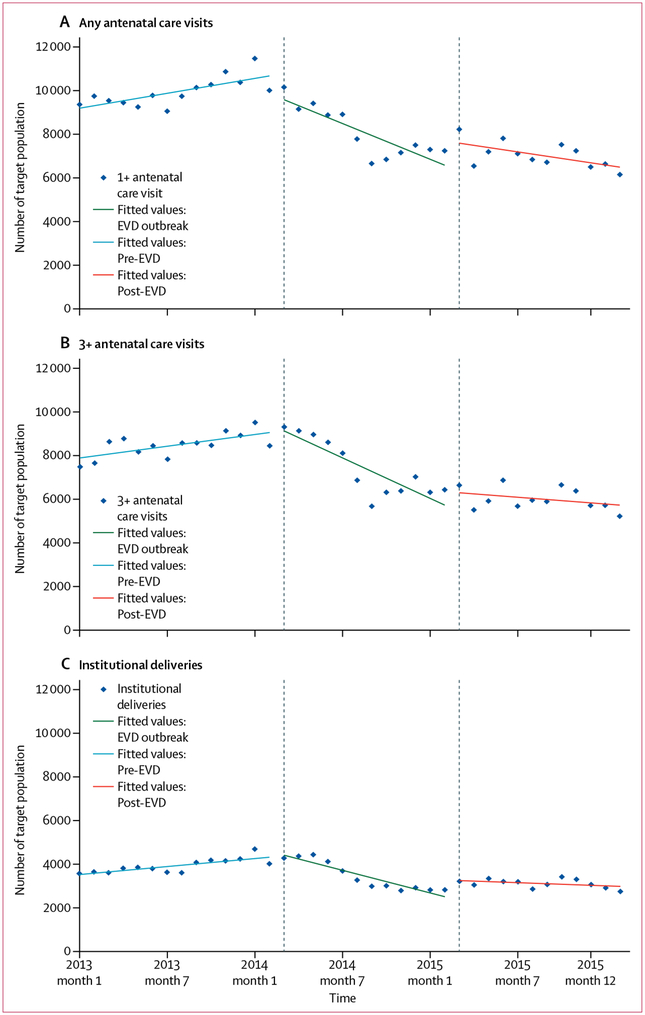
In the months before the Ebola virus disease outbreak, all three maternal indicators showed a significantly positive change in trend, ranging from a monthly average increase of 61 (95% CI 38-84) institutional deliveries to 119 (95% CI 79-158) women achieving at least three antenatal care visits. These increasing trends were reversed during the epidemic: fewer institutional deliveries occurred (-240, 95% CI -293 to -187), and fewer women achieved at least one antenatal care visit (-418, 95% CI -535 to -300) or at least three antenatal care visits (-363, 95% CI -485 to -242) per month (p<0·0001 for all). Compared with the negative trend during the outbreak, the change in trend during the post-outbreak period showed that 173 more women per month (95% CI 51-294; p=0·0074) had at least one antenatal care visit, 257 more (95% CI 117-398; p=0·0010) had at least three antenatal care visits and 149 more (95% CI 91-206; p<0·0001) had institutional deliveries. However, although the numbers for these indicators increased in the post-epidemic period, the trends for all stagnated. Similarly, the increasing trend in child vaccination completion during the pre-epidemic period was followed by significant immediate and trend reductions across most vaccine types. Before the outbreak, the number of children younger than 12 months who had completed each vaccination ranged from 5752 (95% CI 2821-8682) for tuberculosis to 8043 (95% CI 7621-8464) for yellow fever. Immediately after the outbreak, significant reductions occurred in the level of all vaccinations except for yellow fever for which the reduction was marginal. The greatest reductions were noted for polio and tuberculosis at -3594 (95% CI -4811 to -2377; p<0·0001) and -3048 (95% CI -5879 to -216; p=0·0362) fewer vaccines administered, respectively. Compared with pre-Ebola virus disease outbreak trends, significant decreases occurred for all vaccines except polio, with the trend of monthly decreases in the number of children vaccinated ranging from -419 (95% CI -683 to -155; p=0·0034) fewer for BCG to -313 (95% CI-446 to -179; p<0·0001) fewer for pentavalent during the outbreak. In the post-Ebola virus disease outbreak period, vaccination coverage for polio, measles, and yellow fever continued to decrease, whereas the trend in coverage for tuberculosis and pentavalent did not significantly differ from zero.
Most maternal and child health indicators significantly declined during the Ebola virus disease outbreak in 2014. Despite a reduction in this negative trend in the post-outbreak period, the use of essential maternal and child health services have not recovered to their pre-outbreak levels, nor are they all on a course that suggests that they will recover without targeted interventions.
University of Conakry and Centre National de Formation et Recherche de Maferinyah (Guinea).
2014 年西非埃博拉病毒病疫情对受影响国家的卫生系统构成了重大威胁。我们旨在量化埃博拉病毒病对几内亚森林地区妇幼保健服务的影响。
我们对六个卫生区(Beyla、Guéckédou、Kissidougou、Lola、Macenta 和 N'Zérékoré)的公共卫生机构进行了回顾性、观察性队列研究,这些机构提供产前护理、机构分娩和免疫服务。我们检查了 8 项妇幼保健服务指标的每月服务使用数据:产前护理(≥1 次产前护理就诊和≥3 次产前护理就诊)、机构分娩和接种五种婴儿疫苗:脊髓灰质炎、五联疫苗(白喉、破伤风、百日咳、乙型肝炎病毒和流感嗜血杆菌 b 型)、黄热病、麻疹和结核病。我们使用中断时间序列模型来估计三个时期内每个指标的趋势:埃博拉病毒病流行前(2013 年 1 月至 2014 年 2 月)、流行期间(2014 年 3 月至 2015 年 2 月)和流行后(2015 年 3 月至 2016 年 2 月)。我们使用新威豪特(Newey-West)标准误差的分段最小二乘法(OLS)回归来适应序列自相关,并调整了出生季节性对我们结果的潜在影响。
在埃博拉病毒病爆发前的几个月里,所有三项产妇指标的趋势都出现了明显的正向变化,每月平均机构分娩增加了 61(95%CI 38-84),至少有三次产前护理就诊的妇女增加了 119(95%CI 79-158)。这些上升趋势在疫情期间发生逆转:机构分娩减少了 240(95%CI 293 至 187),每月至少有一次产前护理就诊的妇女减少了 418(95%CI 535 至 300),至少有三次产前护理就诊的妇女减少了 363(95%CI 485 至 242)(所有 P 值均<0.0001)。与疫情期间的负面趋势相比,疫情后时期的变化趋势显示,每月有 173 名妇女(95%CI 51-294;P=0.0074)至少有一次产前护理就诊,257 名妇女(95%CI 117-398;P=0.010)至少有三次产前护理就诊,149 名妇女(95%CI 91-206;P<0.0001)进行了机构分娩。然而,尽管这些指标在疫情后时期有所增加,但趋势都停滞不前。同样,疫情前儿童疫苗接种完成率的上升趋势随后是大多数疫苗类型的显著即时和趋势性下降。在疫情爆发前,每个月完成结核病接种的 12 个月以下儿童人数从 5752(95%CI 2821-8682)到黄热病的 8043(95%CI 7621-8464)不等。疫情爆发后,除了黄热病外,所有疫苗接种水平都显著下降,而黄热病的降幅则微不足道。注意到最大的降幅发生在脊髓灰质炎和结核病疫苗接种方面,分别减少了 3594(95%CI 4811 至 2377;P<0.0001)和 3048(95%CI 5879 至 216;P=0.0362)。与埃博拉病毒病疫情爆发前的趋势相比,除脊髓灰质炎外,所有疫苗的接种人数都有所减少,每月接种儿童人数的下降趋势范围从 BCG 减少 419(95%CI 683 至 155;P=0.0034)到五联疫苗减少 313(95%CI 446 至 179;P<0.0001)。在埃博拉病毒病疫情爆发后时期,脊髓灰质炎、麻疹和黄热病的疫苗接种覆盖率继续下降,而结核病和五联疫苗的覆盖率趋势与零没有显著差异。
2014 年埃博拉病毒病疫情期间,大多数母婴健康指标显著下降。尽管疫情后期间这一负面趋势有所减少,但基本母婴保健服务的使用并未恢复到疫情前的水平,而且它们都没有恢复的趋势,这表明如果没有有针对性的干预措施,它们将无法恢复。
科纳克里大学和 Maferinyah 国家培训和研究中心(几内亚)。