Flaherty Renée L, Owen Matthew, Fagan-Murphy Aidan, Intabli Haya, Healy David, Patel Anika, Allen Marcus C, Patel Bhavik A, Flint Melanie S
School of Pharmacy and Biomolecular Sciences, Stress, Aging and Disease Group, University of Brighton, Brighton, BN2 4GJ, UK.
Brighton and Sussex Medical School, Brighton, BN1 9PX, UK.
Breast Cancer Res. 2017 Mar 24;19(1):35. doi: 10.1186/s13058-017-0823-8.
Psychological stress increases the circulating levels of the stress hormones cortisol and norepinephrine (NE). Chronic exposure to elevated stress hormones has been linked to a reduced response to chemotherapy through induction of DNA damage. We hypothesize that stress hormone signalling may induce DNA damage through the production of reactive oxygen species (ROS)/reactive nitrogen species (RNS) and interference in DNA repair processes, promoting tumourigenesis.
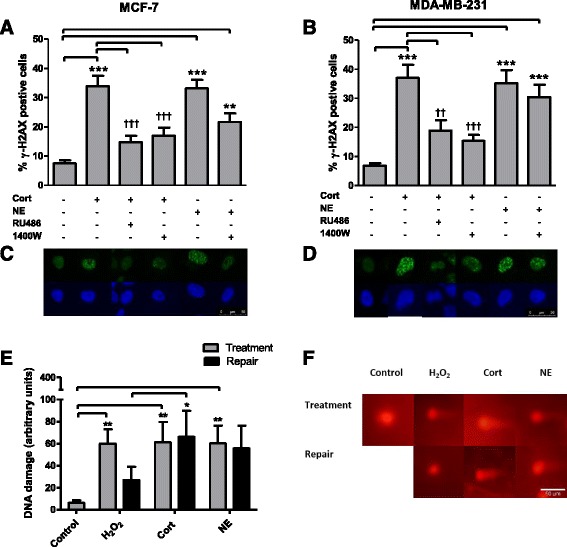
Breast cancer cell lines were incubated with physiological levels of cortisol and NE in the presence and absence of receptor antagonists and inducible nitric oxide synthase (iNOS) inhibitors and DNA damage measured using phosphorylated γ-H2AX. The rate of DNA repair was measured using comet assays and electrochemical sensors were used to detect ROS/RNS in the cell lysates from cells exposed to stress hormones. A syngeneic mouse model was used to assess the presence of iNOS in mammary tumours in stressed versus control animals and expression of iNOS was examined using western blotting and qRT-PCR.
Acute exposure to cortisol and NE significantly increased levels of ROS/RNS and DNA damage and this effect was diminished in the presence of receptor antagonists. Cortisol induced DNA damage and the production of RNS was further attenuated in the presence of an iNOS inhibitor. An increase in the expression of iNOS in response to psychological stress was observed in vivo and in cortisol-treated cells. Inhibition of glucocorticoid receptor-associated Src kinase also produced a decrease in cortisol-induced RNS.
These results demonstrate that glucocorticoids may interact with iNOS in a non-genomic manner to produce damaging levels of RNS, thus allowing an insight into the potential mechanisms by which psychological stress may impact breast cancer.
心理压力会增加应激激素皮质醇和去甲肾上腺素(NE)的循环水平。长期暴露于升高的应激激素与化疗反应降低有关,这是通过诱导DNA损伤实现的。我们假设应激激素信号传导可能通过产生活性氧(ROS)/活性氮(RNS)以及干扰DNA修复过程来诱导DNA损伤,从而促进肿瘤发生。
在存在和不存在受体拮抗剂以及诱导型一氧化氮合酶(iNOS)抑制剂的情况下,将乳腺癌细胞系与生理水平的皮质醇和NE一起孵育,并使用磷酸化γ-H2AX测量DNA损伤。使用彗星试验测量DNA修复率,并使用电化学传感器检测暴露于应激激素的细胞裂解物中的ROS/RNS。使用同基因小鼠模型评估应激动物与对照动物乳腺肿瘤中iNOS的存在情况,并使用蛋白质免疫印迹和定量逆转录-聚合酶链反应(qRT-PCR)检测iNOS的表达。
急性暴露于皮质醇和NE会显著增加ROS/RNS水平和DNA损伤,并且在存在受体拮抗剂的情况下这种效应会减弱。皮质醇诱导DNA损伤,并且在存在iNOS抑制剂的情况下RNS的产生会进一步减弱。在体内和皮质醇处理的细胞中观察到,响应心理压力iNOS的表达增加。抑制糖皮质激素受体相关的Src激酶也会使皮质醇诱导的RNS减少。
这些结果表明,糖皮质激素可能以非基因组方式与iNOS相互作用,产生具有损伤性水平的RNS,从而使我们能够深入了解心理压力可能影响乳腺癌的潜在机制。