Le Caroline P, Nowell Cameron J, Kim-Fuchs Corina, Botteri Edoardo, Hiller Jonathan G, Ismail Hilmy, Pimentel Matthew A, Chai Ming G, Karnezis Tara, Rotmensz Nicole, Renne Giuseppe, Gandini Sara, Pouton Colin W, Ferrari Davide, Möller Andreas, Stacker Steven A, Sloan Erica K
Drug Discovery Biology Theme, Monash Institute of Pharmaceutical Sciences, Monash University, Parkville, Victoria 3052, Australia.
Department of Visceral Surgery and Medicine, University Hospital Bern, 3010 Bern, Switzerland.
Nat Commun. 2016 Mar 1;7:10634. doi: 10.1038/ncomms10634.
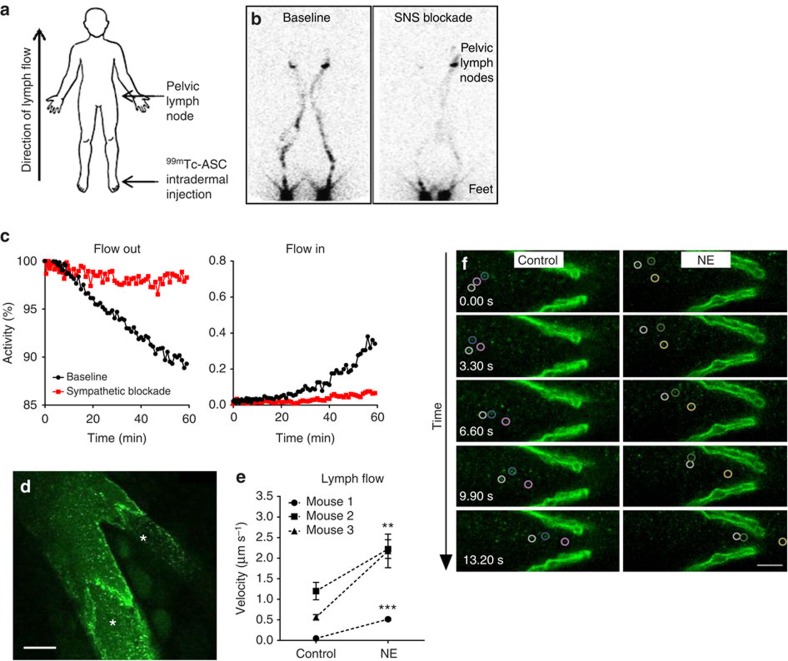
Chronic stress induces signalling from the sympathetic nervous system (SNS) and drives cancer progression, although the pathways of tumour cell dissemination are unclear. Here we show that chronic stress restructures lymphatic networks within and around tumours to provide pathways for tumour cell escape. We show that VEGFC derived from tumour cells is required for stress to induce lymphatic remodelling and that this depends on COX2 inflammatory signalling from macrophages. Pharmacological inhibition of SNS signalling blocks the effect of chronic stress on lymphatic remodelling in vivo and reduces lymphatic metastasis in preclinical cancer models and in patients with breast cancer. These findings reveal unanticipated communication between stress-induced neural signalling and inflammation, which regulates tumour lymphatic architecture and lymphogenous tumour cell dissemination. These findings suggest that limiting the effects of SNS signalling to prevent tumour cell dissemination through lymphatic routes may provide a strategy to improve cancer outcomes.
慢性应激会诱导交感神经系统(SNS)发出信号并推动癌症进展,尽管肿瘤细胞扩散的途径尚不清楚。在这里,我们表明慢性应激会重塑肿瘤内部和周围的淋巴网络,为肿瘤细胞逃逸提供途径。我们发现肿瘤细胞衍生的VEGFC是应激诱导淋巴重塑所必需的,并且这依赖于巨噬细胞的COX2炎症信号传导。SNS信号的药理学抑制可阻断慢性应激对体内淋巴重塑的影响,并减少临床前癌症模型和乳腺癌患者的淋巴转移。这些发现揭示了应激诱导的神经信号传导与炎症之间意想不到的相互作用,这种相互作用调节肿瘤淋巴结构和肿瘤细胞的淋巴源性扩散。这些发现表明,限制SNS信号传导的作用以防止肿瘤细胞通过淋巴途径扩散可能提供一种改善癌症治疗结果的策略。