Department of Orthopaedics and Traumatology, Bao-An District People's Hospital, Shenzhen, P.R. China.
Department of Orthopaedics & Traumatology, Li Ka Shing Institute of Health Sciences and Lui Che Woo Institute of Innovative Medicine, Faculty of Medicine, The Chinese University of Hong Kong, Prince of Wales Hospital, Shatin, Hong Kong SAR, P.R. China.
Sci Rep. 2017 Mar 24;7(1):409. doi: 10.1038/s41598-017-00466-4.
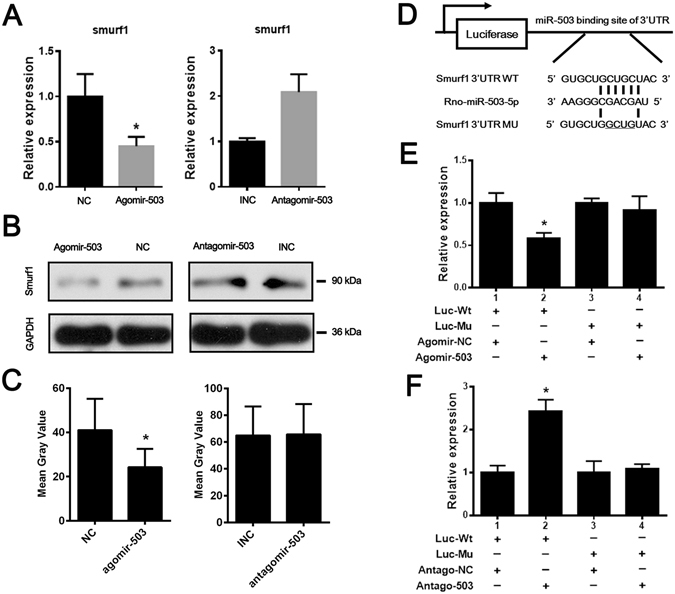
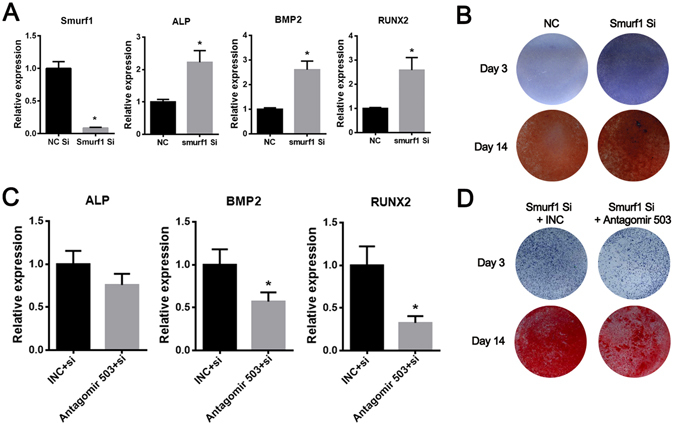
Distraction osteogenesis (DO) is a unique technique for promoting bone formation in clinical practice. However the underlying mechanism remains elusive. As epigenetic mediators, microRNAs have been reported to play important roles in regulating osteogenesis. In this study, after successfully established the DO model of rats, a microRNA microarray was performed to find molecular targets for DO. Total 100 microRNAs were identified as differently expressed, with miR-503 being one of the most significantly up-regulated miRNAs in DO. The further investigation also showed that miR-503 was upregulated during osteogenesis in mesenchymal stem cells of rats, and overexpression of miR-503 significantly promoted osteogenesis in vitro and accelerated mineralization in DO process in vivo. By using bioinformatic investigations and luciferase activities, we successfully demonstrated that Smurf1, a negative regulator of osteogenesis, was a real target of miR-503. Furthermore, Smurf1 knockdown promoted osteogenesis and antagomir-503 abolished the promotive effect, suggesting that miR-503 mediated osteogenic differentiation via suppressing Smurf1 expression. To sum up, these findings indicated that miR-503 promoted osteogenesis and accelerated bone formation, which may shed light on the development for a potential therapeutic target for bone repair.
牵张成骨术(DO)是一种在临床实践中促进骨形成的独特技术。然而,其潜在机制仍难以捉摸。作为表观遗传调节剂,microRNAs 已被报道在调节成骨中发挥重要作用。在这项研究中,成功建立了大鼠 DO 模型后,进行了 microRNA 微阵列分析,以寻找 DO 的分子靶标。共鉴定出 100 个差异表达的 microRNAs,其中 miR-503 是 DO 中上调最显著的 microRNAs 之一。进一步的研究还表明,miR-503 在大鼠间充质干细胞成骨过程中上调,过表达 miR-503 可显著促进体外成骨,并加速 DO 过程中的矿化。通过生物信息学研究和荧光素酶活性,我们成功证明了 Smurf1,一种成骨的负调节剂,是 miR-503 的真正靶标。此外,Smurf1 的敲低促进了成骨,而 antagomir-503 则消除了促进作用,表明 miR-503 通过抑制 Smurf1 的表达来介导成骨分化。总之,这些发现表明 miR-503 促进成骨和加速骨形成,这可能为骨修复的潜在治疗靶点的开发提供了思路。