Chen Xiaobing, Zhang Jianzheng, Wang Xiinling, Ren Jixin, Liu Zhi
Institute of Orthopaedics, Chinese PLA, Beijing Army General Hospital, Beijing, China (mainland).
Med Sci Monit. 2017 Mar 26;23:1456-1463. doi: 10.12659/msm.899476.
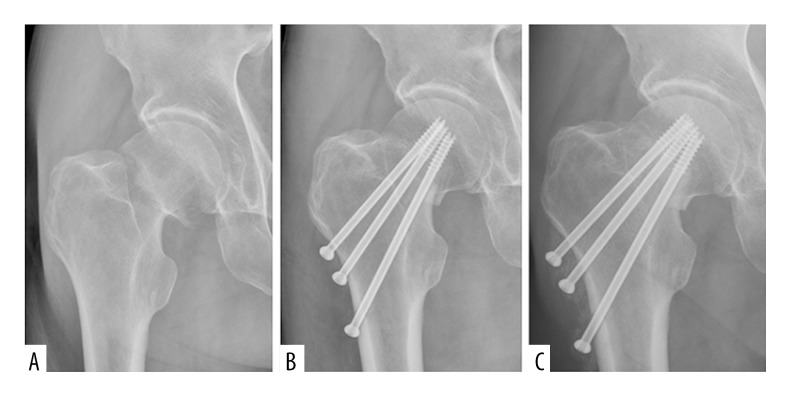
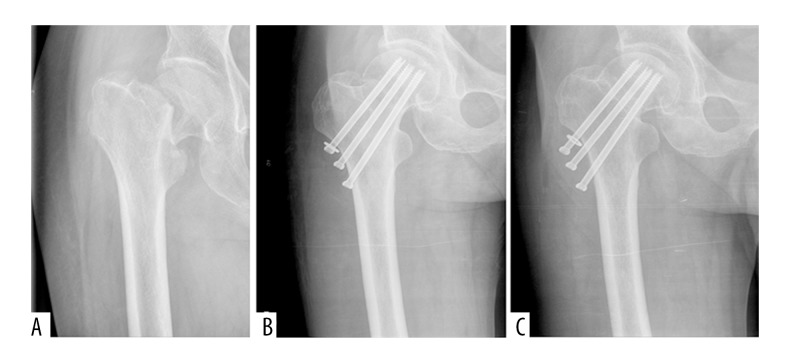
BACKGROUND To study the incidence of and factors influencing "neck shortening" in elderly patients treated for femoral neck fractures using multiple cancellous screws. MATERIAL AND METHODS Of the 197 femoral neck fracture cases treated via closed reduction and cancellous screws fixation from January 2006 to February 2010, 110 were followed up. Patient age, gender, operative time, implantation method, reduction quality, fracture type, bone mineral density, loading time, length of hospital stay, and Harris hip score 12 months after operation were recorded. The patients were divided into two groups (shortening and non-shortening) based on their X-ray performance during follow-up. The healing rates and Harris hip scores of the two groups were compared, and the influencing factors of femoral neck shortening were analyzed. RESULTS Of the 110 cases followed up, 94.5% (104/110) were healed and neck shortening occurred in 41.8% (46/110) within 12.5 months (mean) after treatment. The Harris hip score of the shortening group was lower than that of the non-shortening group (78±17 vs. 86±23, p=0.048). The fracture healing rates of the two groups were not significantly different (p=0.068). The factors influencing neck shortening were significantly correlated with bone mineral density, patient age, gender, and type of fracture. CONCLUSIONS The incidence of neck shortening in elderly patients treated for femoral neck fracture using cancellous screws was high. Bone mineral density, patient age, gender, and type of fracture were the influencing factors of neck shortening.
研究采用多枚松质骨螺钉治疗老年股骨颈骨折患者中“颈部缩短”的发生率及影响因素。
2006年1月至2010年2月间,对197例采用闭合复位及松质骨螺钉内固定治疗的股骨颈骨折病例中的110例进行随访。记录患者年龄、性别、手术时间、植入方法、复位质量、骨折类型、骨密度、负重时间、住院时间及术后12个月的Harris髋关节评分。根据随访期间X线表现将患者分为两组(缩短组和未缩短组)。比较两组的愈合率及Harris髋关节评分,并分析股骨颈缩短的影响因素。
110例随访患者中,94.5%(104/110)愈合,41.8%(46/110)在治疗后平均12.5个月内出现颈部缩短。缩短组的Harris髋关节评分低于未缩短组(78±17 vs. 86±23,p = 0.048)。两组骨折愈合率无显著差异(p = 0.068)。影响颈部缩短的因素与骨密度、患者年龄、性别及骨折类型显著相关。
采用松质骨螺钉治疗老年股骨颈骨折患者颈部缩短的发生率较高。骨密度、患者年龄、性别及骨折类型是颈部缩短的影响因素。