Computer Aided Medical Procedures, Johns Hopkins University, Baltimore, MD, USA.
Laboratory for Computational Sensing and Robotics, Johns Hopkins University, Baltimore, MD, USA.
Int J Comput Assist Radiol Surg. 2017 Jun;12(6):901-910. doi: 10.1007/s11548-017-1564-y. Epub 2017 Mar 25.
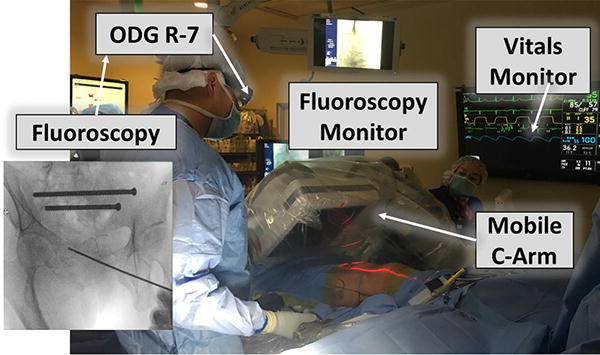
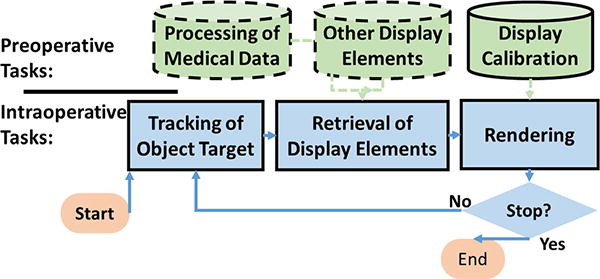
Optical see-through head-mounted displays (OST-HMD) feature an unhindered and instantaneous view of the surgery site and can enable a mixed reality experience for surgeons during procedures. In this paper, we present a systematic approach to identify the criteria for evaluation of OST-HMD technologies for specific clinical scenarios, which benefit from using an object-anchored 2D-display visualizing medical information.
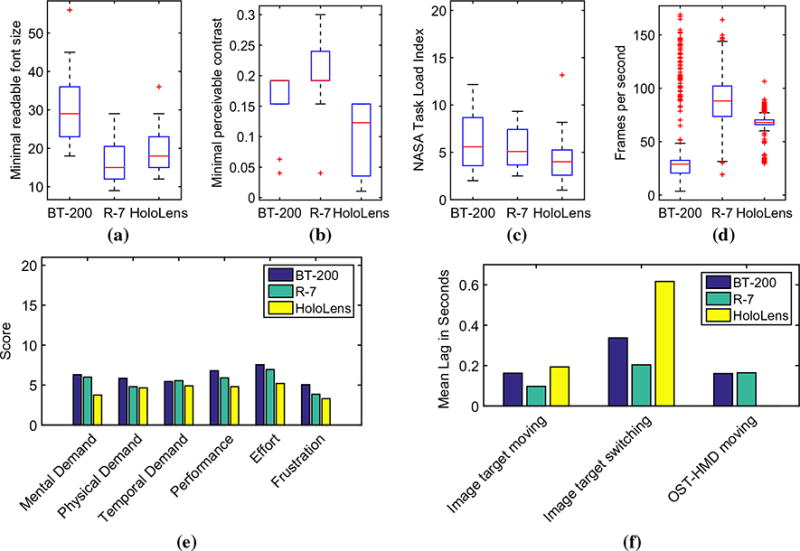
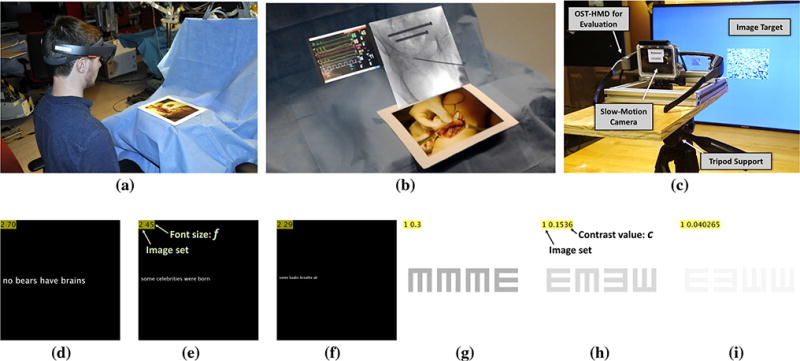
Criteria for evaluating the performance of OST-HMDs for visualization of medical information and its usage are identified and proposed. These include text readability, contrast perception, task load, frame rate, and system lag. We choose to compare three commercially available OST-HMDs, which are representatives of currently available head-mounted display technologies. A multi-user study and an offline experiment are conducted to evaluate their performance.
Statistical analysis demonstrates that Microsoft HoloLens performs best among the three tested OST-HMDs, in terms of contrast perception, task load, and frame rate, while ODG R-7 offers similar text readability. The integration of indoor localization and fiducial tracking on the HoloLens provides significantly less system lag in a relatively motionless scenario.
With ever more OST-HMDs appearing on the market, the proposed criteria could be used in the evaluation of their suitability for mixed reality surgical intervention. Currently, Microsoft HoloLens may be more suitable than ODG R-7 and Epson Moverio BT-200 for clinical usability in terms of the evaluated criteria. To the best of our knowledge, this is the first paper that presents a methodology and conducts experiments to evaluate and compare OST-HMDs for their use as object-anchored 2D-display during interventions.
光学穿透式头戴式显示器(OST-HMD)具有不受阻碍且即时的手术部位视图,可让外科医生在手术过程中体验混合现实。本文提出了一种系统方法来确定评估特定临床情况下 OST-HMD 技术的标准,这些标准受益于使用对象锚定的 2D 显示器来可视化医学信息。
确定并提出了用于评估 OST-HMD 用于可视化医学信息及其使用的性能的标准。这些标准包括文本可读性、对比度感知、任务负载、帧率和系统延迟。我们选择比较三种市售的 OST-HMD,它们代表了当前可用的头戴式显示技术。进行了多用户研究和离线实验来评估它们的性能。
统计分析表明,在测试的三种 OST-HMD 中,Microsoft HoloLens 在对比度感知、任务负载和帧率方面表现最佳,而 ODG R-7 提供了类似的文本可读性。HoloLens 上集成的室内定位和基准跟踪在相对静止的场景中提供了显著更低的系统延迟。
随着越来越多的 OST-HMD 出现在市场上,所提出的标准可用于评估它们在混合现实手术干预中的适用性。目前,就评估的标准而言,Microsoft HoloLens 可能比 ODG R-7 和 Epson Moverio BT-200 更适合临床使用。据我们所知,这是第一篇提出方法并进行实验评估和比较 OST-HMD 用于干预期间作为对象锚定的 2D 显示器的论文。