Hansen Laura W, Yang Weng Lang, Bolognese Alexandra C, Jacob Asha, Chen Tracy, Prince Jose M, Nicastro Jeffrey M, Coppa Gene F, Wang Ping
Department of Surgery, Hofstra Northwell School of Medicine, Manhasset, NY.
Department of Surgery, Hofstra Northwell School of Medicine, Manhasset, NY; Center for Immunology and Inflammation, The Feinstein Institute for Medical Research, Manhasset, NY.
Surgery. 2017 Aug;162(2):349-357. doi: 10.1016/j.surg.2017.02.006. Epub 2017 Mar 23.
Sepsis remains one of the leading causes of infant death worldwide. It is characterized by uncontrolled inflammatory responses due to proven bacterial infection. Despite improvement in supportive care and the availability of effective antibiotics, no specific therapy targeting the dysregulated inflammatory response is available for neonatal sepsis. Milk fat globule epidermal growth factor-factor 8 (MFG-E8) is a secretory glycoprotein abundantly present in human milk. MFG-E8 suppresses the systemic inflammatory responses in adult murine injury models by improving the clearance of dying cells. We hypothesized that exogenous administration of recombinant mouse MFG-E8 could inhibit the exaggerated inflammatory response and lung injury in a murine model of neonatal sepsis.
Neonatal sepsis was induced in 5- to 7-day-old male and female C57BL6 mice using an intraperitoneal injection of cecal slurry. At 1 hour after sepsis induction, a single dose of 40 μg/kg recombinant mouse MFG-E8 or vehicle was administered via retro-orbital injection. All neonates were returned to their mothers as a group. At 10 hours after cecal slurry injection, pups were killed and blood and lung tissues were collected. Control mice underwent a similar procedure with the exception of cecal slurry intraperitoneal injection.
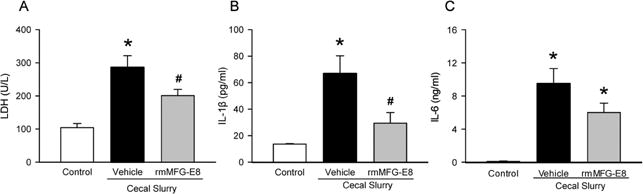
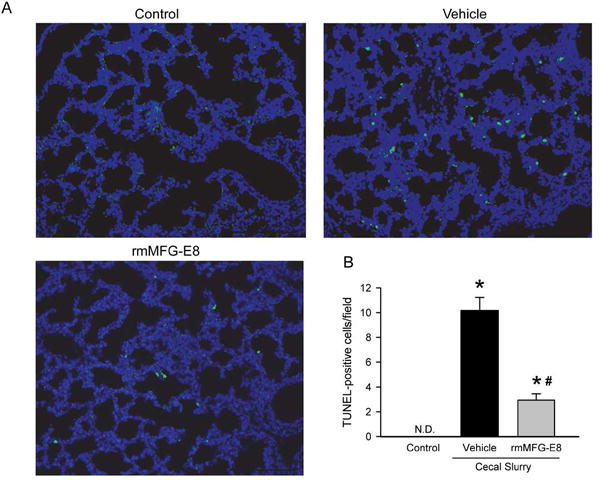
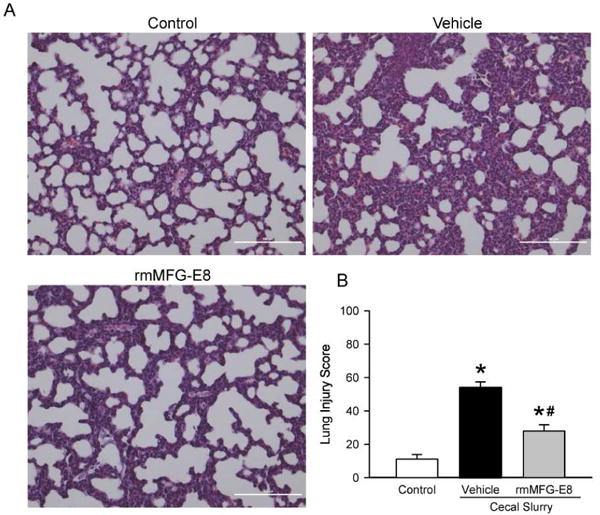
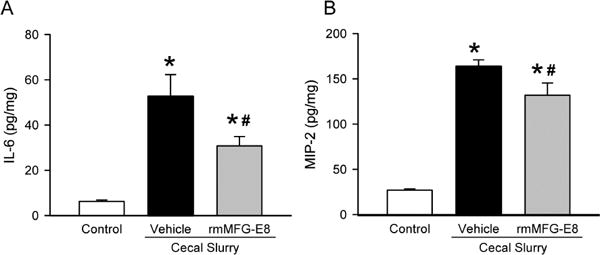
Serum lactate dehydrogenase, IL-1β, and IL-6 were significantly increased 10 hours after cecal slurry injection. Treatment with recombinant mouse MFG-E8 decreased these levels by 30%, 56%, and 37%, respectively. Lung morphology was significantly compromised in the vehicle group after cecal slurry injection, whereas the recombinant mouse MFG-E8-treated groups demonstrated a 48% improvement in the lung injury score. Lung IL-6 and MIP-2 protein levels were significantly reduced with recombinant mouse MFG-E8 treatment. Lung neutrophil infiltration as observed by Gr-1 staining and, TUNEL-positive cells were also significantly reduced with recombinant mouse MFG-E8 treatment.
Treatment with recombinant mouse MFG-E8 attenuated inflammation and lung injury in murine neonatal sepsis. Thus, MFG-E8 could be developed as a possible therapy for neonatal sepsis.
脓毒症仍然是全球婴儿死亡的主要原因之一。其特征是由于已证实的细菌感染导致不受控制的炎症反应。尽管支持治疗有所改善且有有效的抗生素可用,但针对新生儿脓毒症失调的炎症反应尚无特异性治疗方法。乳脂肪球表皮生长因子8(MFG-E8)是一种分泌性糖蛋白,大量存在于人乳中。MFG-E8通过改善死亡细胞的清除来抑制成年小鼠损伤模型中的全身炎症反应。我们假设外源性给予重组小鼠MFG-E8可以抑制新生儿脓毒症小鼠模型中过度的炎症反应和肺损伤。
通过腹腔注射盲肠匀浆在5至7日龄的雄性和雌性C57BL6小鼠中诱导新生儿脓毒症。在脓毒症诱导后1小时,通过眶后注射给予单剂量40μg/kg重组小鼠MFG-E8或赋形剂。所有新生儿作为一组返回其母亲身边。在盲肠匀浆注射后10小时,处死幼崽并收集血液和肺组织。对照小鼠除腹腔注射盲肠匀浆外,进行类似的操作。
盲肠匀浆注射后10小时,血清乳酸脱氢酶、IL-1β和IL-6显著升高。重组小鼠MFG-E8治疗使这些水平分别降低了30%、56%和37%。盲肠匀浆注射后,赋形剂组的肺形态受到显著损害,而重组小鼠MFG-E8治疗组的肺损伤评分改善了48%。重组小鼠MFG-E8治疗显著降低了肺IL-6和MIP-2蛋白水平。通过Gr-1染色观察到的肺中性粒细胞浸润以及TUNEL阳性细胞也因重组小鼠MFG-E8治疗而显著减少。
重组小鼠MFG-E8治疗减轻了小鼠新生儿脓毒症中的炎症和肺损伤。因此,MFG-E8可开发为新生儿脓毒症的一种可能治疗方法。