Jyotishi Manya, Fein Deborah, Naigles Letitia
Department of Psychological Sciences, University of Connecticut Storrs, CT, USA.
Front Psychol. 2017 Mar 10;8:319. doi: 10.3389/fpsyg.2017.00319. eCollection 2017.
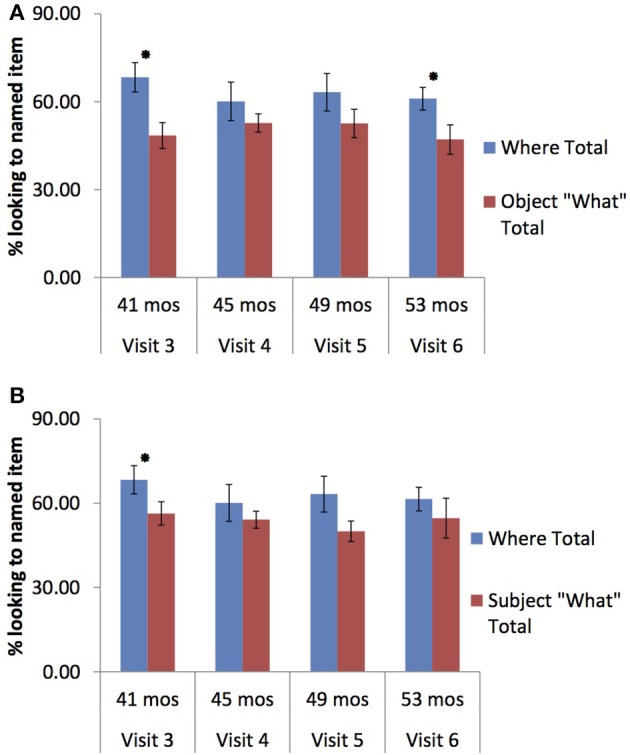
Compared to typically developing children, children with autism (ASD) show delayed production of wh-questions. It is currently controversial the degree to which such deficits derive from social-pragmatic requirements and/or because these are complex grammatical structures. The current study employed the intermodal preferential looking (IPL) paradigm, which reduces social-pragmatic demands. The IPL paradigm can help distinguish these proposals, as successful comprehension promotes the "pragmatics-origins" argument whereas comprehension difficulties would implicate a "grammatical-origins" argument. Additionally, we tested both the linguistic and social explanations by assessing the contributions of children's early grammatical knowledge (i.e., SVO word order) and their social-pragmatic scores on the Vineland to their later wh-question comprehension. Fourteen children with ASD and 17 TD children, matched on language level, were visited in their homes at 4-month intervals. Comprehension of wh-questions and SVO word order were tested via IPL: the wh-question video showed a costumed horse and bird serving as agents or patients of familiar transitive actions. During the test trials, they were displayed side by side with directing audios (e.g., "What did the horse tickle?", "What hugged the bird?", "Where is the horse/bird?"). Children's eye movements were coded offline; the DV was their percent looking to the named item during test. To show comprehension, children should look longer at the named item during a where-question than during a subject-wh or object-wh question. Results indicated that TD children comprehended both subject and object wh-questions at 32 months of age. Comprehension of object-wh questions emerged later in children with ASD compared to their TD peers, but at similar levels of . Moreover, performance on word order and social-pragmatic scores independently predicted both groups' later performance on wh-question comprehension. Our findings indicate that both grammar and social-pragmatics are implicated in the comprehension of wh-questions. The "grammatical-origins" argument is supported because the ASD group did not reveal earlier and stable comprehension of wh-questions; furthermore, their performance on SVO word order predicted their later success in linguistic processing of wh-questions. The "pragmatic-origins" argument is also supported because children's earlier socialization and communication scores strongly predicted their successful performance on wh-question comprehension.
与发育正常的儿童相比,患有自闭症(ASD)的儿童在特殊疑问句的产出上表现出延迟。目前存在争议的是,这些缺陷在多大程度上源于社会语用要求和/或因为这些是复杂的语法结构。本研究采用了跨通道优先注视(IPL)范式,该范式减少了社会语用需求。IPL范式有助于区分这些观点,因为成功的理解支持“语用起源”论点,而理解困难则意味着“语法起源”论点。此外,我们通过评估儿童早期语法知识(即主谓宾语序)的贡献以及他们在《温兰德社会适应量表》上的社会语用得分对其后来特殊疑问句理解的影响,来检验语言和社会两种解释。14名患有自闭症的儿童和17名发育正常的儿童,在语言水平上进行了匹配,每隔4个月在他们家中进行回访。通过IPL测试对特殊疑问句和主谓宾语序的理解:特殊疑问句视频展示了一匹穿着戏服的马和一只鸟,它们分别作为熟悉的及物动作的施事者或受事者。在测试试验中,它们与指示音频(例如,“马挠了什么?”,“什么拥抱了鸟?”,“马/鸟在哪里?”)并排展示。儿童的眼动在离线状态下进行编码;因变量是他们在测试期间看向被命名项目的百分比。为了表明理解情况,儿童在回答“在哪里”的问题时,看向被命名项目的时间应该比回答主语特殊疑问句或宾语特殊疑问句时更长。结果表明,发育正常的儿童在32个月大时就能理解主语和宾语特殊疑问句。与发育正常的同龄人相比,患有自闭症的儿童对宾语特殊疑问句的理解出现得较晚,但程度相似。此外,语序表现和社会语用得分独立预测了两组儿童后来在特殊疑问句理解方面的表现。我们的研究结果表明,语法和社会语用都与特殊疑问句的理解有关。“语法起源”论点得到了支持,因为自闭症组没有表现出对特殊疑问句更早且稳定的理解;此外,他们在主谓宾语序上的表现预测了他们后来在特殊疑问句语言处理方面的成功。“语用起源”论点也得到了支持,因为儿童早期的社交和沟通得分强烈预测了他们在特殊疑问句理解方面的成功表现。