Goyal Uma, Pan Junhan, Cui Haiyan, Stea Baldassarre
Department of Radiation Oncology, University of Arizona, Tucson, AZ.
Division of Biostatistics, University of Arizona Cancer Center, Tucson, AZ, USA.
J Contemp Brachytherapy. 2017 Feb;9(1):14-19. doi: 10.5114/jcb.2017.65476. Epub 2017 Jan 26.
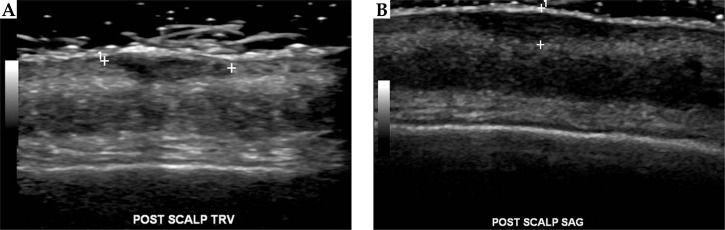
Electronic brachytherapy (eBT) is a form of contact radiation therapy used for thin superficial non-melanomatous skin cancers (NMSCs). An accurate measurement of diameter and depth is important for eBT treatment planning. Therefore, we compared clinical measurements by an experienced physician to measurements obtained using ultrasound (US), an objective imaging modality, in order to determine if clinical measurements were accurate enough for adequate NMSC treatment.
Eighteen patients with 20 biopsy-proven NMSCs first had a clinical examination and then an US evaluation prior to starting eBT. One physician provided a clinical measurement for diameter and depth based on physical examination during radiation oncology consultation. The patients then had an US evaluation with a 14 or 18 MHz US unit, to determine both the diameter and depth measurements; eBT dose prescription was done using the US derived measurements. The clinical measurements and US measurements were compared using a -test.
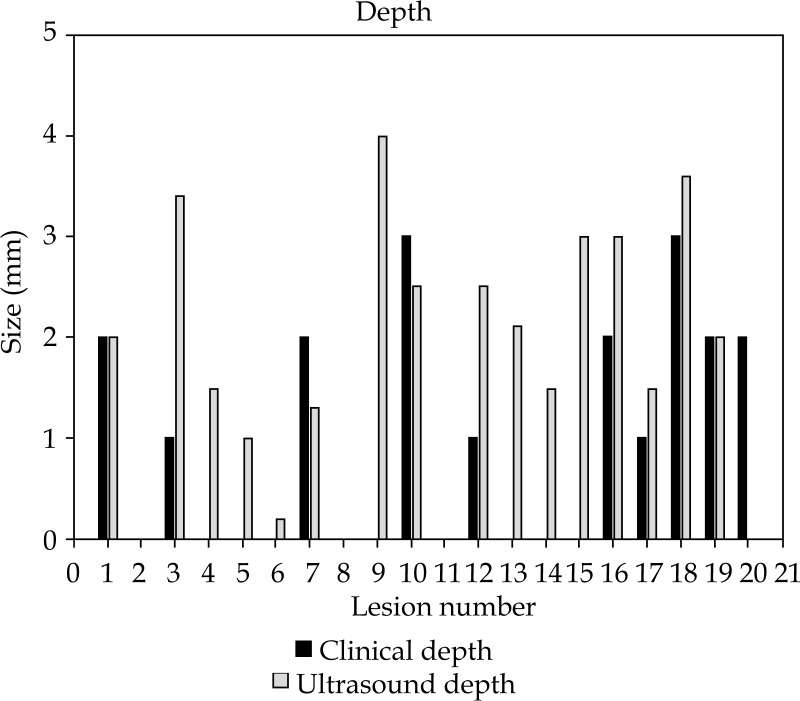
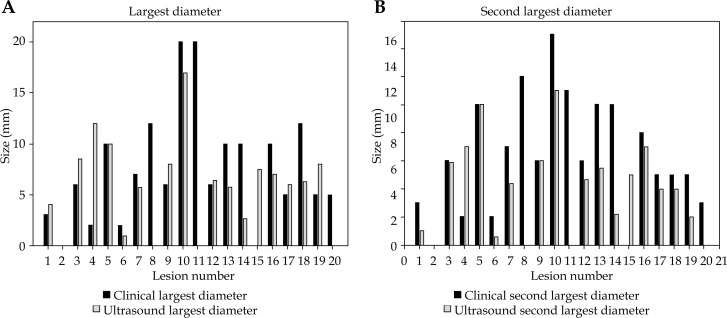
Seventeen lesions were basal cell carcinoma and 3 lesions were squamous cell carcinoma. The most common location was the nose (10 lesions). The difference between the clinical and the US derived measurements for the second largest diameter was found to be statistically significant ( = 0.03), while the difference for the largest diameter of the lesions was not ( = 0.24). More importantly, the depth measurements obtained with US were also found to be significantly different from the clinical estimates ( = 0.02). All patients have had a complete response to therapy with a median follow-up of 24 months.
Statistically different measurements were obtained in 2 of 3 parameters used in choosing applicator size and prescription depth using an US assessment. The data presented suggests that US is a more objective modality than clinical judgment for determining superficial NMSC diameter and prescription depth for personalized eBT planning.
电子近距离放射治疗(eBT)是一种用于治疗浅表性非黑色素瘤皮肤癌(NMSC)的接触性放射治疗形式。准确测量直径和深度对于eBT治疗计划至关重要。因此,我们将经验丰富的医生进行的临床测量与使用超声(US)这种客观成像方式获得的测量结果进行比较,以确定临床测量对于充分治疗NMSC是否足够准确。
18例经活检证实患有20处NMSC的患者在开始eBT治疗前,首先进行了临床检查,然后进行了超声评估。一名医生在放射肿瘤学会诊期间基于体格检查提供了直径和深度的临床测量值。然后患者使用14或18MHz的超声设备进行超声评估,以确定直径和深度测量值;eBT剂量处方是根据超声得出的测量值进行的。使用t检验比较临床测量值和超声测量值。
17处病变为基底细胞癌,3处病变为鳞状细胞癌。最常见的部位是鼻子(10处病变)。发现临床测量值与超声得出的第二大直径测量值之间的差异具有统计学意义(P = 0.03),而病变最大直径的差异则无统计学意义(P = 0.24)。更重要的是,超声获得的深度测量值也被发现与临床估计值有显著差异(P = 0.02)。所有患者对治疗均有完全反应,中位随访时间为24个月。
在选择施源器尺寸和处方深度时使用的3个参数中,有2个通过超声评估获得的测量值在统计学上存在差异。所呈现的数据表明,在确定浅表NMSC直径和个性化eBT计划的处方深度方面,超声比临床判断是一种更客观的方式。