Marthin June Kehlet, Stevens Elizabeth Munkebjerg, Larsen Lars Allan, Christensen Søren Tvorup, Nielsen Kim Gjerum
Danish PCD & chILD Centre, CF Centre Copenhagen, Paediatric Pulmonary Service, Department of Paediatrics and Adolescent Medicine, Copenhagen University Hospital, Rigshospitalet, Blegdamsvej 9, Copenhagen, DK-2100 Denmark.
Wilhelm Johannsen Centre for Functional Genome Research, Department of Cellular and Molecular Medicine, University of Copenhagen, Blegdamsvej 3, DK-2200 Copenhagen, Denmark.
Cilia. 2017 Mar 23;6:3. doi: 10.1186/s13630-017-0049-5. eCollection 2017.
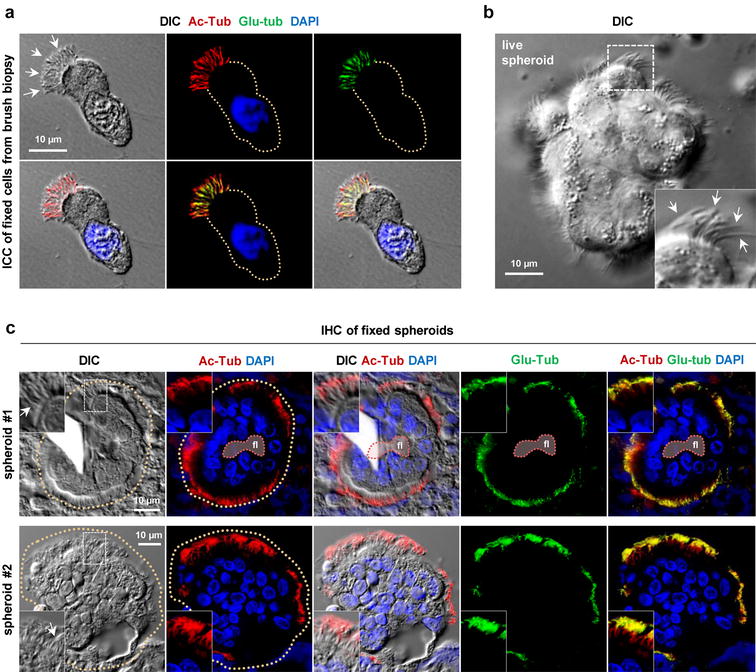
Three-dimensional explant spheroid formation is an ex vivo technique previously used in studies of airway epithelial ion and water transport. Explanted cells and sheets of nasal epithelium form fully differentiated spheroids enclosing a partly fluid-filled lumen with the ciliated apical surface facing the outside and accessible for analysis of ciliary function.
We performed a two-group comparison study of ciliary beat pattern and ciliary beat frequency in spheroids derived from nasal airway epithelium in patients with primary ciliary dyskinesia (PCD) and in healthy controls. Nasal ciliary cells and sheets were removed on day 1 by nasal brush biopsy and analyzed with regard to ciliary beat pattern-and frequency using high-speed video imaging for standard reference values. Three-dimensional explant spheroid formation was initiated in the same individual on the same day by incubation of cells and sheets from a separate brush biopsy. Harvested spheroids were analyzed earliest possible and values of spheroid ciliary beat pattern and frequency were compared to the corresponding reference values from day 1.
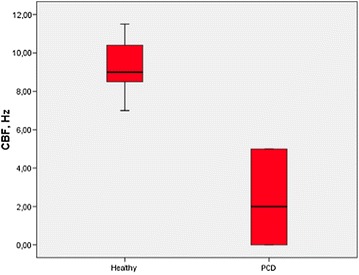
Spheroids formed fast in serum-free culture medium. Formation was successful in 15 out of 18 (82%) sampled individuals. Thus, formation was successful in seven healthy controls and eight PCD patients, while unsuccessful in 3 with PCD due to infection. Median (range) number of days in culture before harvesting of spheroids was 4 (1-5) in healthy versus 2 (1-5) in PCD. Spheroid ciliary beat pattern and frequency were unchanged compared to their corresponding day 1 standard reference values. Spheroid ciliary beat frequency discriminated highly significant between healthy controls (9.3 Hz) and PCD patients (2.4 Hz) ( < 0.0001). Survival of spheroids was 16 days in a single healthy person.
Patient-specific three-dimensional explant spheroid formation from a minimal invasive nasal brush biopsy is a feasible, fast and valid ex vivo method to assess ciliary function with potential of aiding the diagnosis of PCD. In addition, it may be a useful model in the investigation of pathophysiological aspects and drug effects in human nasal airway epithelium.
三维外植体球体形成是一种先前用于气道上皮离子和水转运研究的离体技术。鼻上皮细胞和片层形成完全分化的球体,包围着部分充满液体的管腔,纤毛顶端表面朝外,便于分析纤毛功能。
我们对原发性纤毛运动障碍(PCD)患者和健康对照者的鼻气道上皮来源的球体中的纤毛搏动模式和纤毛搏动频率进行了两组比较研究。在第1天通过鼻刷活检获取鼻纤毛细胞和片层,并使用高速视频成像分析纤毛搏动模式和频率,以获取标准参考值。在同一天,对来自同一人的另一次刷检所获得的细胞和片层进行培养,启动三维外植体球体形成。尽早对收获的球体进行分析,并将球体纤毛搏动模式和频率的值与第1天的相应参考值进行比较。
球体在无血清培养基中快速形成。18名采样个体中有15名(82%)成功形成。因此,7名健康对照者和8名PCD患者成功形成,3名PCD患者因感染未成功形成。健康组收获球体前的培养天数中位数(范围)为4(1 - 5)天,PCD组为2(1 - 5)天。与相应的第1天标准参考值相比,球体纤毛搏动模式和频率没有变化。健康对照者(9.3Hz)和PCD患者(2.4Hz)的球体纤毛搏动频率差异高度显著(<0.0001)。一名健康人的球体存活了16天。
通过微创鼻刷活检进行患者特异性三维外植体球体形成是一种可行、快速且有效的离体方法,可用于评估纤毛功能,有助于PCD的诊断。此外,它可能是研究人类鼻气道上皮病理生理方面和药物作用的有用模型。