UCL Great Ormond Street Institute of Child Health, London, UK.
D.D.H. Lee and D. Cardinale contributed equally.
Eur Respir J. 2021 Oct 14;58(4). doi: 10.1183/13993003.00455-2020. Print 2021 Oct.
Development of therapeutic approaches for rare respiratory diseases is hampered by the lack of systems that allow medium-to-high-throughput screening of fully differentiated respiratory epithelium from affected patients. This is a particular problem for primary ciliary dyskinesia (PCD), a rare genetic disease caused by mutations in genes that adversely affect ciliary movement and consequently mucociliary transport. Primary cell culture of basal epithelial cells from nasal brush biopsies followed by ciliated differentiation at the air-liquid interface (ALI) has proven to be a useful tool in PCD diagnostics but the technique's broader utility, including in pre-clinical PCD research, has been restricted by the limited number of basal cells that can be expanded from such biopsies.
We describe an immunofluorescence screening method, enabled by extensive expansion of basal cells from PCD patients and the directed differentiation of these cells into ciliated epithelium in miniaturised 96-well transwell format ALI cultures. As proof-of-principle, we performed a personalised investigation in a patient with a rare and severe form of PCD (reduced generation of motile cilia), in this case caused by a homozygous nonsense mutation in the gene.
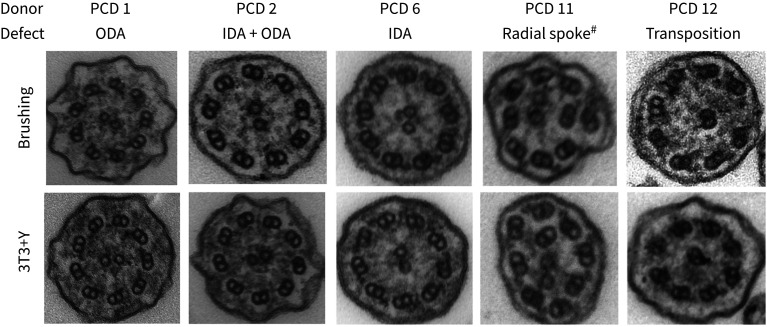
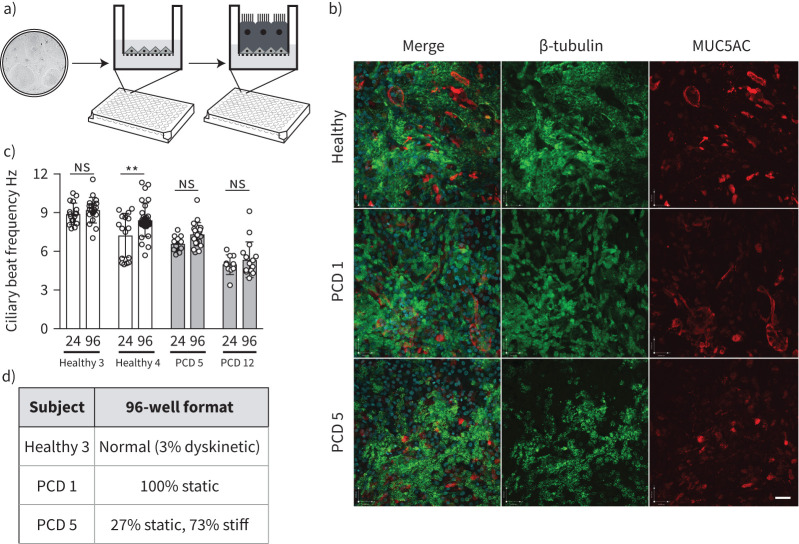
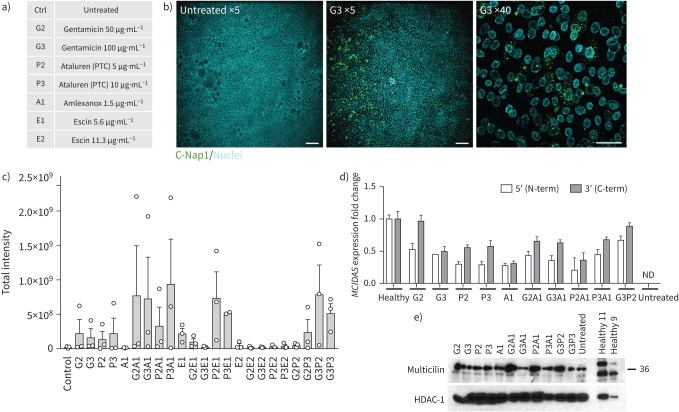
Initial analyses of ciliary ultrastructure, beat pattern and beat frequency in the 96-well transwell format ALI cultures indicate that a range of different PCD defects can be retained in these cultures. The screening system in our proof-of-principal investigation allowed drugs that induce translational readthrough to be evaluated alone or in combination with nonsense-mediated decay inhibitors. We observed restoration of basal body formation but not the generation of cilia in the patient's nasal epithelial cells CONCLUSION: Our study provides a platform for higher throughput analyses of airway epithelia that is applicable in a range of settings and suggests novel avenues for drug evaluation and development in PCD caused by nonsense mutations.
缺乏能够对来自受影响患者的完全分化的呼吸道上皮进行中高通量筛选的系统,这阻碍了治疗罕见呼吸道疾病方法的发展。这对于原发性纤毛运动障碍(PCD)来说是一个特别的问题,PCD 是一种由影响纤毛运动并因此影响黏液纤毛转运的基因突变为病因的罕见遗传性疾病。从鼻刷活检中进行基础上皮细胞的原代培养,然后在气液界面(ALI)进行纤毛分化,已被证明是 PCD 诊断的有用工具,但该技术的更广泛应用,包括在 PCD 的临床前研究中,受到可从此类活检中扩增的基础细胞数量有限的限制。
我们描述了一种免疫荧光筛选方法,该方法通过从 PCD 患者中广泛扩增基础细胞,并将这些细胞定向分化为微型 96 孔 Transwell 格式的 ALI 培养物中的纤毛上皮,从而得以实现。作为原理验证,我们对一例罕见且严重形式的 PCD(运动纤毛生成减少)患者进行了个性化研究,在这种情况下,该疾病是由 基因中的纯合无义突变引起的。
在 96 孔 Transwell 格式的 ALI 培养物中对纤毛超微结构、拍打模式和拍打频率的初步分析表明,这些培养物中可以保留各种不同的 PCD 缺陷。在我们的原理验证研究中,筛选系统允许单独或与无义介导的衰变抑制剂联合评估可诱导翻译通读的药物。我们观察到患者鼻上皮细胞中基底体形成得到恢复,但纤毛生成没有得到恢复。
我们的研究为可在多种环境中应用的气道上皮高通量分析提供了一个平台,并为由无义突变引起的 PCD 的药物评估和开发提供了新的途径。