Filipozzi Pierre, Ayav Carole, Ngueyon Sime Willy, Laurain Emmanuelle, Kessler Michèle, Brunaud Laurent, Frimat Luc
Department of Nephrology, University Hospital, Vandœuvre-lès-Nancy, France.
Néphrolor Network of Care, Vandœuvre-lès-Nancy, France.
BMJ Open. 2017 Mar 27;7(3):e011482. doi: 10.1136/bmjopen-2016-011482.
To define groups of patients according to the changes of biochemical parameters, that is, serum calcium, phosphate and parathyroid hormone (PTH), over a 2-year follow-up period using group-based multi-trajectory modeling (GBMM) among a cohort of dialysis patients with newly diagnosed secondary hyperparathyroidism (SHPT) (ie, PTH≥500 ng/L for the first time) and to compare their patient characteristics and treatments.
Pharmacoepidemiological study.
In the 12 dialysis units located in the French region of Lorraine.
A total of 269 dialysis patients with newly diagnosed SHPT were prospectively included from December 2009 to May 2012 and followed-up for 2 years.
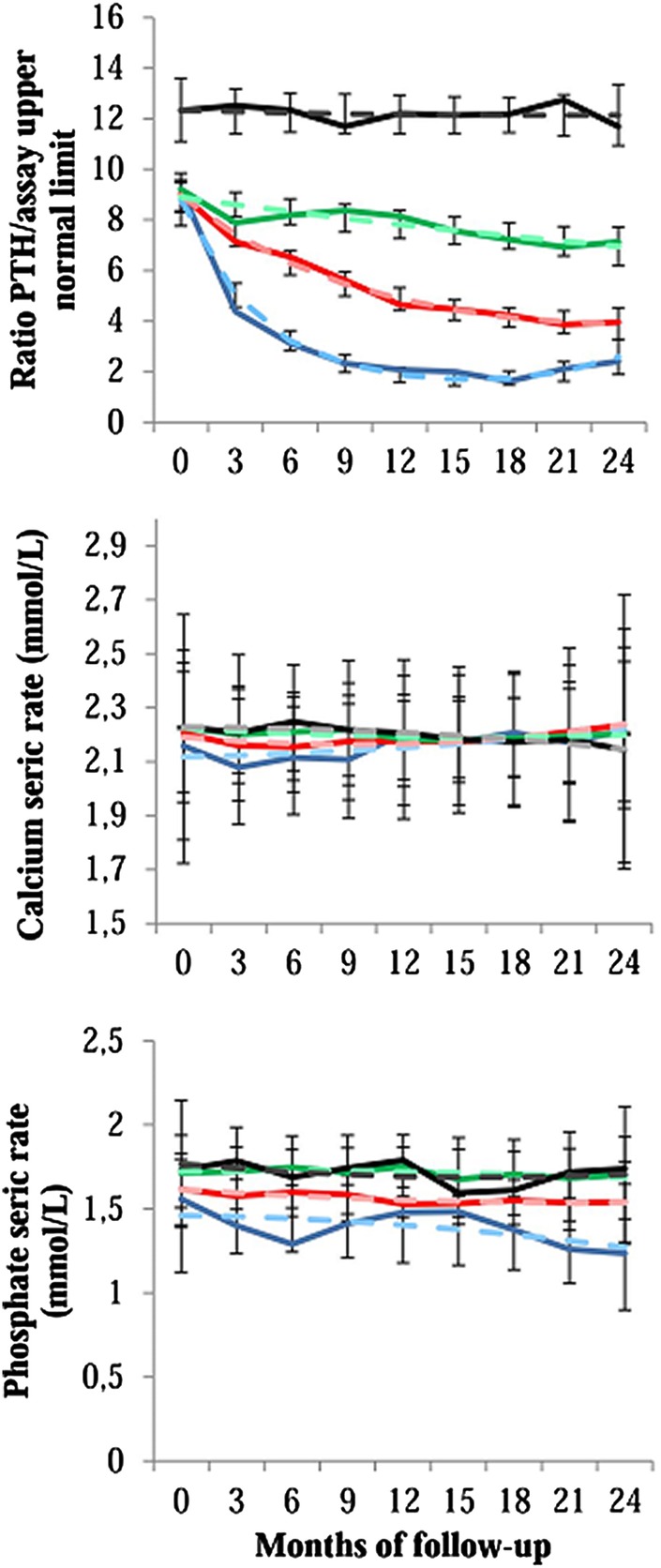
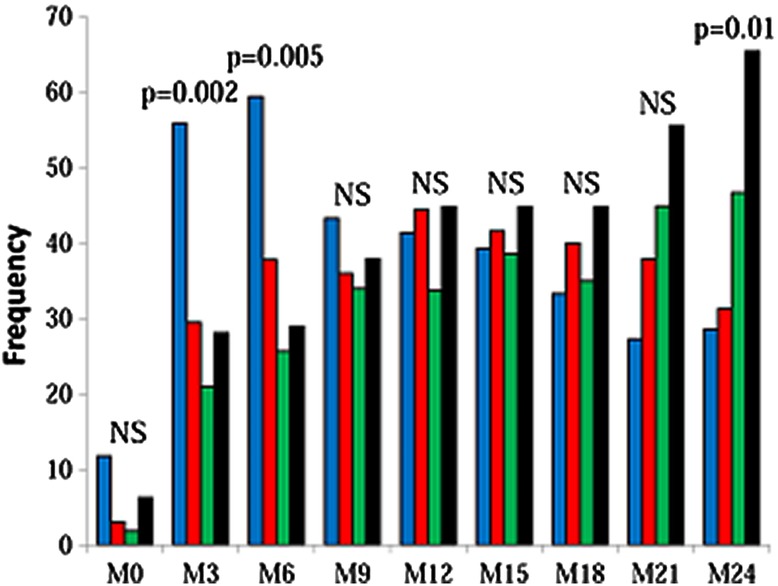
We identified four distinct trajectory groups: 'rapid PTH drop' experiencing a rapid and sharp decrease (over weeks) in PTH level associated with decreasing phosphate level within normal range (n=34; 12.7%), 'gradual PTH decrease' experiencing a gradual and continuous decrease (over months) in PTH level and maintaining phosphate at a middle level throughout the study (n=98; 36.4%), 'slow PTH decrease with high phosphate' experiencing a slow decrease in PTH level associated with a relatively high phosphate level (n=105; 39.0%) and 'uncontrolled SHPT' with high levels of PTH and phosphate throughout the study (n=32; 11.9%). Patients in the 'uncontrolled SHPT' group were significantly (p<0.00001) younger than patients in other groups. Kidney Disease Improving Global Outcomes (KDIGO) targets for PTH, phosphate and calcium were reached simultaneously for 14.9% of patients at baseline and 16.7% at the end of the study. Patients were given cinacalcet more frequently at months 3 and 6 in the 'rapid PTH drop' and at month 24 in the 'uncontrolled SHPT' groups.
Over 2 years following a new SHPT diagnosis, a younger age and a higher rate of alkaline phosphatase were associated to a continuous uncontrolled SHPT. Patients with the lowest PTH at the end of the follow-up tended to receive more often cinacalcet.
ClinicalTrials.gov number, NCT02888639, post results.
在一组新诊断为继发性甲状旁腺功能亢进(SHPT)(即首次甲状旁腺激素(PTH)≥500 ng/L)的透析患者队列中,使用基于组的多轨迹建模(GBMM)根据2年随访期内生化参数(即血清钙、磷和甲状旁腺激素(PTH))的变化来定义患者组,并比较他们的患者特征和治疗方法。
药物流行病学研究。
位于法国洛林地区的12个透析单元。
2009年12月至2012年5月前瞻性纳入了总共269例新诊断为SHPT的透析患者,并随访2年。
我们确定了四个不同的轨迹组:“PTH快速下降”组,PTH水平迅速且急剧下降(在数周内),同时血磷水平在正常范围内下降(n = 34;12.7%);“PTH逐渐下降”组,PTH水平逐渐且持续下降(在数月内),且在整个研究过程中血磷维持在中等水平(n = 98;36.4%);“高磷伴PTH缓慢下降”组,PTH水平缓慢下降,同时血磷水平相对较高(n = 105;39.0%);“SHPT未控制”组,在整个研究过程中PTH和血磷水平均较高(n = 32;11.9%)。“SHPT未控制”组的患者比其他组的患者显著年轻(p<0.00001)。在基线时,14.9%的患者同时达到了改善全球肾脏病预后组织(KDIGO)关于PTH、磷和钙的目标,在研究结束时这一比例为16.7%。在“PTH快速下降”组的第3个月和第6个月以及“SHPT未控制”组的第24个月,患者使用西那卡塞的频率更高。
在新诊断SHPT后的2年中,年龄较小和碱性磷酸酶水平较高与SHPT持续未得到控制有关。随访结束时PTH最低的患者更常使用西那卡塞。
ClinicalTrials.gov编号,NCT02888639,结果发布后。