Singh Harminder, Essayed Walid I, Deb Sayantan, Hoffman Caitlin, Schwartz Theodore H
Neurosurgery, Stanford University Medical Center.
Department of Neurosurgery, Weill Cornell Medical College, New York Presbyterian Hospital, New York.
Cureus. 2017 Feb 10;9(2):e1021. doi: 10.7759/cureus.1021.
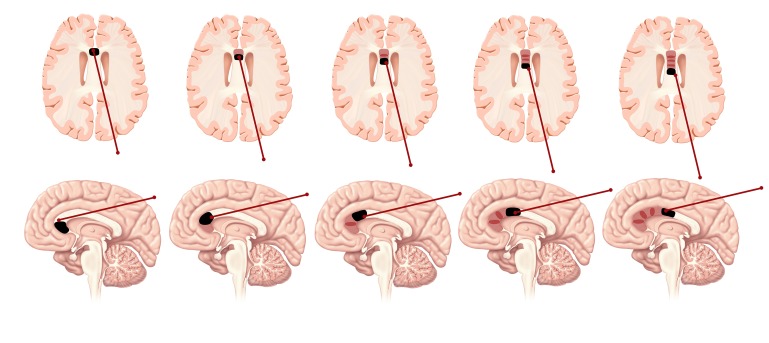
We describe the feasibility of using minimally invasive robotic laser interstitial thermotherapy (LITT) for achieving an anterior two-thirds as well as a complete corpus callosotomy.
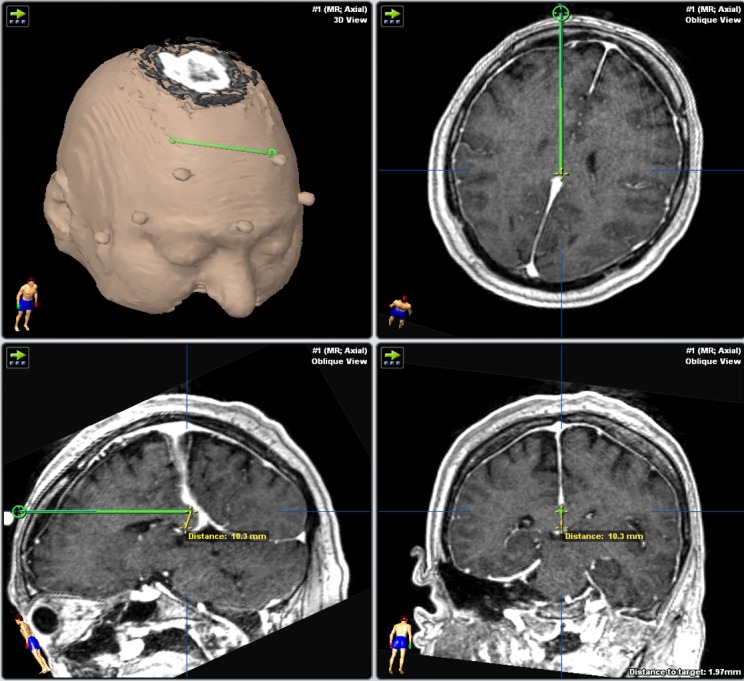
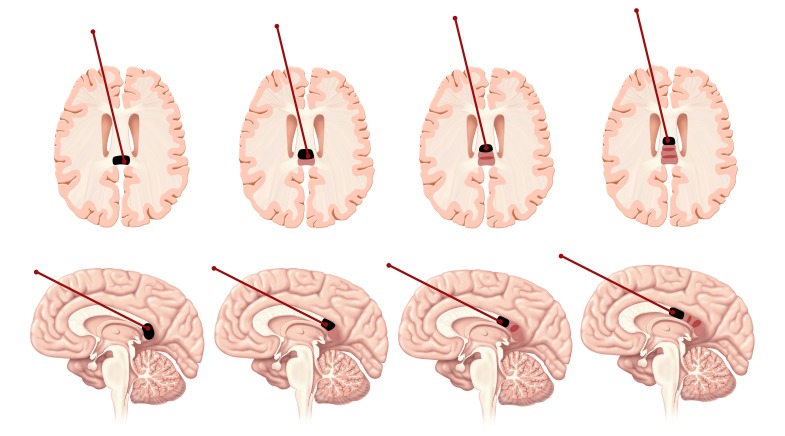
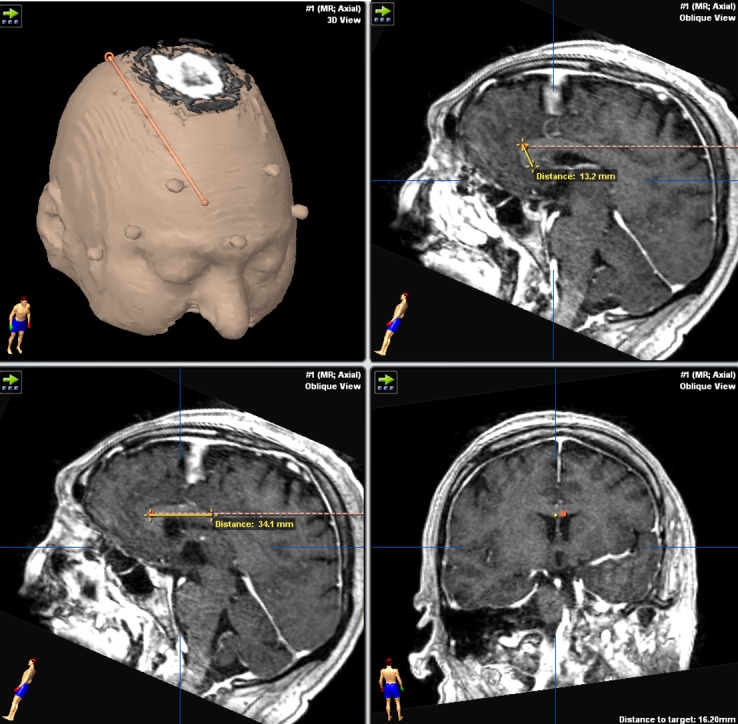
Ten probe trajectories were plotted on normal magentic resonance imaging (MRI) scans using the Brainlab Stereotactic Planning Software (Brainlab, Munich, Germany). The NeuroBlate® System (Monteris Medical, MN, USA) was used to conform the thermal burn to the corpus callosum along the trajectory of the probe. The distance of the ideal entry site from either the coronal suture and the torcula or nasion and the midline was calculated. The distance of the probe tip from the dorsal and ventral limits of the callosotomy in the sagittal plane were also calculated.
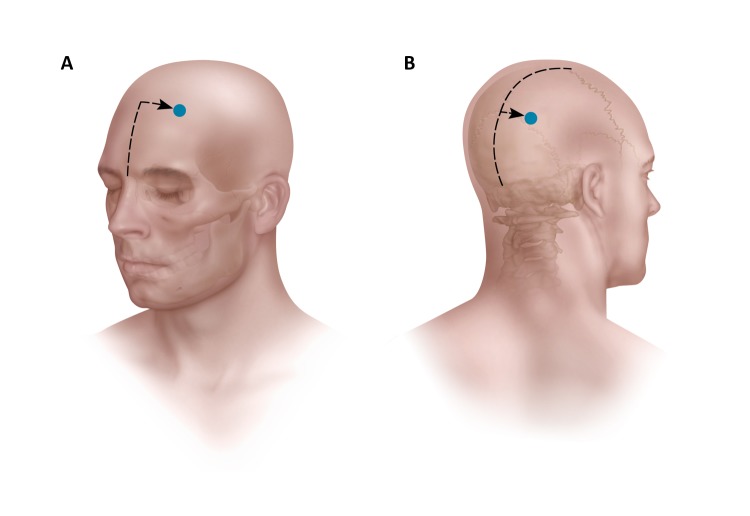
Anterior two-thirds callosotomy was possible in all patients using a posterior parieto-occipital paramedian trajectory through the non-dominant lobe. The average entry point was 3.64 cm from the midline, 10.6 cm behind the coronal suture, and 9.2 cm above the torcula. The probe tip was an average of 1.4 cm from the anterior commissure. For a total callosotomy, an additional contralaterally placed frontal probe was used to target the posterior one-third of the corpus callosum. The average entry site was 3.3 cm from the midline and 9.1 cm above the nasion. The average distance of the probe tip from the base of the splenium was 0.94 cm.
The directional thermoablation capability of the NeuroBlate® system allows for targeted lesioning of the corpus callosum, to achieve a two-thirds or complete corpus callosotomy. A laser distance of < 2 cm is sufficient to reach the entire corpus callosum through one trajectory for an anterior two-thirds callosotomy and two trajectories for a complete callosotomy.
我们描述了使用微创机器人激光间质热疗(LITT)实现胼胝体前三分之二以及完全胼胝体切开术的可行性。
使用Brainlab立体定向规划软件(Brainlab,德国慕尼黑)在正常磁共振成像(MRI)扫描上绘制十条探针轨迹。使用NeuroBlate®系统(美国明尼苏达州Monteris Medical公司)使热灼伤沿着探针轨迹与胼胝体相符。计算理想进针点与冠状缝和窦汇或鼻根与中线的距离。还计算了矢状面中探针尖端与胼胝体切开术背侧和腹侧界限的距离。
所有患者通过非优势叶的后顶枕旁正中轨迹都可以进行胼胝体前三分之二切开术。平均进针点距中线3.64厘米,在冠状缝后10.6厘米,在窦汇上方9.2厘米。探针尖端距前连合平均为1.4厘米。对于完全胼胝体切开术,使用额外的对侧放置的额叶探针靶向胼胝体的后三分之一。平均进针点距中线3.3厘米,在鼻根上方9.1厘米。探针尖端距压部底部的平均距离为0.94厘米。
NeuroBlate®系统的定向热消融能力允许对胼胝体进行靶向损伤,以实现三分之二或完全胼胝体切开术。对于前三分之二胼胝体切开术,<2厘米的激光距离足以通过一条轨迹到达整个胼胝体;对于完全胼胝体切开术,则需要两条轨迹。