Dehne Sarah, Fritz Clarissa, Rieken Stefan, Baris Daniela, Brons Stephan, Haberer Thomas, Debus Jürgen, Weber Klaus-Josef, Schmid Thomas E, Combs Stephanie E, Habermehl Daniel
Department of Radiation Oncology, University Hospital of Heidelberg , Heidelberg , Germany.
Heidelberg Ion Beam Therapy Center (HIT) , Heidelberg , Germany.
Front Oncol. 2017 Mar 13;7:35. doi: 10.3389/fonc.2017.00035. eCollection 2017.
This work investigates on putative cytotoxic effects in four different hepatocellular carcinoma (HCC) cell lines after irradiation with photons or carbon ions in combination with new targeted molecular therapy using either Temsirolimus (TEM) or Gemcitabine (GEM).
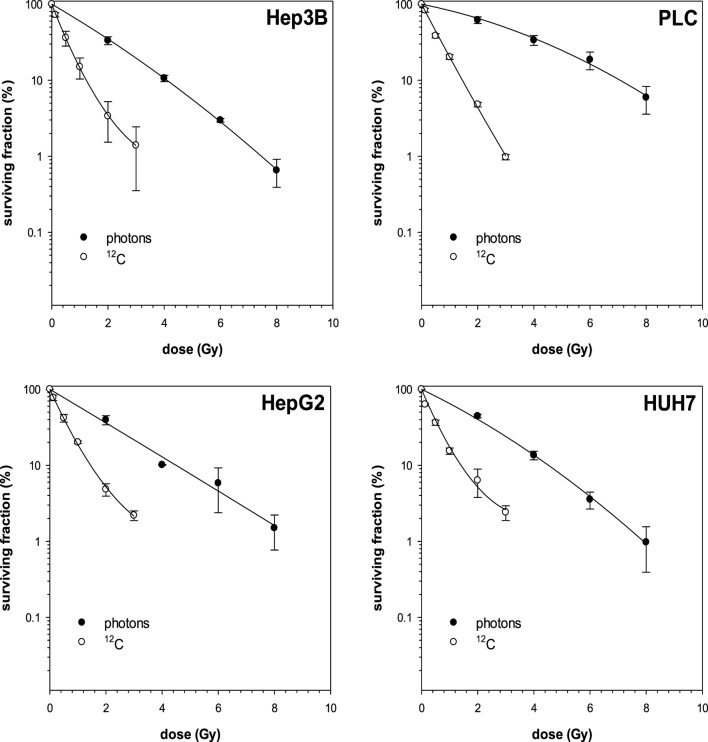
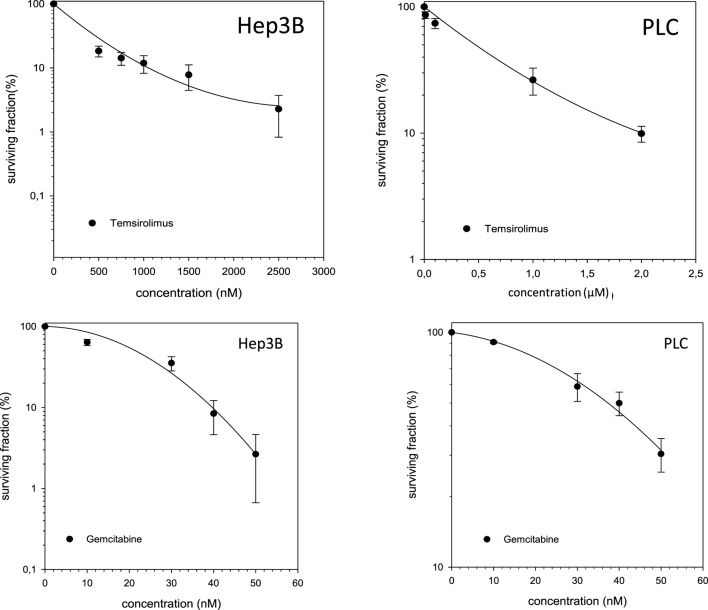
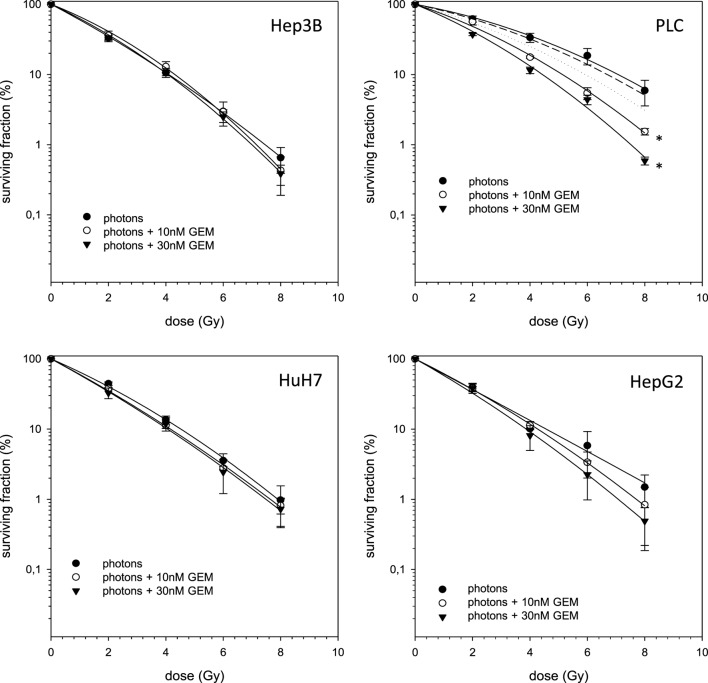
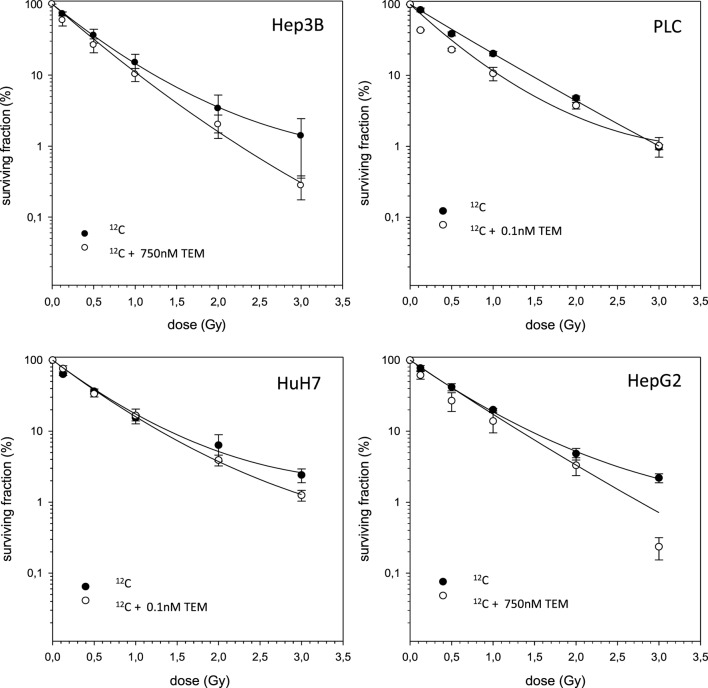
The HCC cell lines HepG2, Hep3B, HuH7, and PLC were cultured and irradiated with photons or carbon ions at the Heidelberg Ion Beam Therapy Center using the raster-scanning method. For combination experiments, cell lines were first treated with Temsirolimus or GEM before irradiation. Cytotoxicity was measured by a clonogenic survival assay. The evaluation of the experiments and the obtained survival curves were based on the concept of additivity defined by Steel and Peckham.
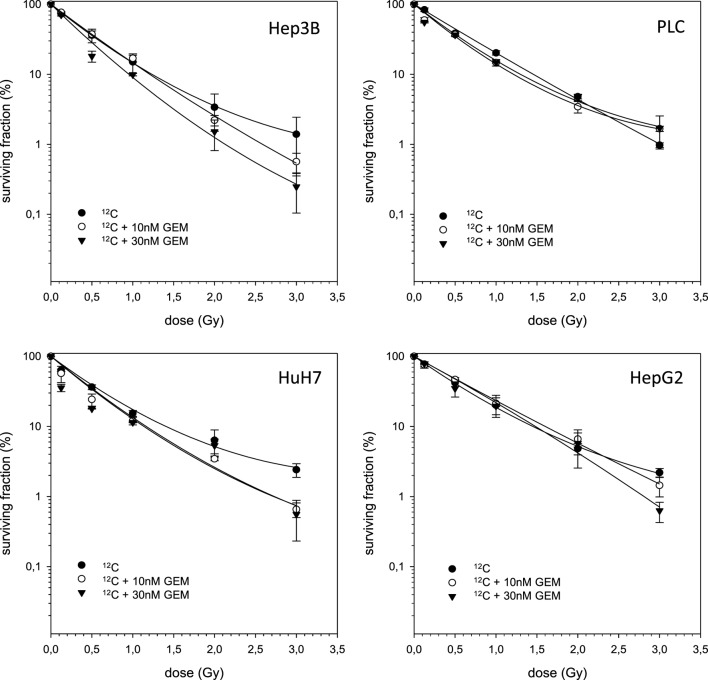
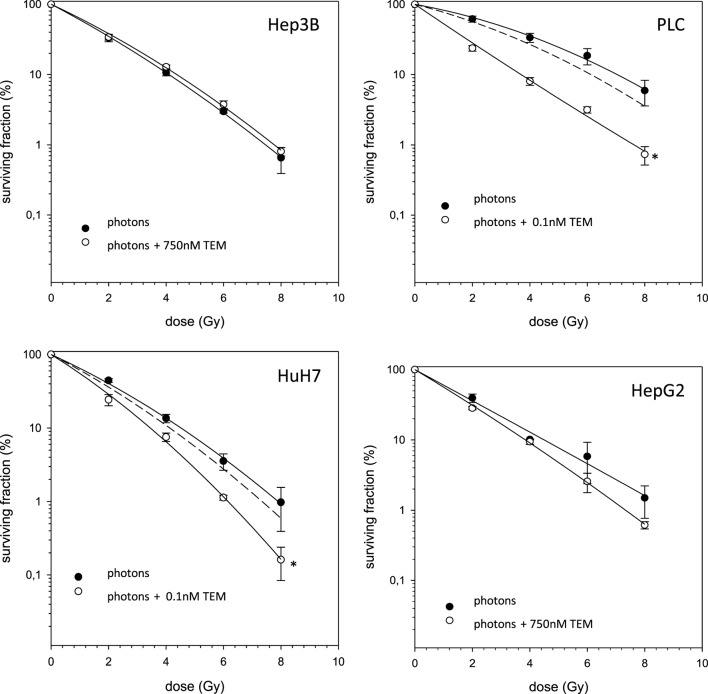
The results for the combination of carbon ions and both tested systemic substances TEM and GEM showed independent toxicities in all four cell lines. Supra-additive effects were observed in PLC cells for photon irradiation combined either with TEM or GEM and in HuH7 cells for the combination of photons with TEM.
Addition of targeted therapy substances Temsirolimus and GEM to photon irradiation showed additive cytotoxicity in HCC cell lines, whereas independent toxicities where reached by the combination of carbon ions to these substances. It can be assumed that combining 12C with systemic substances only has independent effects because heavy ions cause direct damage because of their high-LET character resulting in complex and clustered double-strand breaks. Nonetheless, further investigations are warranted in order to determine whether addition of systemic therapy allows a reduction of radiation doses in combination therapy. This could possibly lead to better responses and tolerances in patients with HCC.
本研究探讨在使用替西罗莫司(TEM)或吉西他滨(GEM)进行新型靶向分子治疗的同时,用光子或碳离子照射后,对四种不同的肝细胞癌(HCC)细胞系的假定细胞毒性作用。
在海德堡离子束治疗中心使用光栅扫描法培养HCC细胞系HepG2、Hep3B、HuH7和PLC,并分别用光子或碳离子进行照射。对于联合实验,细胞系在照射前先用替西罗莫司或吉西他滨进行处理。通过克隆形成存活试验测量细胞毒性。实验评估和所得存活曲线基于Steel和Peckham定义的相加性概念。
碳离子与两种受试全身用药TEM和GEM联合使用的结果显示,在所有四种细胞系中均有独立的毒性作用。在PLC细胞中,光子照射与TEM或GEM联合使用时观察到超相加效应;在HuH7细胞中,光子与TEM联合使用时观察到超相加效应。
在光子照射中添加靶向治疗药物替西罗莫司和吉西他滨在HCC细胞系中显示出相加的细胞毒性,而碳离子与这些药物联合使用则产生独立的毒性作用。可以推测,仅将12C与全身用药联合使用具有独立作用,因为重离子因其高传能线密度特性会导致直接损伤,从而产生复杂的成簇双链断裂。尽管如此,仍有必要进一步研究,以确定添加全身治疗是否能在联合治疗中降低辐射剂量。这可能会使HCC患者获得更好的反应和耐受性。