Institute of Modern Physics, Chinese Academy of Sciences, 509 Nanchang Rd, Lanzhou, 730000, Gansu, People's Republic of China.
The First School of Clinical Medicine, Lanzhou University, Lanzhou, Gansu, People's Republic of China.
Eur J Med Res. 2022 Dec 26;27(1):306. doi: 10.1186/s40001-022-00942-2.
Charged particle beams from protons to carbon ions provide many significant physical benefits in radiation therapy. However, preclinical studies of charged particle therapy for prostate cancer are extremely limited. The aim of this study was to comprehensively investigate the biological effects of charged particles on prostate cancer from the perspective of in vitro studies.
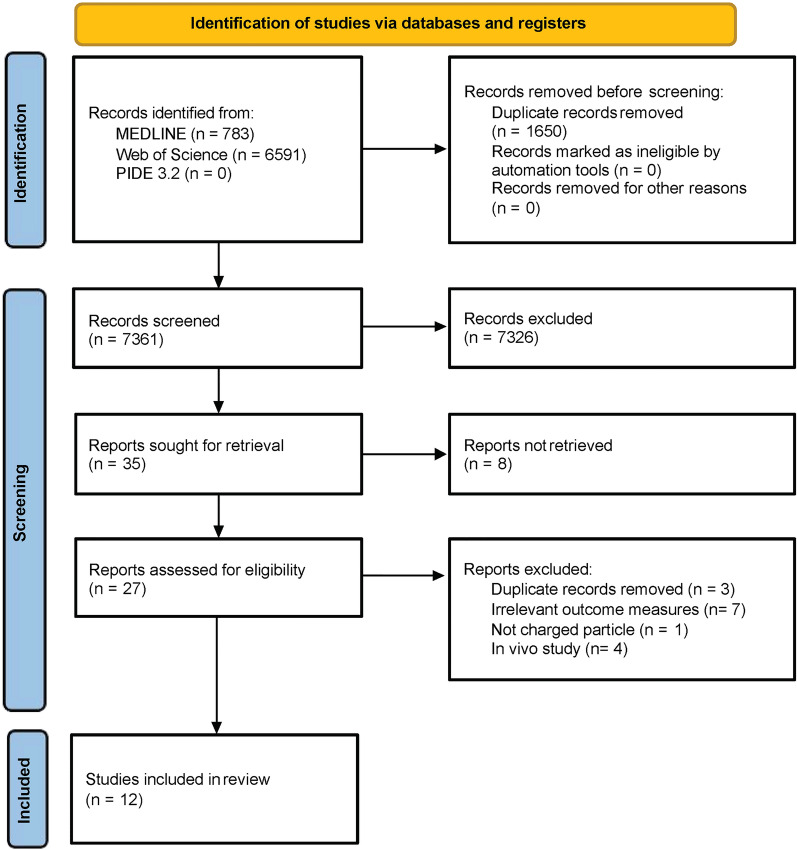
We conducted a systematic review by searching EMBASE (OVID), Medline (OVID), and Web of Science databases to identify the publications assessing the radiobiological effects of charged particle irradiation on prostate cancer cells. The data of relative biological effectiveness (RBE), surviving fraction (SF), standard enhancement ratio (SER) and oxygen enhancement ratio (OER) were extracted.
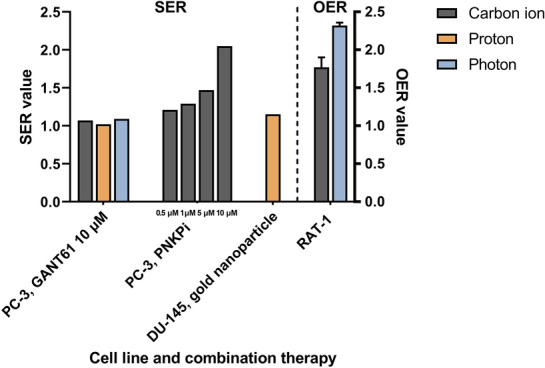
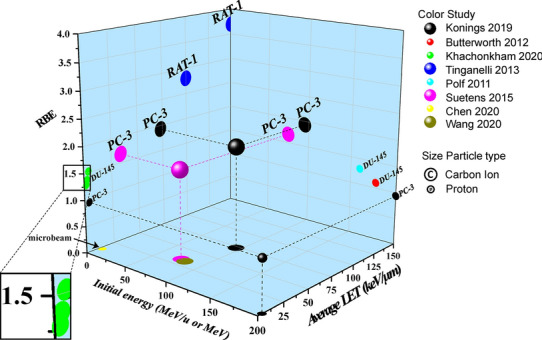
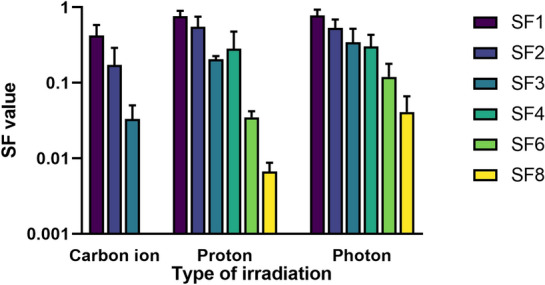
We found 12 studies met the eligible criteria. The relative biological effectiveness values of proton and carbon ion irradiation ranged from 0.94 to 1.52, and 1.67 to 3.7, respectively. Surviving fraction of 2 Gy were 0.17 ± 0.12, 0.55 ± 0.20 and 0.53 ± 0.16 in carbon ion, proton, and photon irradiation, respectively. PNKP inhibitor and gold nanoparticles were favorable sensitizing agents, while it was presented poorer performance in GANT61. The oxygen enhancement ratio values of photon and carbon ion irradiation were 2.32 ± 0.04, and 1.77 ± 0.13, respectively. Charged particle irradiation induced more G0-/G1- or G2-/M-phase arrest, more expression of γ-H2AX, more apoptosis, and lower motility and/or migration ability than photon irradiation.
Both carbon ion and proton irradiation have advantages over photon irradiation in radiobiological effects on prostate cancer cell lines. Carbon ion irradiation seems to have further advantages over proton irradiation.
从质子到碳离子的带电粒子束在放射治疗中提供了许多重要的物理益处。然而,前列腺癌的带电粒子治疗的临床前研究极为有限。本研究的目的是从体外研究的角度全面研究带电粒子对前列腺癌的生物学影响。
我们通过搜索 EMBASE(OVID)、Medline(OVID)和 Web of Science 数据库,进行了系统评价,以确定评估带电粒子辐照对前列腺癌细胞的放射生物学效应的出版物。提取相对生物效应(RBE)、存活分数(SF)、标准增强比(SER)和氧增强比(OER)的数据。
我们发现符合合格标准的研究有 12 项。质子和碳离子照射的相对生物效应值分别为 0.94 至 1.52 和 1.67 至 3.7。碳离子、质子和光子照射的 2 Gy 存活分数分别为 0.17±0.12、0.55±0.20 和 0.53±0.16。PNKP 抑制剂和金纳米颗粒是有利的增敏剂,而 GANT61 的表现较差。光子和碳离子照射的氧增强比分别为 2.32±0.04 和 1.77±0.13。与光子照射相比,带电粒子照射诱导更多的 G0-/G1-或 G2-/M-期阻滞、更多的 γ-H2AX 表达、更多的细胞凋亡、更低的运动和/或迁移能力。
碳离子和质子照射在放射生物学效应方面均优于光子照射对前列腺癌细胞系。碳离子照射似乎比质子照射具有更多优势。