Nawrocki Mariusz J, Majewski Dominik, Puszczewicz Mariusz, Jagodziński Paweł P
Department of Biochemistry and Molecular Biology, Poznań University of Medical Sciences, 6 Święcickiego St., 60-781, Poznań, Poland.
Department of Rheumatology and Internal Diseases, Poznań University of Medical Science, 135/147 28 Czerwca 1956 r. St., 61-545, Poznań, Poland.
Rheumatol Int. 2017 May;37(5):775-783. doi: 10.1007/s00296-017-3711-8. Epub 2017 Mar 27.
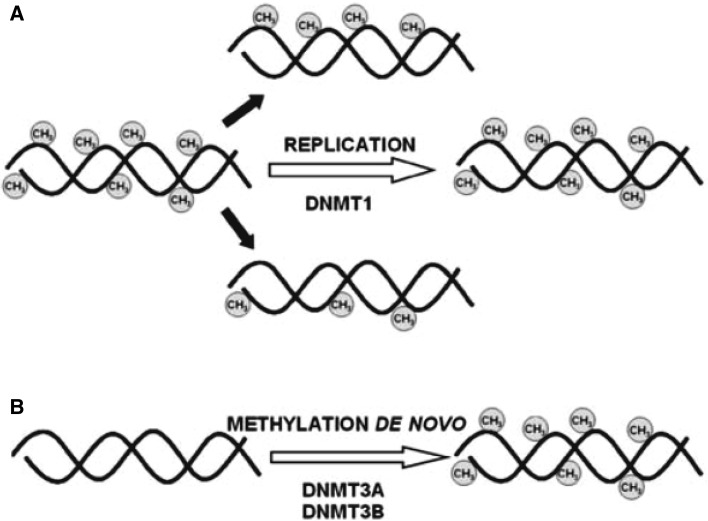
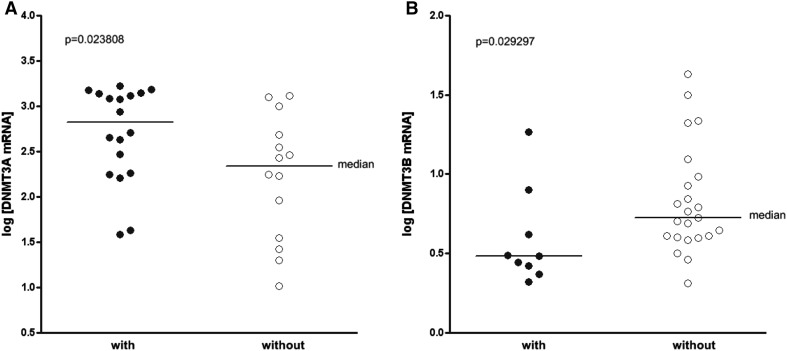
Systemic lupus erythematosus (SLE) is a chronic relapsing autoimmune disease characterized by the presence of autoantibodies directed against nuclear antigens and by chronic inflammation. Although the etiology of SLE remains unclear, the influence of environment factors, which is largely reflected by the epigenetic mechanisms, with DNA methylation changes in particular, is generally considered as main players in the pathogenesis of SLE. We studied DNA methyltransferases' (DNMTs) type 1, 3A and 3B transcript levels in peripheral blood mononuclear cells from patients diagnosed with systemic lupus erythematosus and from the healthy control subjects. Furthermore, the association of DNMT1, DNMT3A, and DNMT3B mRNA levels with gender, age, and major clinical manifestations was analyzed.
Peripheral blood mononuclear cells (PBMCs) were isolated from 32 SLE patients and 40 healthy controls. Reverse transcription and real-time quantitative polymerase chain reaction (RT-qPCR) analyses were used to determine DNMT1, DNMT3A, and DNMT3B mRNA expression levels.
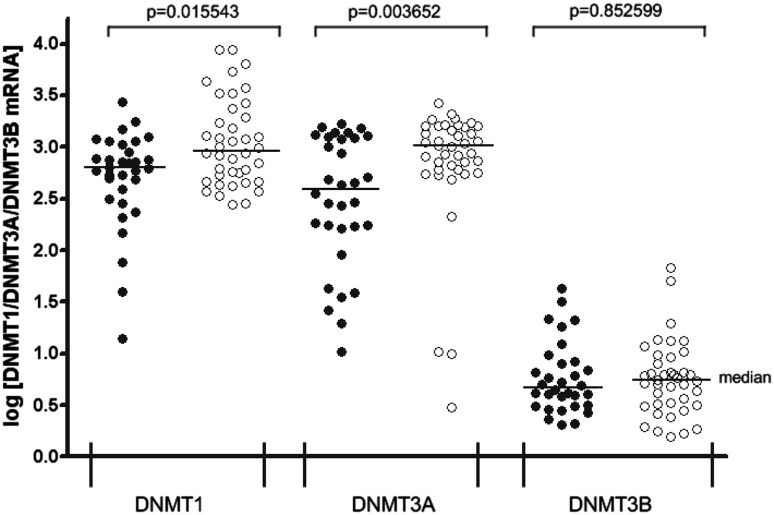
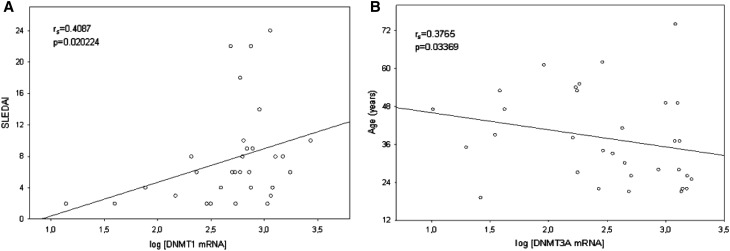
Significantly lower DNMT1 (p = 0.015543) and DNMT3A (p = 0.003652) transcript levels in SLE patients were observed compared with healthy controls. Nevertheless, the DNMT3B mRNA expression levels were markedly lower compared with DNMT1 and DNMT3A, both in PBMCs from affected patients and those from control subjects. Furthermore, the DNMT1 transcript levels were positively correlated with SLE disease activity index (SLEDAI) (r = 0.4087, p = 0.020224), while the DNMT3A transcript levels were negatively correlated with patients age (r = -0.3765, p = 0.03369).
Our analyses confirmed the importance of epigenetic alterations in SLE etiology. Moreover, our results suggest that the presence of some clinical manifestations, such as phototosensitivity and arthritis, might be associated with the dysregulation of DNA methyltransferases' mRNA expression levels.
系统性红斑狼疮(SLE)是一种慢性复发性自身免疫性疾病,其特征是存在针对核抗原的自身抗体以及慢性炎症。尽管SLE的病因尚不清楚,但环境因素的影响在很大程度上由表观遗传机制反映出来,尤其是DNA甲基化变化,通常被认为是SLE发病机制的主要因素。我们研究了诊断为系统性红斑狼疮的患者和健康对照者外周血单个核细胞中DNA甲基转移酶(DNMTs)1、3A和3B的转录水平。此外,还分析了DNMT1、DNMT3A和DNMT3B mRNA水平与性别、年龄和主要临床表现的相关性。
从32例SLE患者和40例健康对照者中分离外周血单个核细胞(PBMC)。采用逆转录和实时定量聚合酶链反应(RT-qPCR)分析来确定DNMT1、DNMT3A和DNMT3B mRNA表达水平。
与健康对照相比,SLE患者中DNMT1(p = 0.015543)和DNMT3A(p = 0.003652)的转录水平显著降低。然而,无论是患病患者还是对照者的PBMC中,DNMT3B mRNA表达水平均明显低于DNMT1和DNMT3A。此外,DNMT1转录水平与SLE疾病活动指数(SLEDAI)呈正相关(r = 0.4087,p = 0.020224),而DNMT3A转录水平与患者年龄呈负相关(r = -0.3765,p = 0.03369)。
我们的分析证实了表观遗传改变在SLE病因中的重要性。此外,我们的结果表明,某些临床表现,如光敏性和关节炎,可能与DNA甲基转移酶mRNA表达水平的失调有关。