Guilfoyle Mathew R, Hutchinson Peter J A, Santarius Thomas
Division of Neurosurgery, Addenbrooke's Hospital, Box 167, Cambridge Biomedical Campus, Cambridge, CB2 0QQ, UK.
Acta Neurochir (Wien). 2017 May;159(5):903-905. doi: 10.1007/s00701-017-3095-2. Epub 2017 Mar 27.
Chronic subdural haematoma (CSDH) is a common condition that is effectively managed by burrhole drainage but requires repeat surgery in a significant minority of patients. The Cambridge Chronic Subdural Haematoma Trial (CCSHT) was a randomised controlled study that showed placement of subdural drains for 48 h following burrhole evacuation significantly reduces the incidence of reoperation and improves survival at 6 months. The present study examined the long-term survival of the patients in the trial.
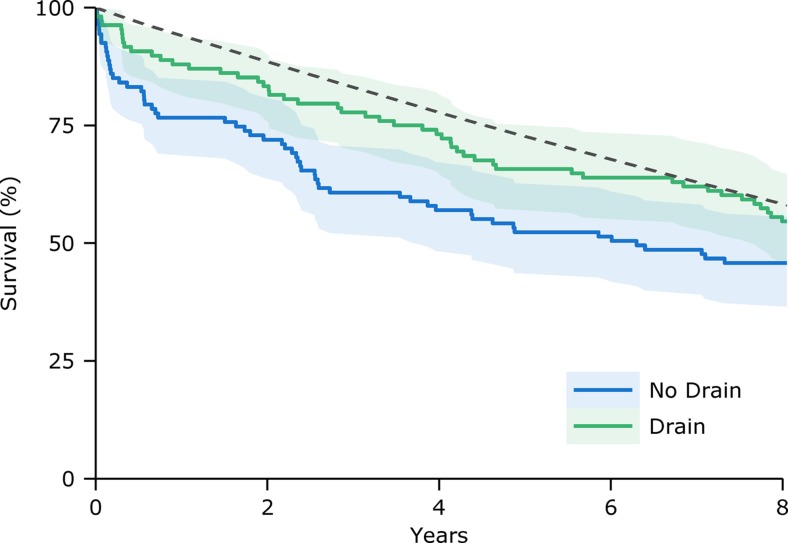
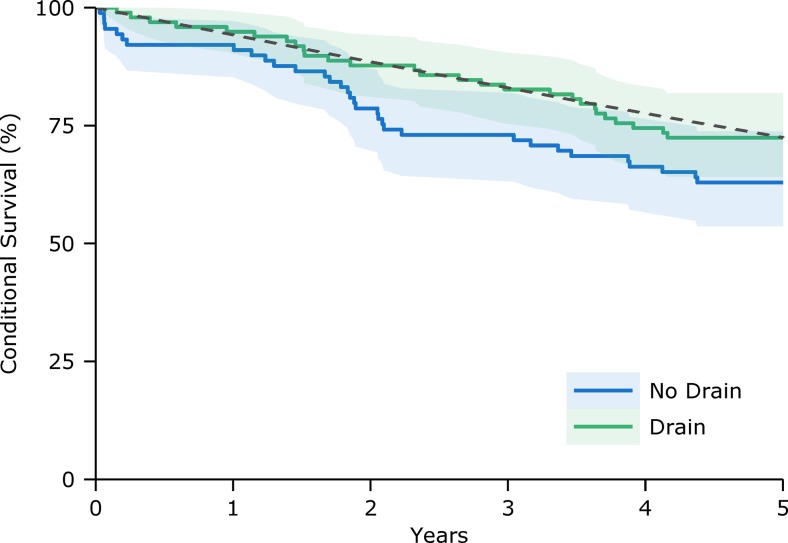
In the original trial patients at a single neurosurgical centre from 2004-2007 were randomly assigned to receive a drain (n = 108) or no drain (n = 107) following burrhole drainage of CSDH. We ascertained whether the trial patients were alive in February 2016-a minimum of 8 years following enrollment-via the UK NHS tracing service. Survival was compared between the trial groups and against expected survival for the UK general population matched for age and sex.
At 5 years following surgery the drain group continued to have significantly better survival than the no drain patients (p = 0.027), but this was no longer apparent at 10 years. Survival of patients in the drain group did not differ significantly from that of the general population whereas patients who did not receive a drain had significantly lower survival than expected (p = 0.0006).
Subdural drains following CSDH evacuation are associated with improved long-term survival, which appears similar to that expected for the general population of the same age and sex. All patients having burrhole CSDH evacuation should receive a drain as standard practice unless specifically contraindicated.
慢性硬膜下血肿(CSDH)是一种常见病症,钻孔引流可有效治疗,但仍有相当一部分患者需要再次手术。剑桥慢性硬膜下血肿试验(CCSHT)是一项随机对照研究,结果显示钻孔引流后放置硬膜下引流管48小时可显著降低再次手术的发生率,并提高6个月时的生存率。本研究对试验患者的长期生存情况进行了调查。
在原试验中,2004年至2007年期间,来自单一神经外科中心的患者在CSDH钻孔引流后被随机分配接受引流(n = 108)或不接受引流(n = 107)。我们通过英国国民健康服务(NHS)追踪服务确定试验患者在2016年2月是否存活——入组至少8年后。比较了试验组之间的生存率以及与年龄和性别匹配的英国普通人群的预期生存率。
术后5年,引流组的生存率仍显著高于未引流患者(p = 0.027),但在10年时这种差异不再明显。引流组患者的生存率与普通人群无显著差异,而未接受引流的患者生存率显著低于预期(p = 0.0006)。
CSDH引流术后放置硬膜下引流管可提高长期生存率,这与相同年龄和性别的普通人群预期生存率相似。所有接受CSDH钻孔引流的患者均应常规接受引流,除非有明确禁忌证。