Yuan Hui, Gao Jie
Department of Internal Medicine, Medical College of He Xi University, Zhangye, Gansu 734000, P.R. China.
Department of Respiratory Medicine, The Third People's Hospital, Guangzhou Medical College, Huizhou, Guangdong 516002, P.R. China.
Mol Med Rep. 2017 May;15(5):3041-3047. doi: 10.3892/mmr.2017.6397. Epub 2017 Mar 27.
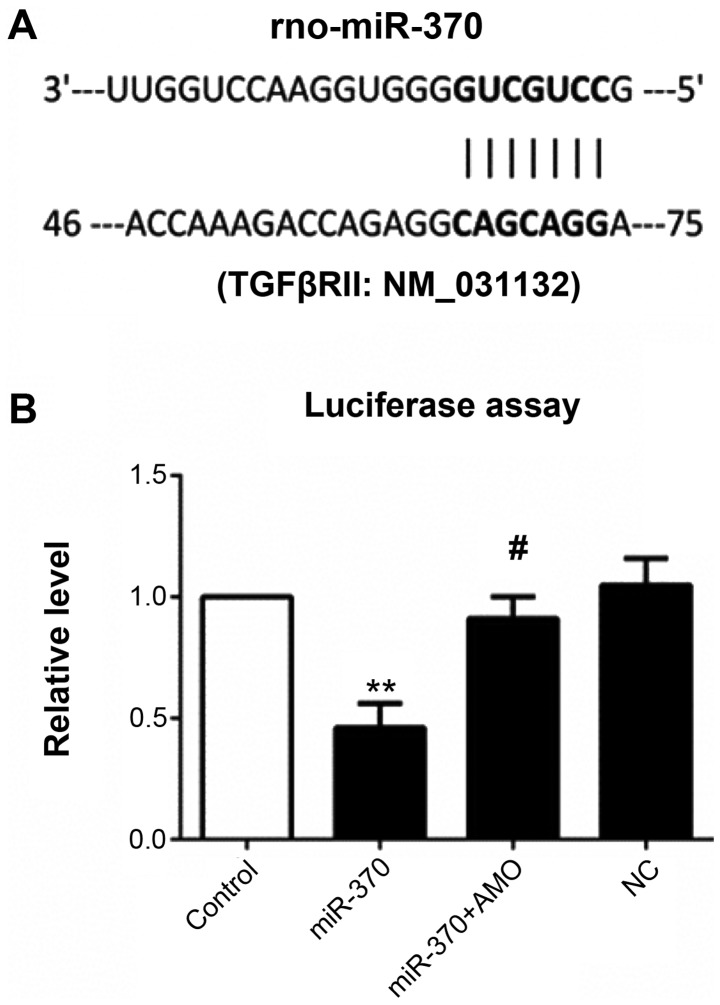
In the present study, we investigated the expression of miR‑370 in the border area of infarction after myocardial infarction and its role in the process of post‑infarction fibrosis. A myocardial infarction model in Sprague-Dawley rats was established. After two weeks, the mRNA levels of transforming growth factor‑β1 (TGFβ1), TGFβRII, ColIa1, ColIIIa1 and miR‑370 and the expression of TGFβ1, TGFβRII and α-smooth muscle actin (α-SMA) proteins in the border area of infarction were detected by real-time fluorescence quantitative polymerase chain reaction (qRT-PCR) and western blot analysis. Cardiac fibroblasts in neonatal rat were isolated and cultured, and the changes in the above indicators were detected after AngII and miR‑370 intervention. Luciferase reporter gene assay was conducted to verify whether TGFβRII was a target gene of miR‑370. In the border area after myocardial infarction, the expression of miR‑370 decreased, while mRNA levels of TGFβ1, TGFβRII, ColIa1 and ColIIIa1 and levels of TGFβ1, TGFβRII and α-SMA proteins were all increased. Luciferase reporter gene assay confirmed that TGFβRII was the target gene of miR‑370. miR‑370 reduced the expression of TGFβRII and inhibited the increased expression of TGFβRII and collagen protein caused by AngII. As well, its inhibited the differentiation effect of muscle fibroblasts while it did not inhibit the expression of TGFβ1. miR‑370 inhibited the expression of TGFβRII protein by combining with TGFβRII mRNA. miR‑370 also partially blocked TGFβ1‑TGFβRII and induced the downstream signal transduction pathways, thus exerting anti‑fibrotic effects.
在本研究中,我们调查了心肌梗死后梗死边缘区miR-370的表达及其在梗死后纤维化过程中的作用。建立了Sprague-Dawley大鼠心肌梗死模型。两周后,通过实时荧光定量聚合酶链反应(qRT-PCR)和蛋白质免疫印迹分析检测梗死边缘区转化生长因子-β1(TGFβ1)、TGFβRII、ColIa1、ColIIIa1和miR-370的mRNA水平以及TGFβ1、TGFβRII和α-平滑肌肌动蛋白(α-SMA)蛋白的表达。分离并培养新生大鼠的心脏成纤维细胞,在血管紧张素II(AngII)和miR-370干预后检测上述指标的变化。进行荧光素酶报告基因检测以验证TGFβRII是否为miR-370的靶基因。在心肌梗死后的边缘区,miR-370的表达降低,而TGFβ1、TGFβRII、ColIa1和ColIIIa1的mRNA水平以及TGFβ1、TGFβRII和α-SMA蛋白的水平均升高。荧光素酶报告基因检测证实TGFβRII是miR-370的靶基因。miR-370降低了TGFβRII的表达,并抑制了AngII引起的TGFβRII和胶原蛋白表达的增加。此外,它抑制了肌成纤维细胞的分化作用,而未抑制TGFβ1的表达。miR-370通过与TGFβRII mRNA结合抑制TGFβRII蛋白的表达。miR-370还部分阻断了TGFβ1-TGFβRII并诱导下游信号转导通路,从而发挥抗纤维化作用。