Tajti Gabor, Gesztelyi Rudolf, Pak Krisztian, Papp Csaba, Keki Sandor, Szilasi Magdolna Emma, Mikaczo Angela, Fodor Andrea, Szilasi Maria, Zsuga Judit
Department of Health Systems Management and Quality Management for Health Care, Faculty of Public Health; Department of Pulmonology, Faculty of Medicine.
Department of Pharmacology and Pharmacotherapy, Faculty of Medicine.
Int J Chron Obstruct Pulmon Dis. 2017 Mar 14;12:873-884. doi: 10.2147/COPD.S127373. eCollection 2017.
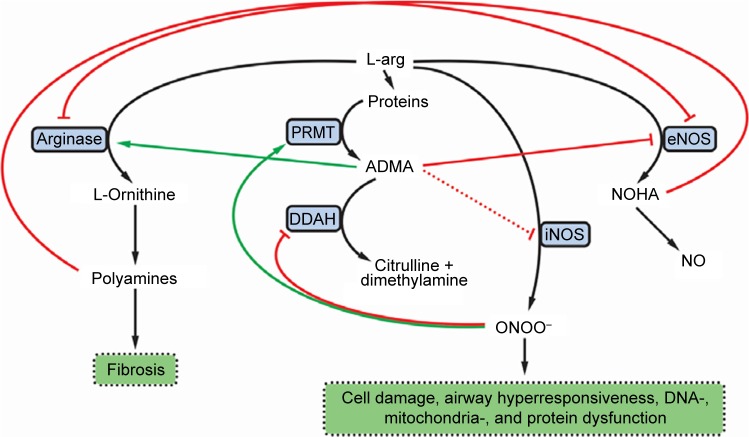
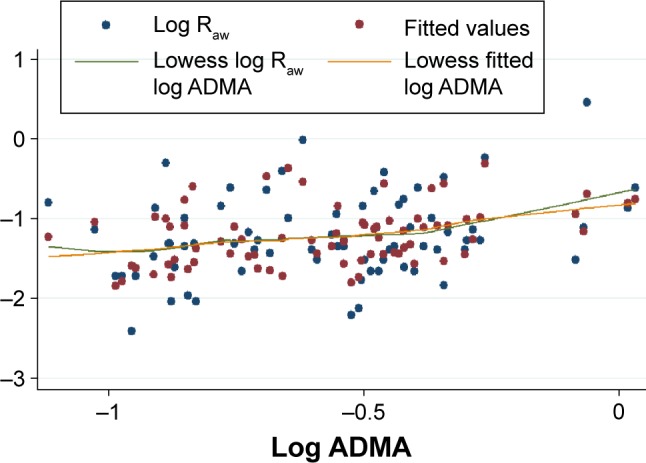
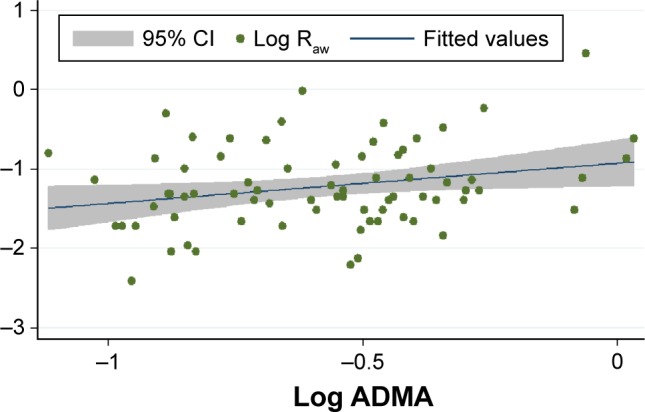
The major feature of COPD is a progressive airflow limitation caused by chronic airway inflammation and consequent airway remodeling. Modified arginase and nitric oxide synthase (NOS) pathways are presumed to contribute to the inflammation and fibrosis. Asymmetric dimethylarginine (ADMA) may shunt L-arginine from the NOS pathway to the arginase one by uncoupling and competitive inhibition of NOS and by enhancing arginase activity. To attest the interplay of these pathways, the relationship between ADMA and airflow limitation, described by airway resistance (R), was investigated in a cohort of COPD patients. Every COPD patient willing to give consent to participate (n=74) was included. Case history, laboratory parameters, serum arginine and ADMA, pulmonary function (whole-body plethysmography), and disease-specific quality of life (St George's Respiratory Questionnaire) were determined. Multiple linear regression was used to identify independent determinants of R. The final multiple model was stratified based on symptom control. The log R showed significant positive correlation with log ADMA in the whole sample (Pearson's correlation coefficient: 0.25, =0.03). This association remained significant after adjusting for confounders in the whole data set (: 0.42; confidence interval [CI]: 0.06, 0.77; =0.022) and in the worse-controlled stratum (: 0.84; CI: 0.25, 1.43; =0.007). Percent predicted value of forced expiratory flow between 25% and 75% of forced vital capacity showed that significant negative, elevated C-reactive protein exhibited significant positive relationship with R in the final model. Positive correlation of R with ADMA in COPD patients showing evidence of a systemic low-grade inflammation implies that ADMA contributes to the progression of COPD, probably by shunting L-arginine from the NOS pathway to the arginase one.
慢性阻塞性肺疾病(COPD)的主要特征是由慢性气道炎症及随之而来的气道重塑导致的进行性气流受限。推测精氨酸酶和一氧化氮合酶(NOS)途径的改变会导致炎症和纤维化。不对称二甲基精氨酸(ADMA)可能通过使NOS解偶联和竞争性抑制以及增强精氨酸酶活性,将L-精氨酸从NOS途径分流至精氨酸酶途径。为证实这些途径之间的相互作用,在一组COPD患者中研究了ADMA与气流受限(通过气道阻力(R)描述)之间的关系。纳入了每一位愿意同意参与研究的COPD患者(n = 74)。确定了病史、实验室参数、血清精氨酸和ADMA、肺功能(全身体积描记法)以及疾病特异性生活质量(圣乔治呼吸问卷)。采用多元线性回归来确定R的独立决定因素。最终的多元模型根据症状控制进行分层。在整个样本中,log R与log ADMA呈显著正相关(Pearson相关系数:0.25,P = 0.03)。在对整个数据集的混杂因素进行校正后(β:0.42;置信区间[CI]:0.06,0.77;P = 0.022)以及在控制较差的分层中(β:0.84;CI:0.25,1.43;P = 0.007),这种关联仍然显著。用力肺活量25%至75%之间的用力呼气流量的预测值百分比表明,在最终模型中,显著降低的用力呼气流量与升高的C反应蛋白均与R呈显著正相关。在显示有全身低度炎症证据的COPD患者中,R与ADMA呈正相关,这意味着ADMA可能通过将L-精氨酸从NOS途径分流至精氨酸酶途径,从而促进COPD的进展。