Scott Jeremy A, Maarsingh Harm, Holguin Fernando, Grasemann Hartmut
Occupational and Environmental Health, Dalla Lana School of Public Health, University of Toronto, Toronto, ON, Canada.
Department of Pharmaceutical Sciences, Lloyd L. Gregory School of Pharmacy, Palm Beach Atlantic University, West Palm Beach, FL, United States.
Front Pharmacol. 2021 Mar 23;12:627503. doi: 10.3389/fphar.2021.627503. eCollection 2021.
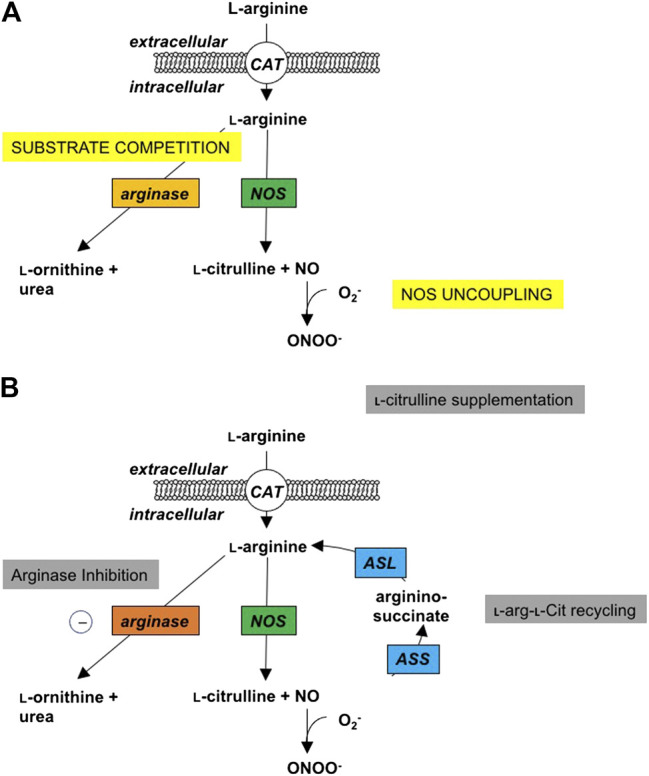
Nitric oxide (NO) is produced by a family of isoenzymes, nitric oxide synthases (NOSs), which all utilize L-arginine as substrate. The production of NO in the lung and airways can play a number of roles during lung development, regulates airway and vascular smooth muscle tone, and is involved in inflammatory processes and host defense. Altered L-arginine/NO homeostasis, due to the accumulation of endogenous NOS inhibitors and competition for substrate with the arginase enzymes, has been found to play a role in various conditions affecting the lung and in pulmonary diseases, such as asthma, chronic obstructive pulmonary disease (COPD), cystic fibrosis (CF), pulmonary hypertension, and bronchopulmonary dysplasia. Different therapeutic strategies to increase L-arginine levels or bioavailability are currently being explored in pre-clinical and clinical studies. These include supplementation of L-arginine or L-citrulline and inhibition of arginase.
一氧化氮(NO)由一氧化氮合酶(NOSs)这一同工酶家族产生,这些酶均利用L-精氨酸作为底物。肺和气道中NO的产生在肺发育过程中可发挥多种作用,调节气道和血管平滑肌张力,并参与炎症过程和宿主防御。由于内源性NOS抑制剂的积累以及与精氨酸酶对底物的竞争导致L-精氨酸/NO稳态改变,已发现其在影响肺部的各种病症和肺部疾病(如哮喘、慢性阻塞性肺疾病(COPD)、囊性纤维化(CF)、肺动脉高压和支气管肺发育不良)中起作用。目前正在临床前和临床研究中探索增加L-精氨酸水平或生物利用度的不同治疗策略。这些策略包括补充L-精氨酸或L-瓜氨酸以及抑制精氨酸酶。