Fraga Michelle, de Carvalho Talita Giacomet, Bidone Juliana, Schuh Roselena Silvestri, Matte Ursula, Teixeira Helder Ferreira
Pharmaceutical Sciences Graduate Program, Universidade Federal do Rio Grande do Sul; Gene Therapy Center, Experimental Research Center, Hospital de Clínicas de Porto Alegre.
Gene Therapy Center, Experimental Research Center, Hospital de Clínicas de Porto Alegre; Genetics and Molecular Biology Graduate Program, Universidade Federal do Rio Grande do Sul, Porto Alegre, Brazil.
Int J Nanomedicine. 2017 Mar 15;12:2061-2067. doi: 10.2147/IJN.S121558. eCollection 2017.
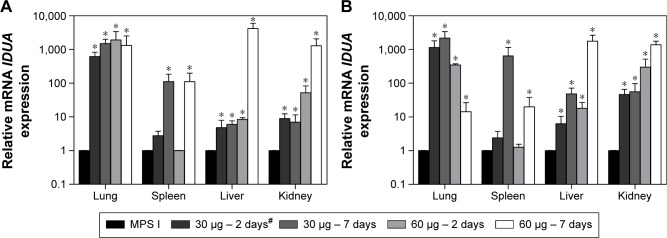
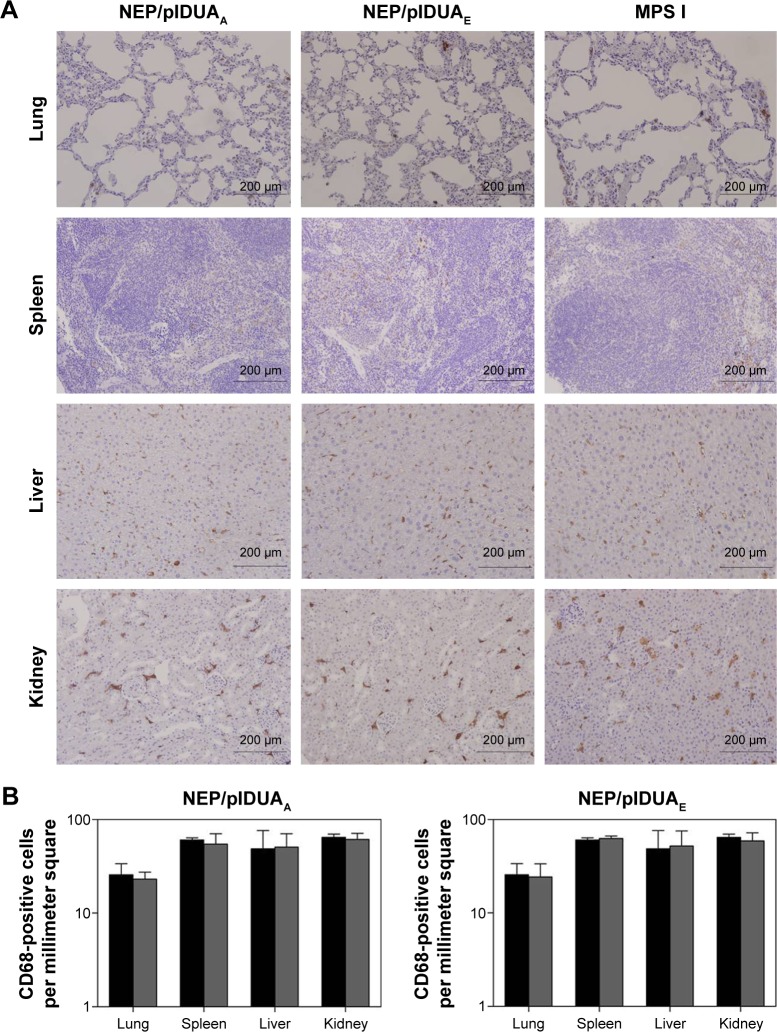
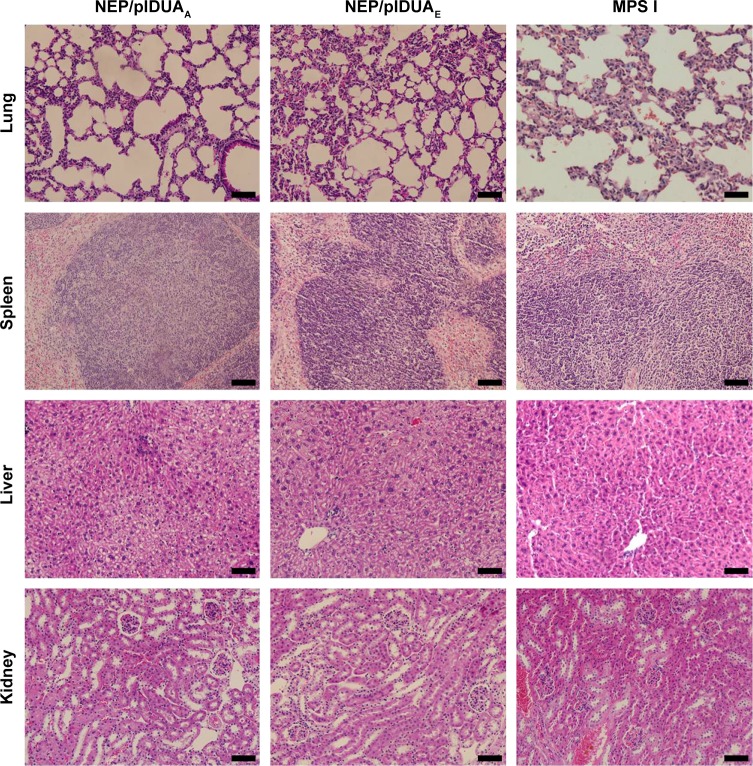
Mucopolysaccharidosis type I (MPS I) is an autosomal disease caused by alpha-l-iduronidase (IDUA) deficiency. This study used knockout mice as a model to evaluate whether parameters such as dose of plasmid and time of treatment could influence the transfection efficiency of complexes formed with PEGylated cationic nanoemulsions and plasmid (pIDUA), which contains the gene that encodes for IDUA. Formulations were composed of medium chain triglycerides, 1,2-dioleoyl-sn-glycero-3-phosphoethanolamine, 1,2-distearoyl--glycero-3-phosphoethanolamine--(amino[polyethylene glycol]-2000), 1,2-dioleoyl-sn-glycero-3-trimethylammonium propane (DOTAP), glycerol, and water and were prepared by the adsorption or encapsulation of preformed pIDUA-DOTAP complexes by high-pressure homogenization. A progressive increase in expression was observed with an increase in the dose and time of transfection for mice treated with both complexes (adsorbed and encapsulated), especially in the liver. Regardless of the complex administered, a significant increase in IDUA activity was detected in lungs and liver compared with nontreated MPS I when a dose of 60 μg was administered and IDUA activity was measured 7 days postadministration. Tissue sections of major organs showed no presence of cell necrosis, inflammatory infiltrate, or an increase in apoptosis. Furthermore, immunohistochemistry for CD68 showed no difference in the number of macrophage cells in treated and nontreated animals, indicating the absence of inflammatory reaction caused by the treatment. The data set obtained in this study allowed establishing that factors such as dose and time can influence transfection efficiency in different degrees and that these complexes did not lead to any lethal effect in the MPS I murine model used.
I型黏多糖贮积症(MPS I)是一种由α-L-艾杜糖醛酸酶(IDUA)缺乏引起的常染色体疾病。本研究以基因敲除小鼠为模型,评估质粒剂量和治疗时间等参数是否会影响聚乙二醇化阳离子纳米乳剂与含有编码IDUA基因的质粒(pIDUA)形成的复合物的转染效率。制剂由中链甘油三酯、1,2-二油酰基-sn-甘油-3-磷酸乙醇胺、1,2-二硬脂酰基-sn-甘油-3-磷酸乙醇胺-N-[氨基(聚乙二醇)-2000]、1,2-二油酰基-sn-甘油-3-三甲基氯化铵(DOTAP)、甘油和水组成,通过高压均质法吸附或包封预先形成的pIDUA-DOTAP复合物来制备。对于用两种复合物(吸附型和包封型)处理的小鼠,随着转染剂量和时间的增加,观察到表达逐渐增加,尤其是在肝脏中。无论给予哪种复合物,当给予60μg剂量并在给药后7天测量IDUA活性时,与未治疗的MPS I相比,在肺和肝脏中检测到IDUA活性显著增加。主要器官的组织切片未显示细胞坏死、炎性浸润或凋亡增加。此外,CD68免疫组化显示,治疗组和未治疗组动物的巨噬细胞数量没有差异,表明治疗未引起炎症反应。本研究获得的数据集表明,剂量和时间等因素可不同程度地影响转染效率,且这些复合物在所用的MPS I小鼠模型中未导致任何致死效应。