Vatte Chittibabu, Al Amri Ali M, Cyrus Cyril, Chathoth Shahanas, Acharya Sadananda, Hashim Tariq Mohammad, Al Ali Zhara, Alshreadah Saleh Tawfeeq, Alsayyah Ahmed, Al-Ali Amein K
Department of Genetic Research, Institute for Research and Medical Consultation, University of Dammam, Dammam.
Department of Internal Medicine, King Fahd Hospital of the University, University of Dammam, Al-Khobar.
Onco Targets Ther. 2017 Mar 13;10:1527-1533. doi: 10.2147/OTT.S132187. eCollection 2017.
Epidermal growth factor receptor () is a commonly altered gene that is identified in various cancers, including head and neck squamous cell carcinoma (HNSCC). Therefore, is a promising molecular marker targeted by monoclonal antibodies and small molecule inhibitors targeting the tyrosine kinase (TK) domain.
The objective of this study was to investigate the spectrum of mutations in exons 18, 19, 20, and 21 of the gene in HNSCC patients.
This retrospective study included 47 confirmed HNSCC cases. Mutations in the TK domain, exons 18, 19, 20, and 21 of the gene, were detected by Scorpion chemistry and ARMS technologies on Rotor-Gene Q real-time polymerase chain reaction.
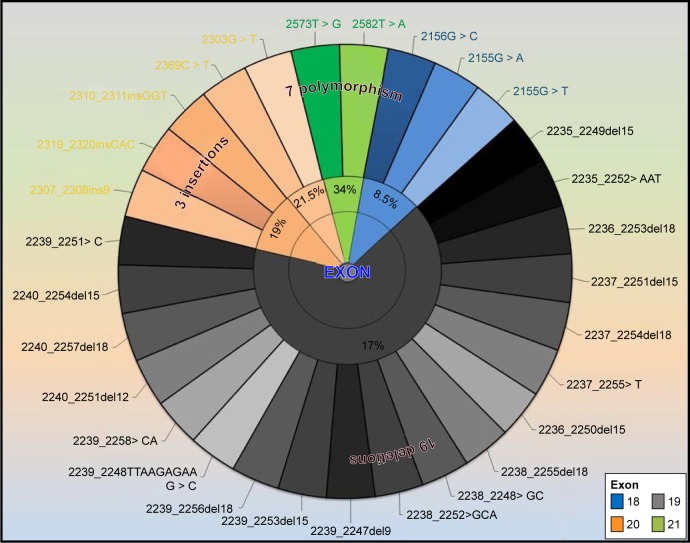
The tumors exhibited EGFR-TK domain mutations in 57% of cases. Four cases of T790M mutations were reported for the first time among HNSCC patients. Out of the total mutations, L861Q (exon 21), exon 20 insertions and deletions of exon 19 accounted for the majority of mutations (21%, 19%, and 17%, respectively). mutation status was correlated with the higher grade (=0.026) and advanced stage (=0.034) of HNSCC tumors.
Higher frequency of EGFR-TK domain mutations together with the presence of the T790M mutation suggests that identification of these mutations might streamline the therapy and provide a better prognosis in HNSCC cases.
表皮生长因子受体(EGFR)是一种在包括头颈部鳞状细胞癌(HNSCC)在内的多种癌症中常见的基因改变。因此,EGFR是一种有前景的分子标志物,可被靶向酪氨酸激酶(TK)结构域的单克隆抗体和小分子抑制剂作用。
本研究旨在调查HNSCC患者中EGFR基因第18、19、20和21外显子的突变谱。
这项回顾性研究纳入了47例确诊的HNSCC病例。通过Scorpion化学法和ARMS技术在Rotor-Gene Q实时聚合酶链反应上检测EGFR基因TK结构域(第18、19、20和21外显子)的突变。
57%的病例肿瘤呈现EGFR-TK结构域突变。首次在HNSCC患者中报道了4例T790M突变。在所有突变中,L861Q(第21外显子)、第20外显子插入和第19外显子缺失占突变的大多数(分别为21%、19%和17%)。EGFR突变状态与HNSCC肿瘤的高分级(P = 0.026)和晚期(P = 0.034)相关。
EGFR-TK结构域突变的高频率以及T790M突变的存在表明,识别这些突变可能会简化治疗并为HNSCC病例提供更好的预后。