
先天性膈疝合并11q部分三体胎儿的超声、超声心动图、磁共振成像及基因分析
Ultrasound, Echocardiography, MRI, and Genetic Analysis of a Fetus with Congenital Diaphragmatic Hernia and Partial 11q Trisomy.
作者信息
Fernández-Perea Yolanda, García-Díaz Lutgardo, Sánchez Javier, Antiñolo Guillermo, Borrego Salud
机构信息
Department of Genetics, Reproduction and Fetal Medicine, Institute of Biomedicine of Seville (IBIS), University Hospital Virgen del Rocío/CSIC/University of Seville, Seville, Spain.
Department of Genetics, Reproduction and Fetal Medicine, Institute of Biomedicine of Seville (IBIS), University Hospital Virgen del Rocío/CSIC/University of Seville, Seville, Spain; Centre for Biomedical Network Research on Rare Diseases (CIBERER), Seville, Spain.
出版信息
Case Rep Obstet Gynecol. 2017;2017:1471704. doi: 10.1155/2017/1471704. Epub 2017 Mar 2.
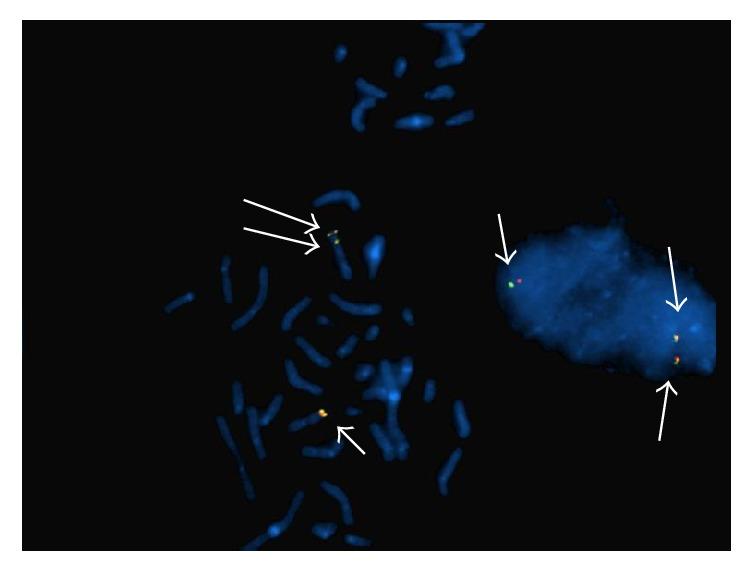
Congenital diaphragmatic hernia (CDH) is a serious birth defect with a significant mortality and morbidity. The current and constant progress in ultrasound techniques has led to the improvement of the prenatal diagnosis of this malformation. CDH is a developmental defect whose etiology is heterogeneous and takes place when the pleuroperitoneal folds and septum transversum fail to converge and fuse. Survival depends on the extent of pulmonary hypoplasia and the disease may be potentially worsened by the presence of added congenital defects. 40% of CDH cases are associated with at least one additional anomaly. The ultrasound diagnosis is established with essential signs: loss of uniform echogenicity of lungs and marked mediastinal shift. We report the case of a fetus with isolated CDH diagnosed at 21 weeks of gestation by ultrasound and confirmed by RMI, whose genetic analysis of amniotic fluid cells identified a de novo partial trisomy of the long arm of chromosome 11. Different genetic causes have been associated with CDH. Moreover, it is expectable that the use of new techniques for prenatal diagnosis will reveal novel CNVs associated with CDH and will help us to estimate the recurrence risk for this defect as well as for other associated anomalies.
先天性膈疝(CDH)是一种严重的出生缺陷,具有较高的死亡率和发病率。超声技术的不断进步使得这种畸形的产前诊断得到了改善。CDH是一种发育缺陷,其病因具有异质性,发生于胸腹皱襞和横隔未能融合时。存活率取决于肺发育不全的程度,并且额外先天性缺陷的存在可能会使病情进一步恶化。40%的CDH病例至少与一种其他异常相关。超声诊断的确立需要具备基本特征:肺的均匀回声消失以及明显的纵隔移位。我们报告了一例孤立性CDH胎儿病例,该病例在妊娠21周时通过超声诊断,并经RMI证实,对羊水细胞进行的基因分析发现11号染色体长臂存在新发部分三体。不同的遗传原因与CDH有关。此外,可以预期,产前诊断新技术的应用将揭示与CDH相关的新的拷贝数变异(CNV),并有助于我们评估这种缺陷以及其他相关异常的复发风险。


 Zotero 插件