Bao Huihui, Cai Huaxiu, Zhao Yan, Huang Xiao, Fan Fangfang, Zhang Chunyan, Li Juxiang, Chen Jing, Hong Kui, Li Ping, Wu Yanqing, Wu Qinhua, Wang Binyan, Xu Xiping, Li Yigang, Huo Yong, Cheng Xiaoshu
Department of Cardiovascular Medicine, the Second Affiliated Hospital of Nanchang University, Nanchang Department of Cardiovascular Medicine, XinHua Hospital Affiliated to Shanghai Jiao Tong, University School of Medicine, Shanghai Department of Cardiology, Peking University First Hospital, Beijing National Clinical Research Study Center for Kidney Disease, State Key Laboratory for Organ, Failure Research, Renal Division, Nanfang Hospital, Southern Medical University, Guangzhou, China.
Medicine (Baltimore). 2017 Mar;96(13):e6423. doi: 10.1097/MD.0000000000006423.
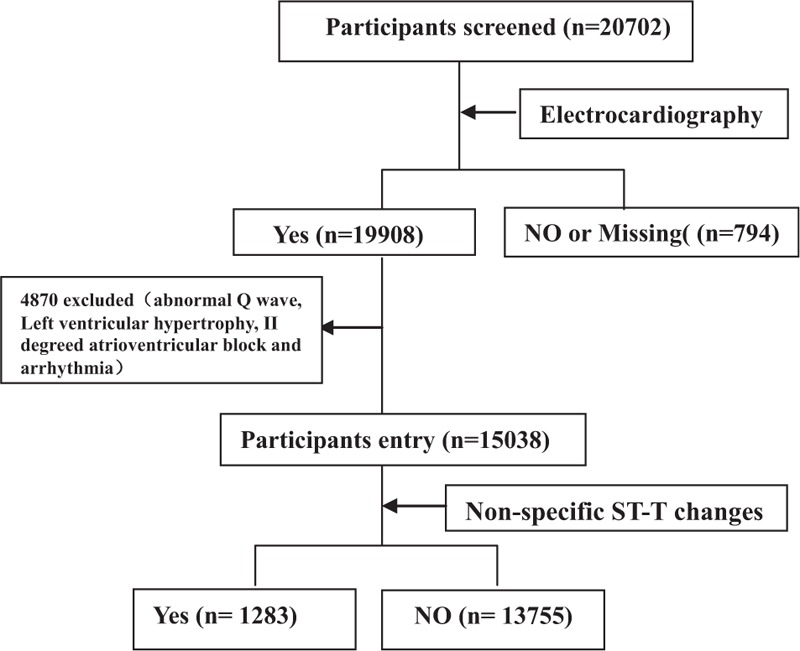
Nonspecific ST-segment and T-wave (ST-T) changes represent one of the most prevalent electrocardiographic abnormalities in hypertensive patients. However, a limited number of studies have investigated the association between nonspecific ST-T changes and unsatisfactory blood pressure (BP) control in adults with hypertension.The study population comprised 15,038 hypertensive patients, who were selected from 20,702 participants in the China Stroke Primary Prevention Trial. The subjects were examined with electrocardiogram test at the initial visit in order to monitor baseline heart activity. According to the results of the electrocardiogram (defined by Minnesota coding), the subjects were divided into 2 groups: ST-T abnormal and ST-T normal. Unsatisfactory BP control was defined as systolic BP ≥140 mm Hg or diastolic BP ≥90 mm Hg following antihypertensive treatment during the 4.5-year follow-up period. Multivariate analysis was used to analyze the association between nonspecific ST-T abnormalities and unsatisfactory BP control.Nonspecific ST-T changes were common in hypertensive adults (approximately 8.5% in the study), and more prevalent in women (10.3%) and diabetic patients (13.9%). The unsatisfactory BP control rate was high in the total population (47.0%), notably in the ST-T abnormal group (55.5%). The nonspecific ST-T abnormal group exhibited a significantly greater rate of unsatisfactory BP control (odds ratio [OR] 1.20, 95% confidence interval [CI] [1.06, 1.36], P = 0.005]), independent of traditional risk factors, as demonstrated by multivariate regression analysis. Notable differences were further observed in male subjects (OR 1.51, 95% CI [1.17, 1.94], P = 0.002) and in patients with comorbid diabetes (OR 1.47, 95% CI [1.04, 2.07], P = 0.029).Greater rates of unsatisfactory BP control in hypertensive patients with electrocardiographic nonspecific ST-T abnormalities were observed, notably in the subcategories of the male subjects and the diabetic patients.
非特异性ST段和T波(ST-T)改变是高血压患者中最常见的心电图异常之一。然而,仅有少数研究调查了非特异性ST-T改变与成年高血压患者血压(BP)控制不佳之间的关联。该研究人群包括15038名高血压患者,他们选自中国卒中一级预防试验的20702名参与者。受试者在初次就诊时接受心电图检查,以监测基线心脏活动。根据心电图结果(由明尼苏达编码定义),受试者被分为两组:ST-T异常组和ST-T正常组。血压控制不佳定义为在4.5年随访期内接受降压治疗后收缩压≥140 mmHg或舒张压≥90 mmHg。采用多因素分析来分析非特异性ST-T异常与血压控制不佳之间的关联。非特异性ST-T改变在高血压成年人中很常见(在该研究中约为8.5%),在女性(10.3%)和糖尿病患者(13.9%)中更为普遍。总体人群中血压控制不佳的比例较高(47.0%),尤其是在ST-T异常组(55.5%)。多因素回归分析表明,非特异性ST-T异常组的血压控制不佳比例显著更高(优势比[OR]为1.20,95%置信区间[CI][1.06,1.36],P = 0.005),且独立于传统危险因素。在男性受试者(OR 1.51,95% CI[1.17,1.94],P = 0.002)和合并糖尿病的患者(OR 1.47,95% CI[1.04,2.07],P = 0.029)中进一步观察到显著差异。在有心电图非特异性ST-T异常的高血压患者中观察到更高的血压控制不佳比例,尤其是在男性受试者和糖尿病患者亚组中。