Liu Shu-Qun, Chen Xiang, Yu Chen-Chen, Weng Cheng-Wei, Wu Yan-Qin, Xiong Jun-Cheng, Xu Shi-Hao
Department of Anaesthesiology, Wenzhou People's Hospital, Canghou Xiang, Wenzhou, Zhejiang province, China Department of Anaesthesiology, Wenzhou Central Hospital, Dajian Xiang, Wenzhou, Zhejiang Province, China.
Medicine (Baltimore). 2017 Mar;96(13):e6462. doi: 10.1097/MD.0000000000006462.
Periarticular anesthesia (PAI) with liposomal bupivacaine (LB) and femoral nerve block (FNB) were 2 common type of pain management after total knee arthroplasty (TKA). There is no consensus about PAI with LB shows better clinical outcome than FNB. Thus, we performed a systematic review and meta-analysis to compare the efficacy and safety of PAI with LB and FNB for patients prepared for TKA.
Randomized controlled trials (RCTs) and non-RCTs from PubMed (1966-2017.2), EMBASE (1980-2017.2), and the Cochrane Central Register of Controlled Trials (CENTRAL, 2017.2), Web of Science (1966-2017.2), and Chinese Wanfang database (1980-2017.2) were searched. Continuous outcomes including visual analogue scale (VAS) at 24, 48, and 72 hours, total morphine consumption, length of hospital, and range of motion (ROM) were reported as the weighted mean difference with 95% and confidence interval (CI) and discontinuous outcomes (the occurrence of postoperative nausea and vomiting [PONV]) were presented as relative risk with 95% CI. Random-effects model was adopted to analyze the relevant data.
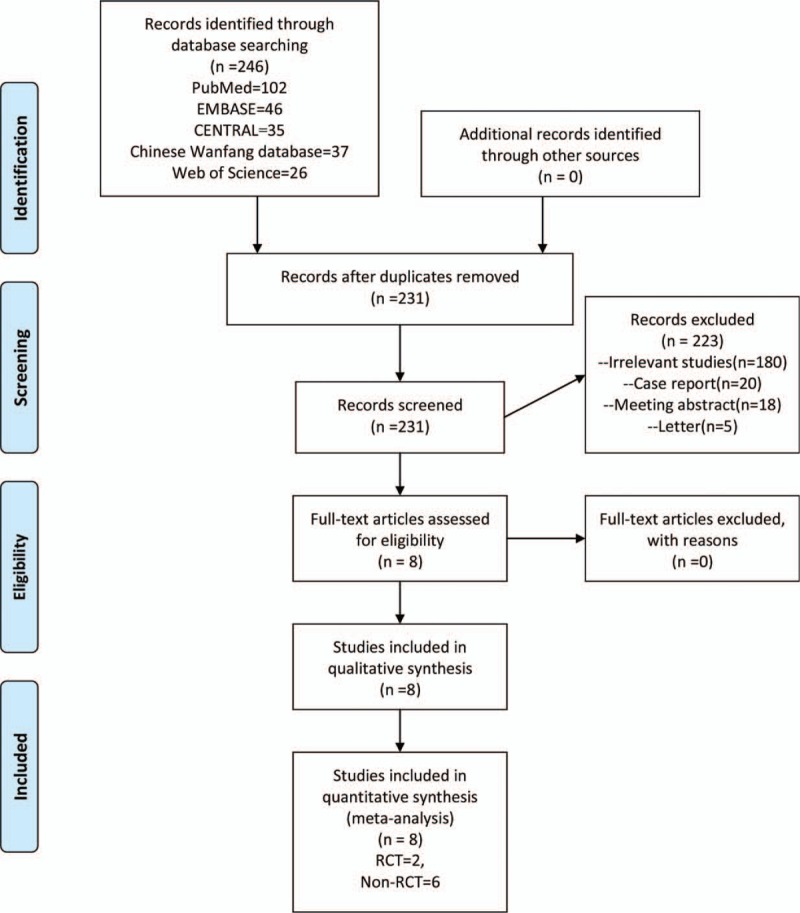
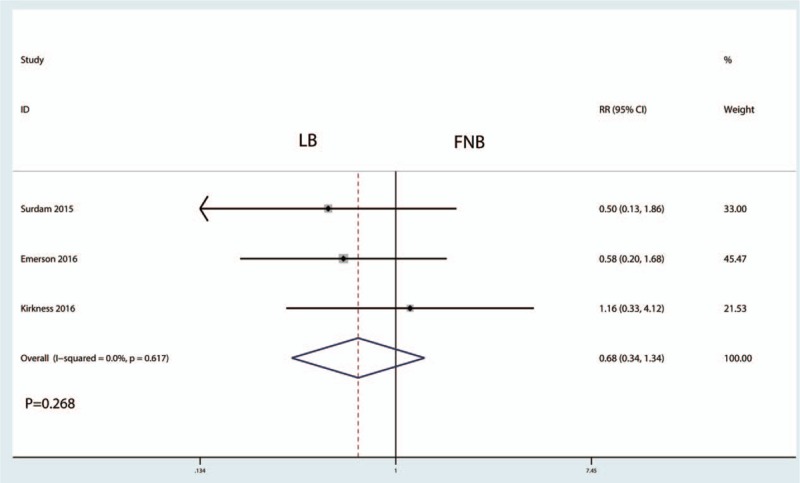
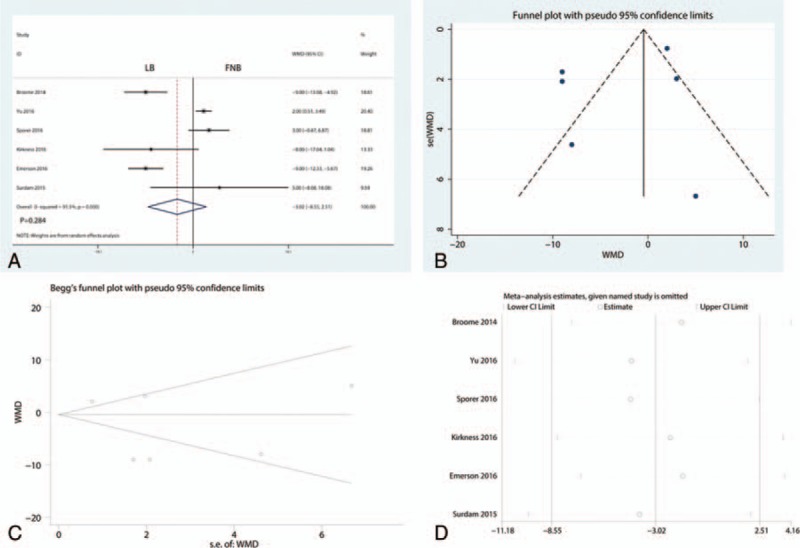
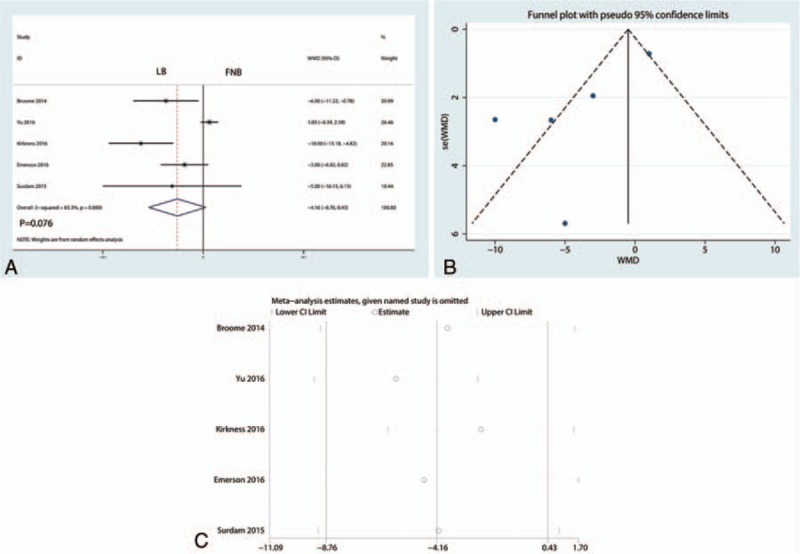
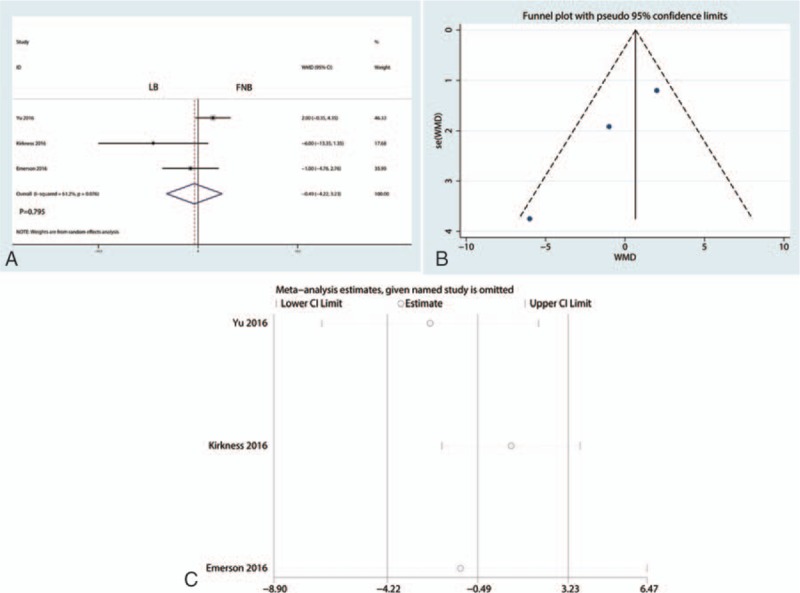
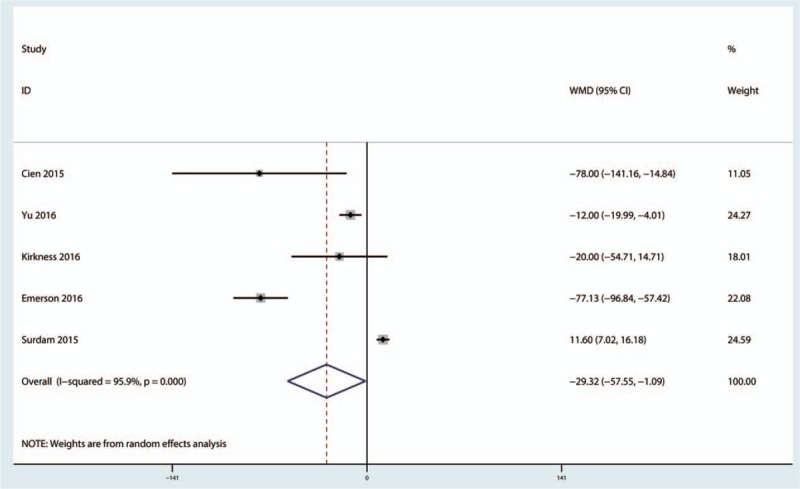
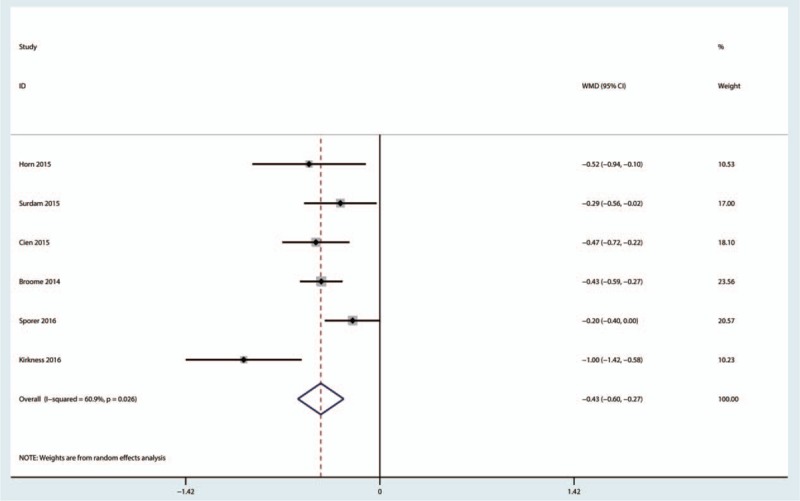
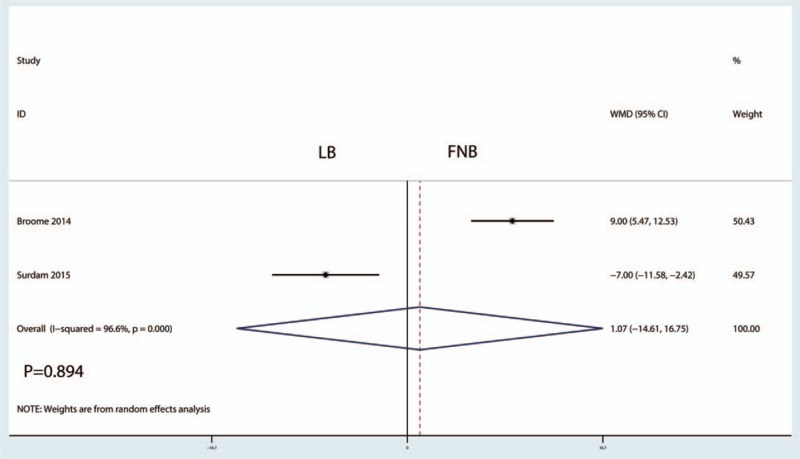
According to the inclusion and exclusion criteria, 8 studies with 2407 patients were eligible and finally included in this meta-analysis (LB = 1114, FNB = 1293). There was no significant difference between VAS at 24, 4, and 72 hours, ROM, and the occurrence of PONV between PAI with LB group versus FNB group (P > 0.05). Compared with the FNB group, PAI with LB was associated with a significant decrease in length of hospital stay by 0.43 day (MD = -0.43; 95% CI -0.60 to -0.27; P = 0.001) and the total dose of total morphine consumption by (MD = -29.32; 95% CI -57.55 to -1.09; P = 0.042).
The review of trials found that PAI with LB provided a significant beneficial effect over FNB in improving the pain or decreased the total morphine consumption in patients who underwent TKA. However, PAI with LB associated with less LOS than FNB. More high quality RCTs are still needed to identify the effects and optimal dose of LB for pain management after TKA.
脂质体布比卡因关节周围麻醉(PAI)和股神经阻滞(FNB)是全膝关节置换术(TKA)后两种常见的疼痛管理方式。对于PAI联合脂质体布比卡因是否比FNB具有更好的临床效果,目前尚无定论。因此,我们进行了一项系统评价和荟萃分析,以比较PAI联合脂质体布比卡因与FNB用于准备接受TKA患者的疗效和安全性。
检索PubMed(1966 - 2017.2)、EMBASE(1980 - 2017.2)、Cochrane对照试验中心注册库(CENTRAL,2017.2)、Web of Science(1966 - 2017.2)和中国万方数据库(1980 - 2017.2)中的随机对照试验(RCT)和非RCT。连续结局包括24、48和72小时的视觉模拟评分(VAS)、吗啡总消耗量、住院时间和活动范围(ROM),以加权平均差及95%置信区间(CI)报告,非连续结局(术后恶心呕吐[PONV]的发生率)以95%CI的相对风险表示。采用随机效应模型分析相关数据。
根据纳入和排除标准,8项研究共2407例患者符合条件并最终纳入本荟萃分析(脂质体布比卡因组 = 1114例,FNB组 = 1293例)。脂质体布比卡因PAI组与FNB组在24、48和72小时的VAS、ROM及PONV发生率方面无显著差异(P > 0.05)。与FNB组相比,脂质体布比卡因PAI组住院时间显著缩短0.43天(MD = -0.43;95%CI -0.60至 -0.27;P = 0.001),吗啡总消耗量的总剂量降低(MD = -29.32;95%CI -57.55至 -1.09;P = 0.042)。
试验综述发现,脂质体布比卡因PAI在改善接受TKA患者的疼痛或降低吗啡总消耗量方面比FNB具有显著的有益效果。然而,脂质体布比卡因PAI的住院时间比FNB短。仍需要更多高质量的RCT来确定脂质体布比卡因在TKA后疼痛管理中的效果和最佳剂量。