Ayuso Teresa, Aznar Patricia, Soriano Luis, Olaskoaga Ander, Roldán Miren, Otano María, Ajuria Iratxe, Soriano Gerardo, Lacruz Francisco, Mendioroz Maite
Multiple Sclerosis Unit, Department of Neurology, Complejo Hospitalario de Navarra, Pamplona, Navarra, Spain.
Department of Neurology, Complejo Hospitalario de Navarra, Pamplona, Navarra, Spain.
PLoS One. 2017 Mar 29;12(3):e0174726. doi: 10.1371/journal.pone.0174726. eCollection 2017.
Vitamin D deficiency has been linked to increased risk of multiple sclerosis (MS) and poor outcome. However, the specific role that vitamin D plays in MS still remains unknown. In order to identify potential mechanisms underlying vitamin D effects in MS, we profiled epigenetic changes in vitamin D receptor (VDR) gene to identify genomic regulatory elements relevant to MS pathogenesis.
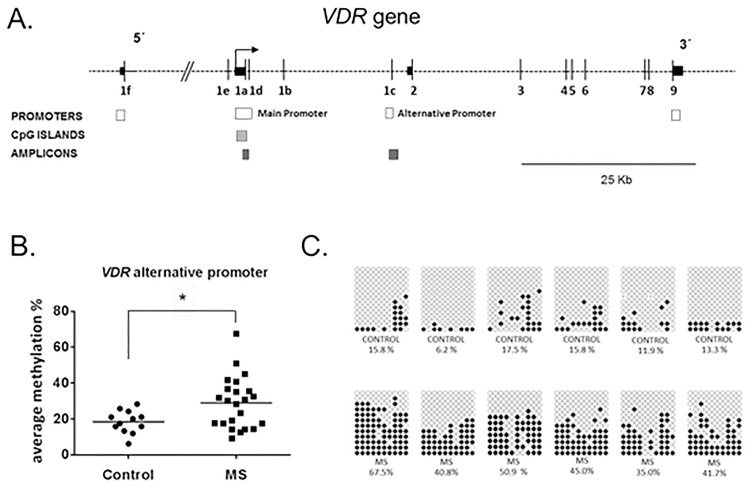
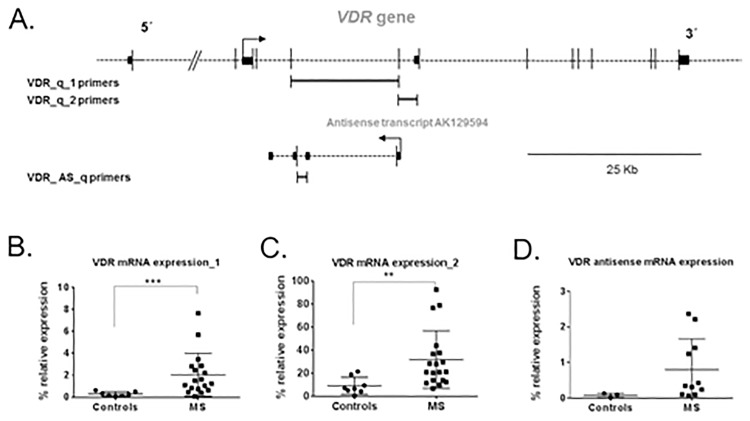
Human T cells derived from whole blood by negative selection were isolated in a set of 23 relapsing-remitting MS (RRMS) patients and 12 controls matched by age and gender. DNA methylation levels were assessed by bisulfite cloning sequencing in two regulatory elements of VDR. mRNA levels were measured by RT-qPCR to assess changes in VDR expression between patients and controls.
An alternative VDR promoter placed at exon 1c showed increased DNA methylation levels in RRMS patients (median 30.08%, interquartile range 19.2%) compared to controls (18.75%, 9.5%), p-value<0.05. Moreover, a 6.5-fold increase in VDR mRNA levels was found in RRMS patients compared to controls (p-value<0.001).
An alternative promoter of the VDR gene shows altered DNA methylation levels in patients with multiple sclerosis, and it is associated with VDR mRNA upregulation. This locus may represent a candidate regulatory element in the genome relevant to MS pathogenesis.
维生素D缺乏与多发性硬化症(MS)风险增加及不良预后有关。然而,维生素D在MS中所起的具体作用仍不清楚。为了确定维生素D对MS产生影响的潜在机制,我们分析了维生素D受体(VDR)基因的表观遗传变化,以识别与MS发病机制相关的基因组调控元件。
通过阴性选择从全血中分离出人类T细胞,选取23例复发缓解型MS(RRMS)患者以及12例年龄和性别相匹配的对照。通过亚硫酸氢盐克隆测序评估VDR两个调控元件中的DNA甲基化水平。通过RT-qPCR测量mRNA水平,以评估患者与对照之间VDR表达的变化。
与对照(18.75%,四分位间距9.5%)相比,位于外显子1c的另一种VDR启动子在RRMS患者中的DNA甲基化水平升高(中位数30.08%,四分位间距19.2%),p值<0.05。此外,与对照相比,RRMS患者的VDR mRNA水平增加了6.5倍(p值<0.001)。
VDR基因的另一种启动子在多发性硬化症患者中显示出DNA甲基化水平改变,并且与VDR mRNA上调相关。该基因座可能代表基因组中与MS发病机制相关的候选调控元件。