van de Waterbeemd Michiel, Llauró Aida, Snijder Joost, Valbuena Alejandro, Rodríguez-Huete Alicia, Fuertes Miguel Angel, de Pablo Pedro J, Mateu Mauricio G, Heck Albert J R
Biomolecular Mass Spectrometry and Proteomics, Bijvoet Center for Biomolecular Research and Utrecht Institute for Pharmaceutical Sciences, Utrecht University, Utrecht, the Netherlands; Netherlands Proteomics Centre, Utrecht, the Netherlands.
Department of Physics of the Condensed Matter, Universidad Autónoma de Madrid, Madrid, Spain.
Biophys J. 2017 Mar 28;112(6):1157-1165. doi: 10.1016/j.bpj.2017.02.003.
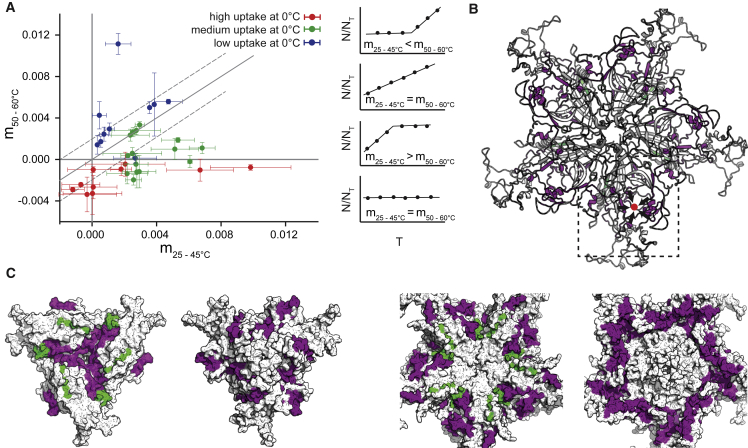
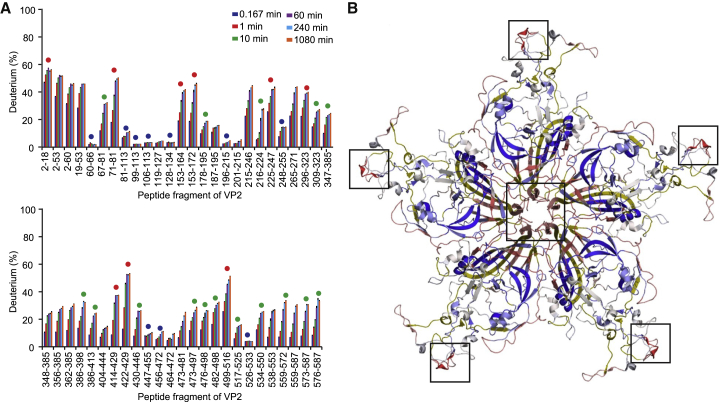
Icosahedral viral capsids are made of a large number of symmetrically organized protein subunits whose local movements can be essential for infection. In the capsid of the minute virus of mice, events required for infection that involve translocation of peptides through capsid pores are associated with a subtle conformational change. In vitro, this change can be reversibly induced by overcoming the energy barrier through mild heating of the capsid, but little is known about the capsid regions involved in the process. Here, we use hydrogen-deuterium exchange coupled to mass spectrometry to analyze the dynamics of the minute virus of mice capsid at increasing temperatures. Our results indicate that the transition associated with peptide translocation involves the structural rearrangement of regions distant from the capsid pores. These alterations are reflected in an increased dynamics of some secondary-structure elements in the capsid shell from which spikes protrude, and a decreased dynamics in the long intertwined loops that form the large capsid spikes. Thus, the translocation events through capsid pores involve a global conformational rearrangement of the capsid and a complex alteration of its equilibrium dynamics. This study additionally demonstrates the potential of hydrogen-deuterium exchange coupled to mass spectrometry to explore in detail temperature-dependent structural dynamics in large macromolecular protein assemblies. Most importantly, it paves the way for undertaking novel studies of the relationship between structure, dynamics, and biological function in virus particles and other large protein cages.
二十面体病毒衣壳由大量对称组织的蛋白质亚基组成,其局部运动对感染至关重要。在小鼠微小病毒的衣壳中,涉及肽通过衣壳孔转运的感染所需事件与细微的构象变化相关。在体外,通过对衣壳进行温和加热克服能量障碍可可逆地诱导这种变化,但对该过程中涉及的衣壳区域知之甚少。在这里,我们使用氢氘交换结合质谱法来分析小鼠微小病毒衣壳在温度升高时的动力学。我们的结果表明,与肽转运相关的转变涉及远离衣壳孔区域的结构重排。这些改变反映在衣壳壳中一些二级结构元件的动力学增加,从这些元件中突出有刺突,以及形成大衣壳刺突的长缠绕环中的动力学降低。因此,通过衣壳孔的转运事件涉及衣壳的全局构象重排及其平衡动力学的复杂改变。这项研究还证明了氢氘交换结合质谱法在详细探索大型高分子蛋白质组装体中温度依赖性结构动力学方面的潜力。最重要的是,它为开展关于病毒颗粒和其他大型蛋白质笼中结构、动力学和生物学功能之间关系的新研究铺平了道路。